

Maddy summaryHR 10299, the Medicaid Funds Integrity Act of 2024, amends federal Medicaid law to prohibit using federal funds for gun violence prevention or intervention programs. Specifically, it adds a new provision (paragraph 28) to Section 1903(i) of the Social Security Act, blocking federal financial participation for such programs under Medicaid. This directly affects state Medicaid programs that might have sought federal funding for initiatives addressing gun violence. The bill creates a concrete funding restriction, ensuring Medicaid dollars cannot be spent on these specific types of programs.
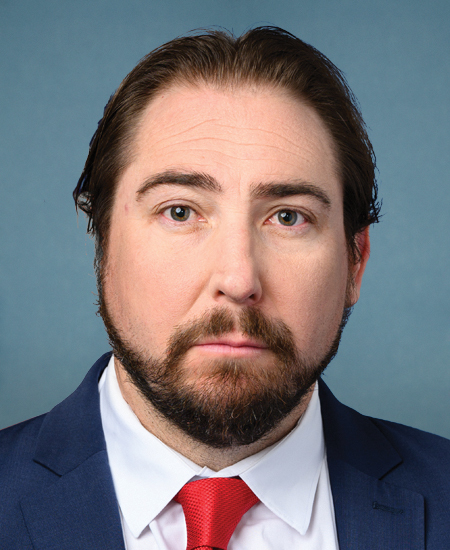
Rep. Elijah Crane
Sponsored bills
Maddy summaryHR 10284, the Secret Service Prioritization Act of 2024, transfers the U.S. Secret Service's authority to investigate and arrest individuals violating specific financial crime laws to the FBI Director. This includes violations related to counterfeit currency, securities fraud, electronic fund transfer fraud, and fraud against federally insured financial institutions (covered under 18 U.S.C. sections 508-510, 213, 433, 493, 657, 709, 1006-1014, 1907-1909). The transfer requires approval from both the Attorney General and FBI Director, while the Secret Service retains its protective duties for officials. The bill takes effect 30 days after enactment, with transitional provisions ensuring continuity for ongoing cases and administrative actions.
Maddy summaryThis bill amends the District of Columbia Code to clarify that nonprofit organizations holding meetings with federal officials (including Members of Congress or government employees) do not count as "doing business" in the District. It specifically adds this activity to the list of non-business activities under D.C. law (Section 29-105.05(a)(11)). The change directly affects nonprofit organizations that regularly engage with federal government representatives. The policy shift removes potential regulatory barriers for these groups when meeting with federal officials in D.C.
Maddy summaryHR 8706, the "Dismantle DEI Act of 2024," would prohibit federal agencies from maintaining diversity, equity, and inclusion (DEI) offices, programs, or training by requiring the closure of existing DEI offices within 90 days and banning federal funding for DEI-related activities. The bill defines "prohibited diversity, equity, and inclusion practices" as those that discriminate based on race, color, ethnicity, religion, biological sex, or national origin, or require training that asserts a particular group is inherently superior or inferior. It would rescind several executive orders related to racial equity and gender inclusion, and prohibit the use of federal funds for DEI-related activities across all federal agencies, contractors, and grant recipients. The bill contains limited exceptions for Equal Employment Opportunity offices and disability rights enforcement offices as historically organized and operated.
Maddy summaryThis bill amends the Energy Act of 2020 to clarify that "critical materials" designated by the Secretary of Energy count as "critical minerals" for federal purposes. It requires the Secretary to add any newly designated non-fuel critical material to the official critical minerals list within 45 days of the determination. The bill directly affects the Department of Energy, streamlining the process for including new minerals critical to national security or economic interests. This change ensures that minerals designated as "critical materials" automatically qualify under existing critical mineral programs without additional legislative steps.
Maddy summaryHR 10083, the "No Funding for Illegal Migrant Billboards Act," prohibits the use of federal funds to advertise the Immigration Detention Ombudsman's office or functions through billboards or similar public advertising. This bill directly affects the Department of Homeland Security, specifically restricting how the Ombudsman's office can be promoted using public funds. The key mechanism is an amendment to the Homeland Security Act of 2002, adding a provision that bans obligating or expending funds for such advertising. The law applies to all public advertising methods, not just physical billboards, and takes effect immediately upon enactment.
Maddy summaryThis bill requires universities that mandate COVID-19 vaccination for attendance to cover medical costs for students who develop specific vaccine-related conditions (like myocarditis, pericarditis, or thrombosis). Students must submit documentation including vaccination records, a medical diagnosis, and cost records to their institution for reimbursement. If a university fails to comply, the Secretary of Education may cut its federal funding. The bill directly affects colleges receiving federal funds with vaccine attendance requirements and students who experience qualifying health issues after mandated vaccination. It does not change vaccination policies but establishes a process for medical cost coverage.
Maddy summaryThe Legacy Mine Cleanup Act of 2024 establishes a new Office of Mountains, Deserts, and Plains within the EPA to coordinate cleanup efforts at abandoned hardrock mine sites across the U.S., with special focus on sites on tribal lands like Navajo Nation uranium mines. It requires the EPA to annually prioritize these sites, develop interagency plans for Navajo uranium sites by 2027, and strengthen coordination with tribes, states, and local governments through regular consultations. The bill mandates best practices for cleanup technologies, waste solutions, and technical assistance for states and tribes, while explicitly stating it does not grant new EPA regulatory authority. This directly affects EPA operations, tribal nations (particularly Navajo Nation), and entities managing abandoned mine sites.
Maddy summaryThis bill limits the number of shareholder proposals that public companies must include in their proxy materials based on the company's filing status: non-accelerated filers must include no more than 2 proposals, accelerated filers no more than 4, and large accelerated filers no more than 7. Proposals must have a "material" financial effect on the company - defined as a substantial financial risk or return relevant to investor decisions - to be included, excluding those focused on non-financial goals like environmental or social issues. The Securities and Exchange Commission must update proxy rules within 180 days to implement these limits and require companies to disclose their selection method for proposals. It directly affects large public companies and their shareholders seeking to influence corporate policies on social or environmental matters through voting.
Maddy summaryThis bill designates the U.S. Postal Service facility at 765 West Old Route 66 in Ash Fork, Arizona, as the "Fayrene Hume Post Office Building." It directly affects that specific postal facility by changing its official name in all federal references. The key provision requires all federal documents, maps, and records to use the new name instead of the previous designation. This is a purely ceremonial renaming with no policy changes or financial impact.