Stopping Traffickers and Their Accomplices Act of 2022 This bill requires an abortion provider to notify the National Human Trafficking Hotline if the provider has a reasonable suspicion that the patient is a victim of trafficking. It also requires each abortion provider to complete annual training on how to identify and respond appropriately to individuals who are at risk of or who have experienced trafficking. The bill establishes penalties for violations.
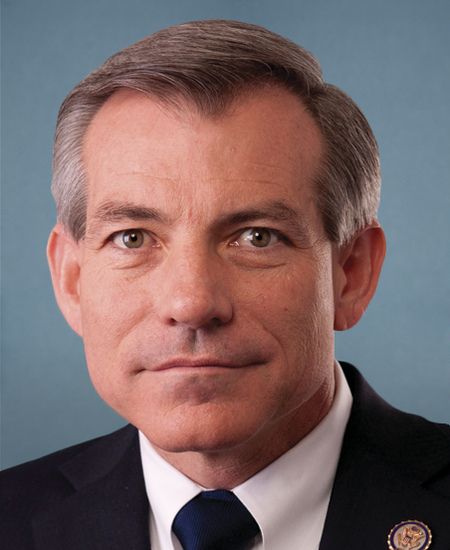
Rep. David Schweikert
Sponsored bills
Illegal Immigrant Payoff Prohibition Act This bill prohibits the payment of a settlement to an alien for a civil action brought against the United States in connection with the alien's inadmissibility to, or unlawful presence in, the United States.
Protect Communities from a Porous Border Act of 2021 This bill requires the Department of Homeland Security (DHS) to notify a state before placing an alien in that state and gives the state final authority to prohibit such a placement. At least 10 business days before placing (e.g., detaining or housing) such an individual in a state, DHS must provide certain information to that state, including (1) the individual's biographic and biometric information, including DNA; and (2) a certification that the biometric and biographic information has been checked in various law enforcement and counterterrorism databases. No federal court shall have jurisdiction to review (1) the requirements and procedures established under this bill, or (2) a decision by a state to prohibit the placement of such an individual in the state. The bill also prohibits any federal official from waiving any of the bill's requirements.
Canadian Snowbird Visa Act This bill authorizes the Department of Homeland Security to admit into the United States qualifying Canadian citizens as long-term nonimmigrant visitors. A qualifying Canadian citizen is an individual who (1) is at least 50 years old, (2) maintains a Canadian residence, (3) owns a U.S. residence or has rented a U.S. accommodation for the duration of the individual's stay, (4) is not inadmissible or deportable, (5) will not engage in employment or labor for hire in the United States other than for a non-U.S.-based person or entity by whom the Canadian citizen was employed in Canada or for whom the Canadian citizen performed services in Canada, and (6) will not seek certain forms of assistance or benefits. A qualified individual may be admitted for up to 240 days during any single 365-day period. The spouse of such an individual may be admitted under the same terms, except that the spouse is not required to separately satisfy the requirement for owning or renting a residence in the United States. The bill grants an individual so admitted nonresident alien tax status.
Preventing Anti-Semitic Hate Crimes Act This bill requires a designated officer or employee of the Department of Justice (DOJ) to facilitate the expedited review of anti-Semitic hate crimes and reports of anti-Semitic hate crimes. Further, the bill requires DOJ to issue guidance for state, local, and tribal law enforcement agencies on expanding public education campaigns to raise awareness of anti-Semitic hate crimes. Finally, the bill increases the statutory maximum prison term for an individual who is convicted of a federal hate crime offense after a prior conviction for a hate crime offense under federal law or a hate crime felony under state law.
Preventing Opportunistic Returns on Trades and Futures by Officials, Leadership, and Individuals in Office Act or the PORTFOLIO Act This bill generally prohibits federal employees and officials from owning or trading in synthetic assets (i.e., tokenized derivatives). It also establishes financial disclosure requirements with respect to cryptocurrency. Specifically, the bill prohibits federal employees, Members of Congress, the President, and Vice President from owning or trading investments in a security, a commodity, a future, cryptocurrency, or any comparable economic interest acquired through synthetic means, such as through a derivative. Such investments must be divested through gift or donation, cashing out, or a qualified blind trust. The appropriate ethics office may grant temporary exemptions in certain situations, such as for preexisting complex financial arrangements from which investments cannot be withdrawn, and may assess fees for violations. The Department of Justice may also bring civil actions for violations. The bill also (1) incorporates cryptocurrency and other digital assets into current financial disclosure requirements; (2) modifies the categories and timelines for financial disclosures; and (3) requires agencies, ethics offices, and the Department of Justice to regularly report on violations of this bill and other related requirements.

This bill generally requires fiduciaries of employer-sponsored retirement plans to make investment decisions based only on pecuniary factors (i.e., factors that a fiduciary prudently determines are expected to have a material effect on the risk and return of an investment based on appropriate investment horizons consistent with the plan's policies and objectives). The bill allows nonpecuniary factors to be considered when selecting investment options for certain participant-directed retirement plans if specified requirements are met (e.g., the investment option is not a default investment). Further, if a plan includes investment options based on nonpecuniary factors, it also must include investment options that are not based on any such factors.
Wild Free-Roaming Horses and Burros Protection Act of 2022 This bill modifies requirements under the Wild Free-Roaming Horses and Burros Act, including by directing the Department of the Interior to (1) establish regulations that require humane treatment of the animals during handling, management activities, removals, euthanasia, holding, and other activities; and (2) take actions to correct, prevent the recurrence of, and record violations of such regulations. The bill also prohibits Interior from destroying such animals unless they are fatally injured or terminally ill.
This bill prohibits the use of additional funds appropriated to the Internal Revenue Service under the Inflation Reduction Act of 2022 for audits of taxpayers with taxable incomes below $400,000.
This bill designates the facility of the United States Postal Service located at 3900 Crown Road Southwest in Atlanta, Georgia, as the John R. Lewis Post Office Building.