

Maddy summaryThe National Cemetery Access Act (HR 5942) requires national cemeteries managed by the Department of Defense, the Department of Veterans Affairs, or the National Park Service to be open to the public on all federal holidays specified in 5 U.S.C. § 6103(a), such as New Year's Day and Independence Day. This directly affects veterans' families and the public who visit these sites on those holidays, ensuring consistent access without closures. The bill mandates standard opening hours on designated federal holidays but does not change the list of holidays or create new benefits.
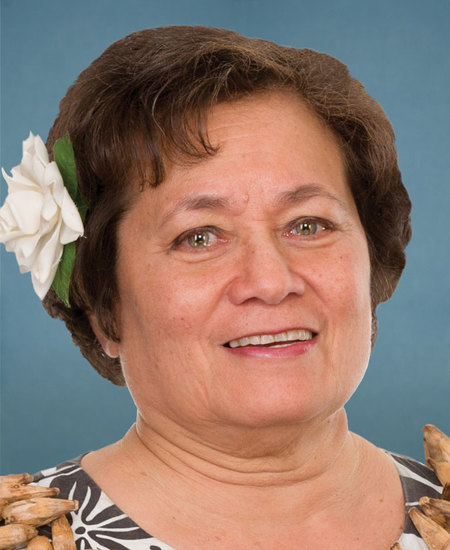
Rep. Aumua Amata Coleman Radewagen
Sponsored bills
Maddy summaryHRES 864 is a ceremonial resolution honoring U.S. veterans on Veterans Day 2025. It does not create new laws or policies but formally recognizes veterans' service and sacrifice, calling on all Americans to observe Veterans Day. The resolution references historical context about Veterans Day's origins (from Armistice Day to honoring all veterans) but contains no concrete policy changes. It directly addresses the general public, urging them to participate in the observance. As a non-binding resolution, it affects no specific individuals or groups through legislative action.
Maddy summaryThis bill (HR 5976) changes U.S. nationality rules for American Samoans, who are currently classified as "non-citizen nationals" (born in American Samoa but not automatic U.S. citizens). It allows these individuals, if residing in a U.S. state or territory covered by specific immigration laws, to apply for a U.S. passport identifying them as both a national *and* a citizen upon written request. The key mechanism is amending passport procedures to enable this dual status through a simple application process, rather than requiring a separate citizenship application. It directly affects American Samoans seeking to transition from non-citizen national status to full U.S. citizenship.
Maddy summaryThis bill maintains a $800 duty-free limit for small shipments (de minimis shipments) from specific U.S. territories into the mainland United States. It directly affects residents and businesses in the U.S. Virgin Islands, Guam, the Northern Mariana Islands, and American Samoa, allowing them to import goods valued under $800 per day without paying import duties or taxes. The law prohibits splitting orders to bypass the $800 limit and requires the Treasury Secretary to implement this rule consistently with pre-January 2025 practices. It also adds the Northern Mariana Islands to an existing exemption for bona fide gifts and mandates consultation on trade policies that could harm territory commerce.
Maddy summaryThis is a procedural resolution (HRES 860), not a bill with legislative effect. It expresses the U.S. House of Representatives' support for former President Trump's 2020 decision to redesignate Nigeria as a "Country of Particular Concern" (CPC) under religious freedom laws. The resolution commends this action due to documented religious persecution in Nigeria, including violence against Christians and minority religious groups. It does not create new policy or alter U.S. assistance; it solely states congressional support for holding Nigeria accountable for religious freedom violations.
Maddy summaryThis bill extends the Digital Coast program through 2030, amending the existing Digital Coast Act. It requires NOAA to make coastal data "fully and freely available" (not just accessible) and explicitly includes underground infrastructure data in the types of information collected. The changes directly affect NOAA, which manages the program, and entities relying on its coastal data for planning and development. The bill focuses on updating program requirements rather than creating new policies.
Maddy summaryHR 647, the Ensuring Veterans’ Final Resting Place Act of 2025, amends a provision in U.S. Code (38 U.S.C. § 2306(h)) to change how burial benefits are provided for veterans. It removes the requirement that a veteran’s family must provide an urn or plaque for the Department of Veterans Affairs (VA) to offer additional burial benefits; the VA will now automatically provide these benefits regardless of whether the family supplies such items. This change directly affects veterans’ families arranging burial services, making it easier to access burial benefits without needing to procure specific items first. The amendment applies to veterans who die on or after January 5, 2021, updating existing eligibility rules.
Maddy summaryThis bill adds Medicare coverage for multi-cancer early detection screening tests (blood or biological tests analyzing cell-free DNA) starting January 1, 2028. It directly affects Medicare beneficiaries aged 68 and older (starting in 2028, with the age limit increasing by 1 year annually), requiring tests to be FDA-cleared and deemed reasonable/necessary by the Secretary for early cancer detection across multiple organ sites. Payment will initially match current stool DNA test rates before 2031, then shift to a lower rate or new payment system after 2031, with limits preventing more than one test per year. The bill explicitly states it does not alter coverage for existing cancer screenings like breast, colorectal, or prostate cancer tests.
Maddy summaryThis bill amends the definition of "State" in the Omnibus Crime Control and Safe Streets Act to explicitly include the Northern Mariana Islands, removing redundant language. It ensures the Northern Mariana Islands qualifies for federal criminal justice funding typically available to states. The bill directly affects the Northern Mariana Islands by enabling its access to these funds for local law enforcement and justice programs. The provided text does not detail provisions for American Samoa, though the bill title references both territories.
Maddy summaryThe SAVES Act (HR 2605) creates a 5-year pilot program where the Department of Veterans Affairs (VA) awards competitive grants to nonprofit organizations to provide service dogs to veterans with specific disabilities. It directly affects veterans with covered conditions like blindness, mobility impairments, PTSD, traumatic brain injury, or other disabilities deemed appropriate for service dog assistance by the VA. Key provisions include: grants capped at $2 million per nonprofit (with $10 million annually authorized), no fees charged to veterans, VA-provided lifetime veterinary insurance for the dogs, and requirements for nonprofits to train veterans and maintain humane animal standards. The program aims to expand access to service dogs as a support tool for veterans managing qualifying disabilities.