

Territories Statistics Collection Equity Act This bill requires implementation of a plan for federal agencies to collect and publish statistics regarding the U.S. territories in the same manner as statistics are collected and reported for the states. Specifically, the bill directs the Interagency Council on Statistical Policy to publish a list and assessment of existing federal statistical programs that collect and publish data for the U.S. territories comparable to the states. The council must submit to Congress a plan to collect and publish statistics regarding the territories in the same manner as statistics are collected and reported by federal agencies for the states. The council, in coordination with agencies, must implement the plan no later than four years after enactment of this bill.
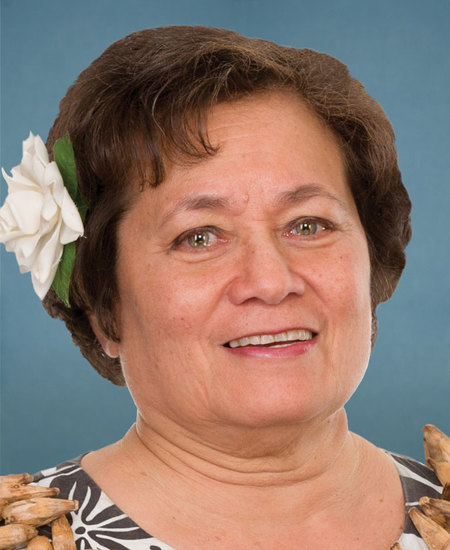
Rep. Aumua Amata Coleman Radewagen
Sponsored bills
Maddy summaryThe National Park Foundation Reauthorization Act of 2022 extends and increases funding for the National Park Foundation. It amends federal law to authorize $15 million annually (up from $5 million) for the Foundation through 2030 (extending from 2023). This bill directly affects the National Park Foundation by providing a longer-term, higher level of federal appropriations for its operations. The key change is a specific funding authorization adjustment in Title 54 of the U.S. Code, with no new program requirements or policy changes.
Modernizing Department of Veterans Affairs Disability Benefit Questionnaires Act This bill requires that all disability benefit questionnaire data collected by persons other than employees of the Department of Veterans Affairs (VA) in the course of VA medical disability examinations must be transmitted to the VA in a machine-readable format.
Elizabeth Dole Home and Community Based Services for Veterans and Caregivers Act of 2022 or the Elizabeth Dole Home Care Act This bill addresses home care and caregiver programs for veterans.
This bill expands eligibility for Department of Veterans Affairs (VA) reimbursement of emergency treatment for veterans who are treated in a non-VA facility. Specifically, the bill waives the requirement that a veteran must have received VA care within the 24-month period preceding the furnishing of emergency treatment if the veteran receives such emergency treatment within the 60-day period following their enrollment in the VA health care system.
Serving Our LGBTQ Veterans Act This bill establishes a Center for Lesbian, Gay, Bisexual, Transgender, and Queer (LGBTQ) Veterans within the Department of Veterans Affairs (VA). Among other functions, the center must serve as principal adviser to the VA on the adoption and implementation of policies and programs affecting veterans who are LGBTQ.
Emergency Relief for Servicemembers Act This bill authorizes a servicemember to terminate specified contracts (e.g., contracts for commercial mobile service or internet service) that are entered into in relation to military orders for a permanent change of station if the member then receives a stop movement order in response to a local, national, or global emergency which prevents the member from using the services provided under the contract.
Department of Veterans Affairs Creation of On-Site Treatment Systems Affording Veterans Improvements and Numerous General Safety Enhancements Act or the VA COST SAVINGS Enhancements Act This bill requires the Department of Veterans Affairs (VA) to install and operate an on-site regulated medical waste treatment system at each VA facility that would benefit from such a system's cost savings. In order to identify which VA facilities would benefit, the VA must develop a uniform regulated medical waste cost analysis model to determine the cost savings associated with the use of an on-site regulated medical waste treatment system.
Court Improvement Equity Act This bill allows the Northern Mariana Islands to access state grant funds for child welfare court improvements in foster care and adoption proceedings under the Court Improvement Program (CIP). Under current law, the Northern Mariana Islands may not receive a CIP grant because the CIP program requires that a participating state or U.S. territory be eligible to operate a Title IV-E program (i.e., be eligible to receive federal payments for the provision of foster care and adoption assistance). This bill allows the Northern Mariana Islands, the only U.S. territory not currently eligible for the Title IV-E program, to participate in the CIP program.
Ensuring the Best Schools for Veterans Act of 2022 This bill makes adjustments to the process by which the Department of Veterans Affairs (VA) evaluates programs of education for violations of the 85/15 Rule. The rule generally prohibits the VA from approving the enrollment of a veteran in any course at an educational institution where more than 85% of the students are having all or part of their tuition or other charges paid by the institution or the VA. The bill adds an exception for tuition or charges paid under a payment plan at an educational institution with a history of offering payment plans that are completed within 180 days after the end of the applicable term, quarter, or semester. The bill also requires the VA to establish a process by which an educational institution may request a review of a determination that the institution has more than 85% of enrolled students that have all or part of their tuition or other charges paid by the institution or the VA. The bill adjusts the existing 35% exemption by exempting courses from the 85/15 Rule if the majority of courses at the institution are approved by the state approving agency, and the total number of veterans, reservists, or eligible beneficiaries who are enrolled at the institution equals 35% or less of the total student enrollment at the institution. Additionally, the 85/15 Rule does not apply with respect to the enrollment of a veteran in a program of education with fewer than 10 students who are having all or part of their tuition or other charges paid to or for them by the educational institution or the VA.