

Maddy summaryHRES 771 is a non-binding resolution expressing the U.S. House of Representatives' support for Israel following Hamas' October 7, 2023, attack. It condemns Hamas' actions, affirms Israel's right to self-defense, and calls for the immediate release of hostages. The resolution also urges enforcement of existing laws restricting aid to terrorists and sanctions against Iran for supporting Hamas. It does not create new policies or allocate funds, as it is a symbolic statement of congressional support.
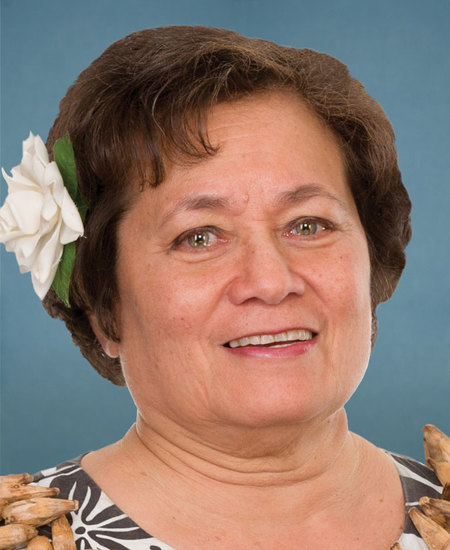
Rep. Aumua Amata Coleman Radewagen
Sponsored bills
Maddy summaryThis bill, HR 6061, would allow U.S. nationals (primarily from American Samoa and other U.S. territories) to become U.S. citizens more easily by waiving specific naturalization requirements. It eliminates the need for language and civics tests, permits naturalization while remaining in U.S. territories (without moving to a state), and allows for reduced fees and waived in-person interviews. The change applies to those who have continuously resided in a territory since birth or serve in the military, addressing barriers to citizenship for security clearances and military service. This directly affects U.S. nationals seeking citizenship without requiring relocation, additional testing, or full fees.
Maddy summaryThis bill authorizes a one-time $40,000 payment to former Air America employees who served at least five years during 1950-1976, or to their survivors (widows/widowers, dependents, or children). Additional $8,000 payments are provided for each full year of service beyond five years. The total funding is capped at $60 million, with claims due within two years of regulations being finalized. It does not create ongoing benefits or change Air America’s legal status, and payments are issued as a single lump sum.
Maddy summaryThis bill amends federal Medicaid law to exclude certain costs spent by State Medicaid Fraud Control Units (MFCUs) in Guam, the Northern Mariana Islands, and American Samoa from federal payment limits. Specifically, it ensures that if these territories qualify for a payment under a specific Medicaid funding provision for a calendar quarter, their MFCU expenditures won't count toward the federal funding cap for that period. The change directly affects these three U.S. territories' Medicaid programs by providing additional flexibility in how fraud prevention costs are accounted for in federal funding calculations. This is a procedural adjustment to existing Medicaid financing rules, not a new benefit or service.
Maddy summaryHR 5847, the International Children with Disabilities Protection Act of 2023, establishes a U.S. government program to support global efforts keeping children with disabilities in families rather than residential institutions. The bill authorizes $2 million in 2024 (rising to $10 million annually by 2029) for grants to organizations led by people with disabilities and family members, prioritizing countries with large populations of children in institutions. Key mechanisms include funding local advocacy groups (requiring 75% of funds to go to disability organizations), building leadership capacity through training and study tours, and creating accessible online programs for policymakers. The program directly affects children with disabilities, their families, and disability rights organizations worldwide by promoting family inclusion and reducing institutionalization, with mandatory annual reports to Congress on implementation.
Maddy summaryHRES 739 is a House resolution disapproving of a September 11, 2023, sanctions waiver that would release $6 billion in Iranian assets held in South Korea. The resolution states this waiver weakens U.S. policy by allowing Iran access to funds that could support its nuclear program and terrorism, and criticizes the delayed notification to Congress. It specifically condemns the administration's nonenforcement of mandatory sanctions and the release of assets without proper congressional review. The resolution demands the administration submit any Iran nuclear agreement to Congress before further sanctions relief. This is a procedural disapproval, not a law altering sanctions.
Maddy summaryHR 5641, the Pay Our Troops Act, ensures military personnel and their support staff continue receiving pay during fiscal year 2024 if Congress fails to pass regular budget appropriations. It appropriates existing Treasury funds to cover pay and allowances for active-duty troops, reserve components, and civilian employees or contractors supporting military operations. The bill automatically terminates on January 1, 2025, or earlier if Congress enacts a regular budget or continuing resolution. This provision directly affects service members, Department of Defense staff, and Coast Guard personnel (when not under the Navy) during budget implementation gaps.
Maddy summaryThis bill exempts Purple Heart medal recipients from paying standard passport application fees. It directly affects military veterans who have been awarded the Purple Heart for combat wounds. The key mechanism amends the 1920 Passport Act to add a specific fee waiver for these veterans when applying for passports. This change would reduce costs for eligible veterans seeking to travel internationally using official U.S. passports.
Maddy summaryHR 5191, the Renewable Energy for U.S. Territories Act, establishes a federal grant program administered by the Secretary of Agriculture to fund renewable energy projects in U.S. territories (Puerto Rico, Guam, U.S. Virgin Islands, American Samoa, and Northern Mariana Islands). Covered entities - defined as eligible not-for-profit organizations - can use grants to develop renewable energy systems, improve energy efficiency, build storage or microgrids, or train local residents, but cannot fund fossil fuel or nuclear projects. The bill also mandates a GAO study on renewable energy potential in territories, focusing on grid modifications, microgrid expansion, and energy resiliency, with findings to be reported to Congress. This program aims to directly support territorial energy infrastructure upgrades and workforce development through concrete funding mechanisms.
Maddy summaryThis bill updates the Small Business Administration's microloan program to include the Northern Mariana Islands (CNMI) as an eligible territory. It amends the definition of "State" in the Small Business Act to explicitly list the CNMI alongside Puerto Rico, Guam, and other U.S. territories. As a result, CNMI-based entrepreneurs and small businesses will now qualify for SBA microloans previously available only to businesses in states and certain other territories. The change directly affects CNMI small business owners seeking low-interest loans to start or expand operations. The bill makes no other policy changes beyond this definitional update.