

Protecting American Business from Foreign Adversaries Act of 2022 This bill requires specified companies and other entities associated with a foreign country to register an agent with the Department of Commerce for service of process (i.e., the legal process for notifying a defendant that legal action has been taken against them) in the United States. Specifically, a corporation or other commercial entity conducting business in the United States must register an agent if the entity (1) is organized under the laws of, or has its principal place of business in, a foreign country; (2) has a majority of shares held by an individual or a group of individuals who reside in a foreign country; or (3) is owned by individuals or entities who reside in or are headquartered outside of the United States and the majority of the entity's earnings are derived from commerce outside of the United States.
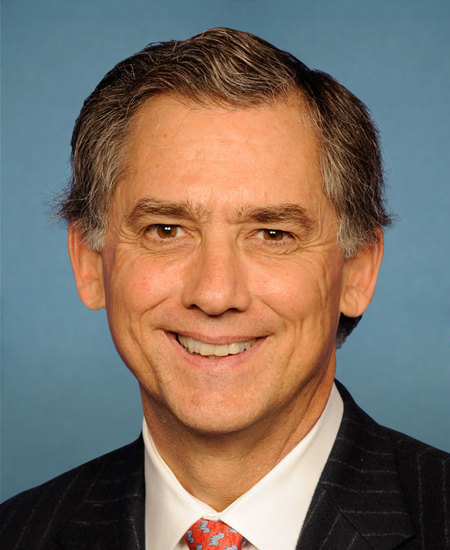
Rep. J. French Hill
Sponsored bills
Midland Over Moscow Act This bill imposes sanctions related to the Nord Stream 2 pipeline and revises the expedited approval process for natural gas imports and exports in or out of the United States. (Nord Stream 2 is a pipeline constructed to increase the export of natural gas from Russia to Europe.) Within 10 days of this bill's enactment, the President must impose sanctions on any entity responsible for the planning, construction, maintenance, financing, or operation of Nord Stream 2, as well as any corporate officer or principal shareholder with a controlling interest in such an entity. The bill also revokes the President's authority to waive certain sanctions related to Nord Stream 2 and TurkStream, another Russian natural gas pipeline project. The bill also allows any nation, with specified exclusions, to use an expedited process to receive approval to import or export natural gas in or out of the United States (currently only a nation with a free trade agreement with the United States may use the expedited process). Specifically, the bill excludes any nation (1) subject to U.S.-imposed sanctions or trade restrictions, or (2) excluded by the President or Congress for national security reasons.
Human Trafficking Awareness Training Act This bill authorizes the Federal Law Enforcement Training Centers to establish a human trafficking awareness training program for state, local, tribal, territorial, and educational institution law enforcement personnel.
Guaranteeing Ukrainian Autonomy by Reinforcing its Defense (GUARD) Act of 2022 This bill provides support for Ukraine and imposes sanctions related to Nord Stream 2, the pipeline constructed to increase exports of natural gas from Russia. The Department of State must periodically report to Congress a determination as to whether Russia's government meets the criteria to be designated a state sponsor of terrorism. The bill authorizes the State Department to provide Foreign Military Financing assistance to Ukraine in FY2022. The bill also authorizes providing Ukraine with lethal assistance, such as anti-armor weapon systems and anti-aircraft weapons systems. From FY2022-FY2026, Ukraine shall have priority access to excess defense articles. During the same time period, the bill also authorizes providing Ukraine with assistance, including (1) International Military Education and Training assistance; (2) assistance to strengthen cybersecurity and intellectual property enforcement; (3) support and training for banking reform, subsidy reform, corporate governance, and the privatization of state-owned enterprises; and (4) assistance to combat corruption and improve the rule of law. Within 15 days of this bill's enactment, the President must impose sanctions on any entity responsible for planning, constructing, or operating Nord Stream 2, as well as any corporate officer of such an entity. The bill also subjects the President's authority to waive certain sanctions to congressional review. The U.S. Agency for Global Media may expand broadcasting in countries of the former Soviet Union to combat Russian disinformation. The bill requires reports to Congress on various topics, including a strategy on using U.S. diplomacy to support Ukraine.
Halt All Lethal Trafficking of Fentanyl Act or the HALT Fentanyl Act This bill places fentanyl-related substances as a class into schedule I of the Controlled Substances Act. A schedule I controlled substance is a drug, substance, or chemical that has a high potential for abuse; has no currently accepted medical value; and is subject to regulatory controls and administrative, civil, and criminal penalties under the Controlled Substances Act. Additionally, the bill establishes a new, alternative registration process for schedule I research that is funded by the Department of Health and Human Services or the Department of Veterans Affairs or that is conducted under an investigative new drug exemption from the Food and Drug Administration. The bill also makes several other changes to registration requirements for conducting research with controlled substances, including permitting a single registration for related research sites in certain circumstances, waiving the requirement for a new inspection in certain situations, and allowing a registered researcher to perform certain manufacturing activities with small quantities of a substance without obtaining a manufacturing registration.
Public Safety Enhancement Act of 2021 This bill reauthorizes through FY2026 the Community Oriented Policing Services (COPS) grant program. Additionally, the bill requires a certain amount of funds made available under the COPS grant program to be used for the hiring and retention of law enforcement officers.
Illegal Immigrant Payoff Prohibition Act This bill prohibits the payment of a settlement to an alien for a civil action brought against the United States in connection with the alien's inadmissibility to, or unlawful presence in, the United States.
Counter-Kleptocracy Act This bill addresses prevention and elimination of corruption globally. The Department of State must (1) annually rank, using specified standards, foreign countries based on their efforts to eliminate corruption; and (2) designate an anti-corruption contact in the diplomatic mission of any country that does not meet the standards. The State Department must also evaluate whether to sanction foreign persons engaged in significant corruption (1) in countries that make de minimis or no efforts to meet the standards, or (2) connected to a designated Russian pipeline project. The President may temporarily sanction foreign persons engaging in public corruption activities (e.g. bribery). The bill makes it a federal crime for foreign officials to demand or accept bribes to influence the performance of an official act or otherwise confer an improper advantage. Officials who engage in this conduct are subject to a fine, a prison term, or both. Funds recovered by prosecuting this crime shall be deposited into a new fund in the Treasury for anti-corruption initiatives. The Department of Justice must make publicly available an accounting of property relating to foreign government corruption that is forfeited to the United States. The bill addresses issues concerning U.S. visas, including related to (1) abuse of investor visas by corrupt foreign officials or criminals, and (2) foreign individuals denied admission to the United States because of adverse foreign policy consequences. The bill also prohibits extraditions based solely on, and otherwise addresses, International Criminal Police Organization communications.
Transnational Repression Accountability and Prevention Act of 2021 or the TRAP Act of 2021 This bill establishes requirements related to U.S. cooperation with International Criminal Police Organization (INTERPOL) communications. Specifically, no U.S. agency or department may extradite an individual based solely on an INTERPOL notice. In addition, the Department of Justice and the Department of State must take certain actions to support reforms to increase transparency of INTERPOL, including with respect to its communications. The bill also requires reports on countries that abuse INTERPOL communications for political motives and other unlawful purposes.
Daniel Anderl Judicial Security and Privacy Act of 2021 This bill generally prohibits federal agencies and private businesses from publicly posting the personally identifiable information (e.g., home addresses) of federal judges and their immediate family members. It also (1) requires information to be removed upon written request from the federal judge concerned, (2) prohibits data brokers from purchasing or selling such information, and (3) establishes programs to protect such information at the state and local level and to enhance security for judges.