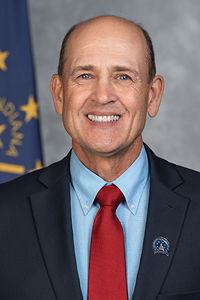
A SENATE RESOLUTION to honor Senator Eddie Melton upon his retirement from the Indiana Senate.
Sen. Gary Byrne
Sponsored bills
Establishes the division of historic sites (division) in the department of natural resources. Transfers management of historic sites from the Indiana state museum and historic sites corporation to the division. Makes an appropriation.
Provides that the office of administrative legal proceedings (OALP) is the ultimate authority for agencies subject to the jurisdiction of the OALP. Provides that a court conducting a judicial review hearing shall review questions of law and fact de novo. Makes conforming amendments.
Allows a city on the Ohio River that established a port authority to annex territory that is not contiguous to the city boundaries if a railroad owned by the port authority connects the city to the annexed territory. Prohibits a public official from being appointed to the executive board of a military base reuse authority after June 30, 2024, and sets certain minimum qualifications for members.
Eliminates the authority of public libraries to impose an ad valorem property tax as a "taxing unit". Requires a public library to prepare and submit an annual budget in the same manner as other departments of county or municipal government. Requires the fiscal body of a county or municipality in which the territory of the public library is located to provide the revenues necessary for the operation and maintenance of the public library by a special tax levy, a specific appropriation, or both. Provides that a special tax levy for public library purposes is included in the calculation of the maximum permissible property tax levy for the county or municipality. Prohibits public libraries from providing a function or service that is not a core public function of the library, unless the specific function or service is included as a line item request in the public library's budget and is approved and funded by the county or municipality to which the budget proposal is submitted. Defines "core public function" for purposes of the statute.
Prohibits a financial services provider from discriminating in providing financial services to a consumer by using a social credit score as a basis for directly or indirectly: (1) declining to provide to the consumer full and equal access to one or more financial services; or (2) providing the consumer with one or more financial services on less favorable terms and conditions than would otherwise apply to the consumer if a social credit score were not used. Defines "social credit score" for purposes of these provisions. Specifies that the term does not include an analysis that involves a financial services provider's evaluation of any quantifiable risks of a consumer's participation in certain business activities or business associations, if the analysis is based on impartial, financial risk based standards that are: (1) established in advance; and (2) publicly disclosed to customers and potential customers; by the financial services provider. Provides that if a financial services provider refuses to provide, terminates, or restricts one or more financial services with respect to a consumer, the consumer may request from the financial services provider a statement of the specific reasons constituting the basis for the refusal, termination, or restriction. Provides that a financial services provider that receives such a request shall transmit to the consumer a written statement setting forth the specific reasons constituting the basis for the refusal, termination, or restriction. Sets forth requirements regarding the: (1) content of; and (2) means and time frame for submitting; a request or statement under these provisions. Provides that a violation of these provisions constitutes a deceptive act that is actionable under the deceptive consumer sales act only by the attorney general. Provides that a consumer aggrieved by a violation of these provisions may bring a civil action for damages, injunctive relief, or both.

Provides that an individual has the right to: (1) save and exchange seeds to grow food; and (2) grow, raise, produce, harvest, and consume the food that the individual chooses; for the individual's own nourishment, sustenance, bodily health, and well-being. Specifies certain acts that are prohibited. Provides that a zoning ordinance may restrict but may not prohibit the growing or raising of food. Specifies that the Indiana state board of animal health may enforce a state or federal law, rule, or regulation concerning animals. Specifies that the right to grow and raise food may not impair the terms of a lease or contract.
Provides that an automated commercial motor vehicle may not be operated on a highway to transport passengers or goods unless a human operator who meets all state and federal qualifications to operate a commercial motor vehicle is physically present in the automated commercial motor vehicle to monitor the performance of the automated commercial motor vehicle and to take control of all or part of the automated commercial motor vehicle's operation, if necessary. Provides that a registered automated commercial motor vehicle must meet federal commercial motor vehicle standards and regulations.
Prohibits certain free or reduced public transportation fares on election day.
Tasks the commission for higher education (commission) and the department of workforce development with collecting and compiling certain information concerning: (1) postsecondary education; (2) career and technical education; (3) workforce qualifications; (4) workforce earnings; and (5) workforce debt. Requires the commission to create an interactive website known as the student horizon dashboard to provide public access to certain collected and compiled information. Requires the commission, with assistance from the department of education and the department of workforce development, to create a report known as the student graduate horizon scorecard (scorecard) for annual distribution. Specifies that the scorecard contain certain information concerning high paying civilian and military careers and in demand jobs. Requires the commission to prepare an annual report for the legislative council. Requires state educational institutions and career and technical education centers to collect and provide information as requested by the commission.