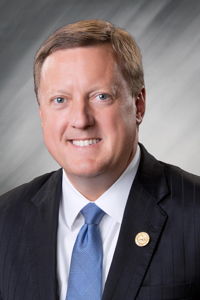
A CONCURRENT RESOLUTION recognizing Judge Edward W. Najam, Jr., for his 30 years of service on the Indiana Court of Appeals.
Sponsored bills
Directs Congress to call a constitutional convention under Article 5 of the Constitution of the United States for the purpose of proposing an amendment to the Constitution of the United States to fix the membership of the United States Supreme Court at nine justices.
A SENATE RESOLUTION memorializing the life of Zachary Steven Eckert.
A CONCURRENT RESOLUTION directing the Congress of the United States to propose to the several states an amendment to the United States Constitution concerning the membership of the United States Supreme Court.
Makes the current offense of carrying a handgun without a license applicable only to persons who are at least 18 years of age but less than 21 years of age. Allows certain persons who are at least 21 years of age to possess or carry a handgun without a license unless the person fits into one of several categories, including a person who: (1) has been convicted of, or arrested for, specified crimes or delinquent offenses; (2) has been prohibited by a court from possessing a handgun or has been found by a court to be dangerous; or (3) has been found by a court to be mentally incompetent, has been involuntarily committed, or has been the subject of a 90 day or regular commitment. Allows certain persons who: (1) do not meet the requirements to receive a license to carry a handgun; and (2) are not otherwise barred from carrying or possessing a handgun by state law; to carry a handgun in specified instances. Makes it a Class A misdemeanor for particular persons to possess or carry a handgun. Increases the penalty to a Level 5 felony in some instances. Defines certain terms. Makes conforming amendments and repeals obsolete provisions. Makes a technical correction.
A SENATE RESOLUTION honoring Senator Karen Tallian upon her retirement from the Indiana Senate.
Provides that a state officer or a state agency may not do either of the following without the express approval of the general assembly: (1) Use the money of a private entity to create or expand a program of the state officer or state agency. (2) Use the money of a private entity to fund or supplement the funding of any employee position within state government.
Prohibits an interactive computer service or a social media platform from censoring any user of the interactive computer service or social media platform, the expression of any user of the interactive computer service or social media platform, or the ability of any user of the interactive computer service or social media platform to receive the expression of another person, based on: (1) the viewpoint of the user or another person; (2) the viewpoint represented in the user's expression or another person's expression; or (3) the user's geographic location in Indiana. Provides for specified exceptions to the prohibition. Provides that an interactive computer service or social media platform that violates the prohibition with respect to a user of the interactive computer service or social media platform is subject to a civil action by the user in which a prevailing user is entitled to one or more of the following: (1) A declaratory judgment. (2) Injunctive relief. (3) Recovery of the user's costs and reasonable and necessary attorney's fees. Provides that an interactive computer service or social media platform that willfully fails to promptly comply with an order issued by a court in an action brought for a violation of the prohibition commits contempt of the court, and provides that the court: (1) may impose on the interactive computer service or social media platform any penalty authorized for contempt of court; and (2) shall impose on the interactive computer service or social media platform a civil penalty for each day the interactive computer service or social media platform remains in noncompliance with the order, in an amount and duration sufficient to secure the interactive computer service's or social media platform's immediate compliance.
Prohibits a governmental entity (entity), including a state educational institution (institution), from discriminating against persons: (1) over the exercise of rights provided or protected by the Constitution of the United States; or (2) by granting preferential treatment to any individual or group on the basis of race, sex, color, ethnicity, or national origin in the operation of public employment, public education, or public contracting. Specifies certain exemptions. Provides that prohibited discrimination may be asserted as a claim or defense in a judicial or administrative proceeding regardless of whether the relevant entity or institution is a party to the proceeding. Provides that, if the relevant entity or institution is not a party to a proceeding, the relevant entity or institution has an unconditional right to intervene in order to respond to an action or claim alleging discrimination. Specifies certain awards and remedies. Defines certain terms.

Provides that the population parameters that refer to political subdivisions throughout the Indiana Code are based on the 2010 federal decennial census until April 1, 2022. Provides that for purposes of local redistricting, political subdivisions shall use data from the 2020 federal decennial census. Establishes new legislative districts for the Indiana general assembly. Provides for expiration of the current legislative districts on the date of the 2022 general election. Makes technical and necessary changes in related statutes. Establishes new Indiana congressional districts. Provides for expiration of the current congressional districts on the date of the 2022 general election. Makes technical and necessary changes in related statutes.