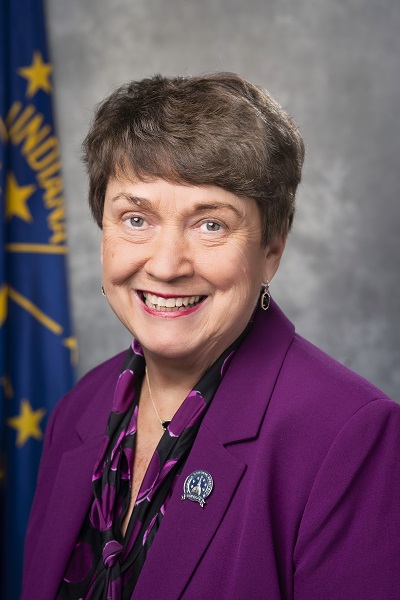
A CONCURRENT RESOLUTION recognizing Judge Edward W. Najam, Jr., for his 30 years of service on the Indiana Court of Appeals.
Sponsored bills
A SENATE RESOLUTION honoring Indiana 4-H and recognizing February 1, 2022, as Indiana 4-H Day at the Statehouse.
A SENATE RESOLUTION memorializing the life of Zachary Steven Eckert.
Requires: (1) the office of the secretary of family and social services; (2) an entity that has contracted with the office of the secretary; and (3) a person that has contracted with an entity; to contract with the area agencies on aging as the primary provider to perform specified long term services and supports programing for certain Medicaid applicants, enrollees, and recipients.
A SENATE RESOLUTION honoring Senator Karen Tallian upon her retirement from the Indiana Senate.
Requires each school corporation, charter school, and state accredited nonpublic elementary school to include cursive writing in its curriculum.
Provides that, after a school receives statewide assessment score reports, a teacher of a student shall discuss the student's statewide assessment results with a parent at the next parent/teacher conference or, if the school does not hold parent/teacher conferences, send a notice to a parent of the student offering to meet with the parent to discuss the results. (Current law requires that, after a school receives statewide assessment score reports, the school shall offer a parent/teacher conference to discuss a student's statewide assessment results with a parent who requests the parent/teacher conference or the parent of each student who does not receive a passing score on the test.) Requires the department of education to include in a contract entered into or renewed after June 30, 2022, with a statewide assessment vendor a requirement that the vendor provide a summary of a student's statewide assessment results that meets certain requirements.
Prohibits a state employee health plan, a state educational institution employee health plan, an accident and sickness insurance policy, and a health maintenance organization contract from requiring authorization for covered early intervention services under an individualized family service plan signed by an advanced practice registered nurse (APRN). Provides for an application for a waiver from certain requirements applying to certain intrastate motor carrier drivers who are insulin dependent diabetics to be signed by an APRN. Provides that an individual who is subject to epileptic seizures may not be denied a driver's license or permit if the individual provides certain documentation from an APRN. Provides for an APRN to sign an order or referral for physical therapy. Adds an APRN to the providers who may perform an examination and provide a statement concerning an injured employee for purposes of worker's compensation claims. Allows an APRN to affirm that an applicant has a temporary disability for purposes of a waiver from continuing education requirements to work on certain lift devices. Requires a health insurance plan to provide coverage for diabetes self-management training ordered by an APRN. Makes technical corrections.
Provides that if a local order addresses an aspect of a declared emergency addressed by an executive order, the local order may be less stringent than the executive order to the extent permitted by the executive order. Provides that if a local order addresses an aspect of a declared emergency that is not addressed by an executive order or if a local order addresses an aspect of a declared emergency more stringently than an executive order, the local order may not take effect, or remain in effect, unless the local order is approved by the county legislative body (in the case of a county health department) or by an ordinance adopted by the city legislative body and approved by the mayor (in the case of a city health department). Provides that the appointment of a county health officer is subject to the approval of the county legislative body. Adds other good cause to the reasons for which a local health officer may be removed in counties other than Marion County. Specifies that a local health officer serves until a successor is appointed and qualified. Establishes an appeals process before legislative bodies of enforcement actions taken by local boards of health and local health officers in response to declared state and local public health emergencies.
Establishes the interim study committee on child services (committee). Provides that the committee: (1) shall review the annual reports submitted by local child fatality review teams and by the statewide child fatality review committee and shall report to the legislative council regarding the committee's review of the reports; and (2) may make recommendations regarding changes in policy or statutes to improve child safety; in addition to reporting to the legislative council regarding any other issue assigned to the committee by the legislative council. Provides that a local child fatality committee may meet at the call of members of the local child fatality committee other than the county prosecutor for purposes of the first meeting of the local child fatality committee. Requires the summary information included in the department's annual report regarding child fatalities to indicate, with regard to a child fatality that was the result of abuse or neglect, whether the child was a ward of the department at the time of the event that led to the child's death. Requires the department to provide the annual report to the committee. Urges the legislative council to assign the following topics to the committee, or to another appropriate study committee, for study during the 2021 legislative interim: (1) Amending the Indiana Code to provide for a structured, limited, confidential process by which members of the general assembly may, in the regular course of legislative duties, individually request and view reports and other materials regarding cases of child abuse or neglect and child fatalities resulting from abuse or neglect, while protecting personally identifying information and confidentiality. (2) The child fatality review process, including recommendations from the department and the state department of health with regard to improving reporting and data collection. Requires a local child fatality review committee that has not held its first meeting as of the effective date of the bill to hold its first meeting not later than December 31, 2021.