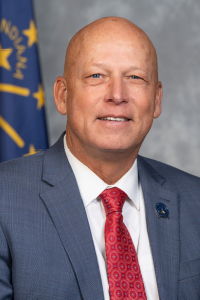
Photo of Michael Crider
R Indiana Senate · District 28

Sen. Michael Crider

Compare
Total votes
2,574
all sessions
Attendance
98%
54 missed
Near the chamber average
With party
96%
of cast votes
Near the chamber average
Bipartisan score
2%
crosses aisle rarely
Near the chamber average
Sponsored
701
bills & resolutions
Near the chamber average
Committees
6
assignments
701 bills and resolutions

Sponsored bills

Total
701
Primary
377
Co-sponsor
324
This page
701
matching current filters
Primary HB 1118
Signed into law · Indiana House · Lead sponsor
Mobile integrated healthcare programs and safety plans.

Specifies that an individualized mental health safety plan includes information concerning a patient's physical health. Allows a mobile integrated healthcare program or a mental health community paramedicine program to provide certain services to help facilitate the patient's safe transition back into the community upon disclosure of a patient's individualized mental health safety plan. Allows a representative of a mobile integrated healthcare program or a representative of a mental health community paramedicine program to request a patient's individualized mental health safety plan from a psychiatric crisis center, psychiatric inpatient unit, or psychiatric residential treatment provider if certain conditions are met.

Signed into law Apr 26, 2021 0 co-sponsors
Primary HB 1285
Signed into law · Indiana House · Lead sponsor
Bureau of Motor Vehicles.

Provides that the bureau of motor vehicles (bureau) shall remit certain taxes not more than 21 days after the collection of the tax. Provides that in the first year an amended surtax or wheel tax rate is effective, the prior surtax or wheel tax rate (as applicable) for the previous calendar year applies to vehicle registrations. Provides that the definition of "credential" includes any form of documentation in physical form or digital form accessible on a mobile device issued by the bureau. Changes the definition of a motor driven cycle to the current definition of a Class B motor driven cycle. Provides that the bureau of motor vehicles commission is protected by the Indiana Tort Claims Act. Expands the types of transactions that the bureau may perform on election day with priority given to credential related transactions. Provides that the bureau may no longer collect fees associated with Riverlink tolls. (Current law provides for the bureau to accept payments for Riverlink tolls.) Provides that temporary license plates may be displayed in the rear window of a vehicle, rather than affixed to the rear of the vehicle. Removes the requirement that the bureau report to law enforcement if a license plate or other proof of registration is lost. Provides that temporary delivery permits may be displayed on a vehicle in a manner determined by the bureau. Provides that a person who becomes an Indiana resident and owns a watercraft must register the watercraft not later than 60 days after becoming an Indiana resident. Provides that a person who fails to register a watercraft within the 60 days after becoming an Indiana resident is subject to an administrative penalty of $15 and commits a Class C infraction. Provides that a motor driven cycle may not be operated unless the vehicle is registered as a motor driven cycle. Provides that a holder of a leaner's permit may operate a motor driven cycle. Provides that the bureau may charge a fee of $25 for expediting certain credentials. Provides that the bureau shall suspend driving privileges or invalidate the learner's permit of an individual who is at least 15 years of age and less than 18 years of age in certain situations. Replaces the term "operator's license" with the term "driver's license". Requires that an individual who has completed driver rehabilitation training hold a learner's permit. Provides that an individual who has signed the application of a minor applicant for a permit or driver's license may subsequently file with the bureau, and be granted, a verified written request that the permit or driver's license expire. Allows the bureau to renew a learner's permit, rather than issuing a new learner's permit. Allows an individual to renew a learner's permit online. Provides that the bureau may approve third parties to conduct skills exams. Removes the provision allowing a licensed driver or an applicant for an initial or renewal driver's license, permit, or endorsement to appeal an action taken by the bureau to revoke or modify the person's driving privileges for medical reasons to the circuit or superior court of the county where the licensed driver or applicant resides prior to exhausting an administrative appeal. Requires individuals to complete driver's safety programs in certain instances. Requires the bureau to implement suspensions for an individual who fails to attend and complete required programs. Allows the bureau to contract with physicians to increase the number of reviewers for medical case files to support and provide recommendations on the revocation of a license for an individual with underlying health conditions. Removes the requirement for special groups to obtain 500 signatures when reapplying for the special group recognition license plate every 10 years. Decreases the number of days a new resident under 18 years of age is required to hold an out-of-state license to 60 days. (Current law requires that a new resident under 18 years of age hold an out-of-state license for 180 days.) Provides that courts must submit the probable cause affidavit in a form and manner prescribed by the bureau. Provides that the bureau shall not place any indication on certain credentials issued by the bureau of the vaccination status of an individual. Provides that the bureau shall not request information regarding the individual's vaccination status or proof of immunity when an individual applies for a credential. Provides that the bureau shall not maintain a data base regarding an individual's vaccination status or proof of immunity. Provides that the bureau shall not connect any bureau data base with any data base that tracks an individual's vaccination status or proof of immunity. Repeals the requirement to request a certificate of compliance for proof of financial responsibility if a motor vehicle accident occurred at least five years prior to the date the bureau receives the copy of the accident report. Provides that the bureau may enter into an agreement with the office of administrative law proceedings to conduct reviews on the bureau's behalf. Makes conforming changes.

Signed into law Apr 23, 2021 0 co-sponsors
Primary HB 1356
Signed into law · Indiana House · Lead sponsor
Permanent trailer registration.

Defines "permanent registration" for purposes of motor vehicles. Provides that the owner of a trailer that weighs 3,000 pounds or less may apply to the bureau of motor vehicles (bureau) for a permanent registration for a fee of $82. Requires the owner of a trailer that applies to the bureau for a permanent registration to pay twice the amount of the surtax otherwise due when the owner obtains a permanent registration. Provides that the owner of a trailer that obtains a permanent registration is not subject to additional surtax payments.

Signed into law Apr 23, 2021 0 co-sponsors
Primary SB 7
Signed into law · Indiana Senate · Lead sponsor
Forensic nurses.

Specifies requirements that a registered nurse must meet in order to practice as a forensic nurse. Requires biennial continuing education for a forensic nurse. Provides that a forensic nurse who is practicing as a forensic nurse on June 30, 2021, is not required to meet the biennial forensic nursing education requirements until June 30, 2023.

Signed into law Apr 22, 2021 0 co-sponsors
Primary SB 365
Signed into law · Indiana Senate · Lead sponsor
Immunity for physician wellness programs.

Defines "wellness program". Specifies that the proceedings and deliberations of a wellness program are confidential. Specifies certain exceptions. Provides that all minutes, records, reports, written expert opinions, written communications, and other comparable memoranda prepared or created by a wellness program are privileged. Specifies certain exceptions. Prohibits all wellness program personnel and participants from revealing or disclosing the substance of wellness program communications, records, and determinations to any person or entity outside of the wellness program. Specifies certain exceptions. Allows a court to order in writing the release of confidential or privileged information belonging to a wellness program after a hearing if the court makes specified findings. Provides that the exchange of confidential or privileged information or memoranda between wellness groups does not result in the waiver of applicable confidentiality and privilege provisions. Provides that confidentiality and privilege provisions applicable to certain records do not make the records inaccessible to people or entities that would otherwise be eligible to receive or access the records under existing state or federal law. Provides that the confidentiality and privilege provisions applicable to wellness groups do not abrogate, limit, or restrict any other privacy protection applicable to a patient or the patient's health or medical information. Specifies that certain individuals may not be named as a party in a civil suit in connection with certain actions taken with respect to a wellness program. Provides that a member, consultant, or participant who comprises or participates in a wellness program is not required to report a licensed physician to the medical licensing board for any act, omission, statement, discovery, or disclosure unless the licensed physician presents a threat to himself or herself, to his or her patients, or to the general public.


Signed into law Apr 22, 2021 0 co-sponsors
Primary SB 3
Signed into law · Indiana Senate · Lead sponsor
Telehealth matters.

Prohibits the Medicaid program from specifying originating sites and distant sites for purposes of Medicaid reimbursement. Prohibits the use of telehealth to provide any abortion, including the writing or filling of a prescription for any purpose that is intended to result in an abortion. Changes the use of the term "telemedicine" to "telehealth". Specifies certain activities that are considered to be health care services for purposes of the telehealth laws. Expands the application of the telehealth statute to additional licensed practitioners instead of applying only to prescribers. Amends the definition of "prescriber" and "telehealth". Provides that a practitioner who directs an employee to perform a specified health service is held to the same standards of appropriate practice as those standards for health care services provided at an in-person setting. Requires that the telehealth medical records be created and maintained under the same standards of appropriate practice for medical records for patients in an in-person setting. Specifies that a patient waives confidentiality of medical information concerning individuals in the vicinity when the patient is using telehealth. Prohibits an employer from requiring a practitioner to provide a health care service through telehealth if the practitioner believes: (1) that health quality may be negatively impacted; or (2) the practitioner would be unable to provide the same standards of appropriate practice as those provided in an in-person setting. Provides that an applicable contract, employment agreement, or policy to provide telehealth services must explicitly provide that a practitioner may refuse at any time to provide health care services if in the practitioner's sole discretion the practitioner believes: (1) that health quality may be negatively impacted; or (2) the practitioner would be unable to provide the same standards of appropriate practice as those provided in an in-person setting. Amends requirements for a prescriber issuing a prescription to a patient via telehealth services. Requires that if a veterinarian is required to establish a veterinarian-client-patient relationship to perform a health care service, the veterinarian shall ensure that a veterinarian-client-patient relationship is established. Repeals the law concerning telepsychology. Prohibits certain insurance policies and individual and group contracts from mandating the use of certain technology applications in the provision of telehealth services.

Signed into law Apr 20, 2021 0 co-sponsors
Showing 371 to 380 of 701 bills
Previous 1 … 37 38 39 … 71 Next