

Increases the penalty for a person who: (1) makes a delivery sale of an e-liquid to an individual less than 21 years of age; (2) sells or distributes tobacco, an e-liquid, or an electronic cigarette to a person less than 21 years of age; and (3) purchases tobacco, an e-liquid, or an electronic cigarette for a person less than 21 years of age; from a Class C infraction to a Class B infraction. Makes it a Class B infraction for a person to make a delivery sale of a vapor product to an individual less than 21 years of age. Makes it a Class B infraction for a person to: (1) sell or distribute a vapor product to a person less than 21 years of age; and (2) purchase a vapor product for a person less than 21 years of age. Makes it a Class C infraction for a person less than 21 years of age to possess an e-liquid or vapor product.
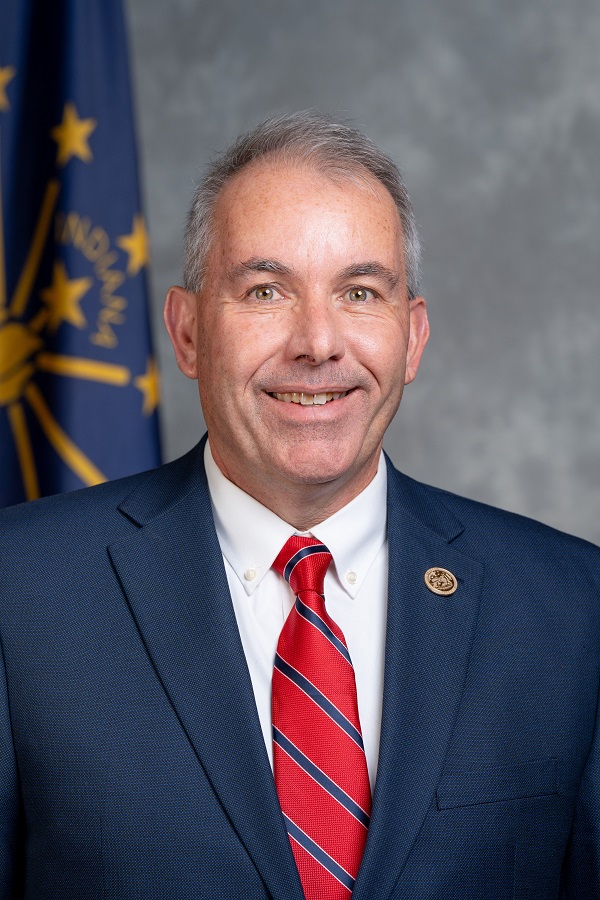
Sen. Scott Alexander
Sponsored bills
Maddy summaryThis is a ceremonial Senate resolution (SR 1) honoring Lieutenant Governor Suzanne Crouch for her service upon her retirement. It does not create new laws or affect any policies; it is a symbolic gesture recognizing her role. The resolution was introduced by Senators Bray and Yoder, adopted unanimously by voice vote on January 8, 2025, and has no binding effect or direct impact on constituents.
Allows the governing bodies of certain local government agencies (local agencies) to adopt rules or policies governing the conduct of meetings. Provides that a rule or policy may provide that the presiding member of the governing body of the local agency may: (1) issue warnings to disruptive attendees and direct them to leave the meeting on the third warning; and (2) direct a law enforcement officer to remove disruptive attendees. Provides that the rules and policies must be posted at the meeting entrance or announced before taking public testimony. Specifies that a provision of the tort claims law providing immunity to a government entity or employee in adopting and enforcing a law or rule applies. Provides that a person commits criminal trespass by knowingly or intentionally: (1) entering a locked area without permission; or (2) refusing to leave an area not publicly accessible after being asked to leave by a law enforcement officer or agent of the property owner or operator. Specifies that: (1) the public access counselor serves at the pleasure of the governor; and (2) when issuing an advisory opinion, the public access counselor may consider only the plain text of the public access laws and valid Indiana court opinions. Provides that a committee appointed directly by the governing body or a governing body's designee does not constitute a governing body that is subject to the open door law if the committee: (1) is appointed for the sole purpose of receiving information, deliberating, or making recommendations to the governing body; and (2) has not more than one member of the governing body as a member.
Prohibits a retail establishment from holding more than one active tobacco sales certificate (certificate) for a retail location at any time. Prohibits the alcohol and tobacco commission (commission) from issuing a certificate to certain persons. Provides that, if a majority interest in a business that holds a certificate is sold or transferred: (1) the new ownership must apply for a new certificate; and (2) the certificate and permit number held by the previous ownership are void 90 days after the sale or transfer of the ownership of the business. Specifies that an employee of a certificate holder (employee) must hold a valid: (1) driver's license issued by the state of Indiana or another state; or (2) identification card issued by the state of Indiana, another state, or the United States; to sell tobacco products. Requires an employee to have the driver's license, identification card, or a copy of these documents readily available to show an excise officer or law enforcement when selling tobacco products. Allows an employee who is unable to show these documents to provide certain evidence within five days. Permits the commission to impose a civil penalty on the certificate holder if an employee fails to timely produce this evidence. Provides that a person who recklessly, knowingly, or intentionally sells a tobacco product without a valid certificate commits a Class C infraction. Makes it a Class C misdemeanor for a person to operate a tobacco and vaping business within 1,000 feet of school property. Specifies exceptions.
Amends the duties of an attendance officer and the state attendance officer. Requires, not later than November 1 of each year, the state attendance officer to submit a report to the legislative council containing recommended legislation based on the state attendance officer's discussions with attendance officers. Requires each governing authority of a school corporation and charter school to establish a truancy prevention policy regarding certain students in kindergarten through grade 6. Provides that a prosecuting attorney shall notify each parent of a child when an affidavit is filed regarding the child's compulsory attendance violations or if the child is a habitual truant.
Provides that a state of disaster emergency declared by the governor: (1) that applies to the entire state may not continue for more than 60 days unless a renewal is authorized by the general assembly; and (2) that only applies to part of the state may not continue for more than 30 days unless renewed by the governor. Provides that the renewal of a statewide disaster emergency authorized by the general assembly may continue for not more than 60 days. Specifies that if a state of disaster emergency that applies to the entire state has ended, the governor may not call a new state of disaster emergency that applies to the entire state unless the new disaster is wholly unrelated to the earlier disaster. Defines "wholly unrelated".
Provides that a deposit account agreement between a depository financial institution and a depositor may be changed or amended from time to time, subject to the terms of the deposit account agreement. Provides that a depositor's continued maintenance of a deposit account after the effective date of any change or amendment to the deposit account agreement, as described in a written notice from the depository financial institution, constitutes prima facie evidence of the depositor's intent to accept the change or amendment.
Provides that, if the attorney general determines probable cause exists, the attorney general, rather than any person lawfully domiciled in Indiana, shall bring an action to compel a governmental body or postsecondary educational institution to comply with statutes requiring cooperation with federal immigration officials. Requires a court to apply a preponderance of the evidence standard to enjoin the violation of those statutes.
Provides that not later than July 15, 2024, the county executive shall provide the department of homeland security (department) certain information relating to each emergency medical services (EMS) provider in the county. Provides that not later than August 15, 2024, the department, in consultation with the Indiana emergency medical services commission, shall prepare and submit a report to the general assembly relating to the provision of EMS. Urges the legislative council to assign to the appropriate study committee the topic of improving the provision of EMS throughout Indiana.
Defines a "residential real estate service agreement" as an agreement: (1) under which a service provider agrees to provide one or more services: (A) in connection with the maintenance, purchase, or sale of residential real estate; and (B) that are not to be performed in their entirety within one year after the agreement is entered into; and (2) that: (A) purports to run with the land or to be binding on future owners; (B) allows for the assignment of the right to provide one or more of the services under the agreement without the consent of the owner of the residential real estate; or (C) purports to create a lien or an encumbrance on, or a security interest in, the residential real estate. Provides that a residential real estate service agreement that is entered into after March 14, 2024, is void and unenforceable. Prohibits a person from recording after March 14, 2024, a residential real estate service agreement in Indiana, regardless of when the residential real estate service agreement is entered into. Provides that a county recorder, or an employee of a county recorder, who records a residential real estate service agreement that is presented to the county recorder's office for recording is not civilly liable under the bill's provisions, regardless of when the recording occurs. Provides that if a residential real estate service agreement (agreement) is recorded in Indiana after March 14, 2024, any person with an interest in the residential real estate that is the subject of the agreement may: (1) apply to a court in the county in which the agreement is recorded for a declaratory judgment declaring the agreement unenforceable; and (2) recover the person's actual damages against any service provider that: (A) is a party to the agreement; and (B) recorded, or caused to be recorded, the agreement. Provides that a service provider that: (1) enters into a residential real estate service agreement with any person; or (2) records, or causes to be recorded, a residential real estate service agreement in Indiana; after March 14, 2024, commits a deceptive act that is subject to the remedies and penalties under the deceptive consumer sales act (act), including an action by the attorney general under the act. Provides that the bill's provisions do not apply to: (1) a residential real estate service agreement entered into before March 15, 2024 (except as otherwise provided in the bill); or (2) certain specified products, contracts, rights, agreements, services, or liens.