

Provides that if any provision, or application of any provision, concerning the manufacture, importation, distribution, or retail sale of alcoholic beverages is deemed to be in conflict with federal law or unconstitutional, certain alcoholic beverage laws shall be construed to limit rather than expand the manufacture, importation, distribution, and retail sale of alcoholic beverages through a three-tier system. Provides a definition of "three-tier system". Defines the term "channel price". Allows a wholesaler to offer a channel price to a retailer if certain conditions are met. Amends the "entertainment complex" definition. Provides that the alcohol and tobacco commission (commission) has additional powers with regard to tobacco. Provides that certain references to alcoholic beverages in bottles include alcoholic beverages in containers. Modifies certain dates concerning alcohol retailer and dealer permits that are deposited with the commission and that may revert to the commission if the permit does not become active. Requires the disclosure of the names of the officers of a corporation or other entity applying for a permit in a published notice or Internet web site. Adds requirements for a permit holder when making an initial request for deposit of a permit. Eliminates Indiana residency requirements for retailers, dealers, and brewers. Provides that residential delivery by a beer retailer, liquor retailer, or wine retailer may only be performed by the permit holder or an employee who holds an employee permit. Requires a permit holder to maintain a written record of each delivery for at least one year that shows the customer's name, location of delivery, and quantity sold. Provides for "grab and go stores" that are accessible only by ticketed event attendees and provide self-service sales of alcoholic beverages in addition to sales of food and nonalcoholic beverages. Provides that certain provisions of the food master hall permit section do not apply to a food hall that: (1) is located in a certified technology park; and (2) operates in a certain type of building or complex of buildings. With certain exceptions, requires a permit applicant to provide the name and address of each person or entity holding at least a 2% interest in the permit and business. Removes the requirement that the department of local government finance consent to the continuation of a permittee's business by the permittee's heir. Requires a municipality to notify the chairman of the commission of any retailer or dealer premises annexed into the municipality, in order to ensure the correct distribution of excise funds. Allows the holder of a food hall vendor's permit and a retailer's permit who also holds a permit for a small brewery, a farm winery, or an artisan distillery to sell certain carry out alcoholic beverages at the retailer's permit premises. Provides that a farm wintery may place wine in bottles or other permissible containers. Allows a farm winery to sell wine by the can. Allows a farm winery to transfer wine from a storage facility or certain locations. Allows a farm winery to sell or transfer wine directly to a wine wholesaler. Provides that an artisan distiller may transfer liquor from a separate storage facility back to the artisan distiller. Allows an artisan distiller to sell or transfer liquor directly to a liquor wholesaler. Makes technical corrections and stylistic changes.
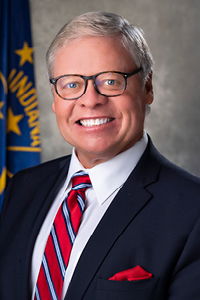
Sen. Ron Alting
Sponsored bills
Allows a food hall that: (1) is located in a certified technology park; and (2) is not located in a historic district or historic building; to be eligible for a food hall master permit. Provides that a project that: (1) borders a lake that is at least 750 acres; and (2) is within a municipality; is eligible for a municipal riverfront development project retailer's permit. Allows a person who holds: (1) a restaurant permit in an economic development area; and (2) an interest in a brewery, farm winery, or artisan distillery (production facility) located on or adjacent to the restaurant; to sell alcoholic beverages manufactured at the production facility for carryout in the restaurant's general merchandising area and from a self-serving display. Provides that a minor may: (1) be in the restaurant's general merchandising area; and (2) participate in a nondrinking tour of the production facility, if the minor is accompanied by an adult family member.
Exempts from day care licensure requirements a child care program that: (1) is operated by a public or private organization under a contract with a public or private school; (2) serves children who are enrolled in a public or private school in grades kindergarten through 12, or in a preschool program offered by the public or private school; and (3) serves children who are: (A) attending school through remote or e-learning due to a disaster emergency; or (B) participating in a learning recovery program that administers an assessment to measure student learning loss and provides Indiana academic standards aligned instruction.
Requires a primary source of supply (primary source) that wants to amend, cancel, terminate, or refuse to renew a distribution agreement entered into with a beer wholesaler to: (1) act in good faith, with good cause, and with due regard for the equities of the beer wholesaler; and (2) provide written notice. Provides that a primary source has a right to amend, cancel, terminate, or refuse to renew distribution agreements with all beer wholesalers that have entered into the same distribution agreement with the primary source and are located in the United States. Prohibits a primary source or beer wholesaler from waiving any provisions of the law regarding distribution agreements.
Changes the distribution of part of the tax revenue in the Tippecanoe County innkeeper's tax fund (fund) so that 10% of the revenue in the fund is distributed to the department of natural resources for the development of projects in the state park and 20% of the revenue in the fund is distributed as determined by the county fiscal body. Provides that the Daviess County innkeeper's tax rate may not exceed 9%. Provides that all or part of the revenue received from imposition of the innkeeper's tax in Boone County may, subject to authorization by the county fiscal body, be pledged towards payment of obligations issued or entered into by a political subdivision in the county to finance the construction, acquisition, enlargement, and equipping of a sports and recreation facility. Provides for collection procedures of a county innkeeper's tax by the department of state revenue if a county fiscal body adopts an ordinance making a change concerning the imposition of the innkeeper's tax.
Specifies the reimbursement rate for inpatient and outpatient Medicaid services that are provided by an out-of-state children's hospital located in a state bordering Indiana in state fiscal years 2022 and 2023. Requires budget committee review of the reimbursements provided to those out-of-state children's hospital. Requires the children's hospitals to provide information required in the review to the family and social services administration not later than August 1.
Requires the department of state revenue (department) to provide written notice, by electronic means, to each employer that is registered in the department's online INTIME program and whose employer's Form WH-1 monthly withholding tax report or withholding tax remittance is past due. Requires each payroll service provider to annually register with the department beginning January 1, 2022. Specifies the contents of the annual registration form. Defines "payroll service provider" and "responsible person" for purposes of these provisions. Provides that the department may charge an annual payroll service provider registration fee for purposes of the registration program. Provides that a provider shall be permitted to retain any income generated on business client (client) funds while held in a provider's legal possession pending remittance to authorized payees if the client agreement expressly permits it and the provider complies with certain rules. Provides that a payroll service provider contract must include a provision that specifies that if the payroll service provider fails to deposit or remit a business client's employer withholding taxes when due, and the failure is caused by an error or omission of the payroll service provider and not by the business client, the payroll service provider shall be required to reimburse the business client for the business client's payment of any penalties or interest assessed by the department as a result of the failure. Provides that, if a provider knowingly or intentionally fails to remit taxes withheld, the provider is liable and responsible persons shall be personally liable for such taxes that were withheld and not remitted, along with penalties and interest. Provides that a responsible person of the provider who knowingly or intentionally fails to remit taxes that were withheld commits a Class A misdemeanor, and increases the penalty depending on the amount of taxes that were not remitted. Provides that the liability shall not be construed to relieve the liability of the employer or any person otherwise with a duty to withhold. Provides that the employer's address shall be the address of record with the department for withholding tax purposes and that a payroll service provider may not change the address of record with the department.
A CONCURRENT RESOLUTION recognizing Hoosier Direct Support Professionals.
A SENATE RESOLUTION declaring that the policy of the State of Indiana is to support the state's sovereign authority to manage, control, and administer its own election laws.
A SENATE RESOLUTION memorializing the victims of the Indianapolis FedEx mass shooting.