

Provides that license reinstatement fees are: (1) $150 for the first offense; (2) $225 for the second offense; and (3) $300 for the third and any subsequent offenses. (Current law provides that license reinstatement fees are: (1) $250 for the first offense; (2) $500 for the second offense; and (3) $1,000 for the third and any subsequent offenses.) Extends for one year the traffic amnesty program to permit certain persons owing unpaid traffic fines, or who may be required to pay a fee for reinstatement of driving privileges, to obtain a reduction in the amount owed or amount payable. Establishes a payment plan to allow a person to pay the remaining 50% of unpaid fees in installments. Specifies that, if amnesty is granted and the court establishes a payment plan, the person is required to pay a $50 traffic amnesty installment fee.
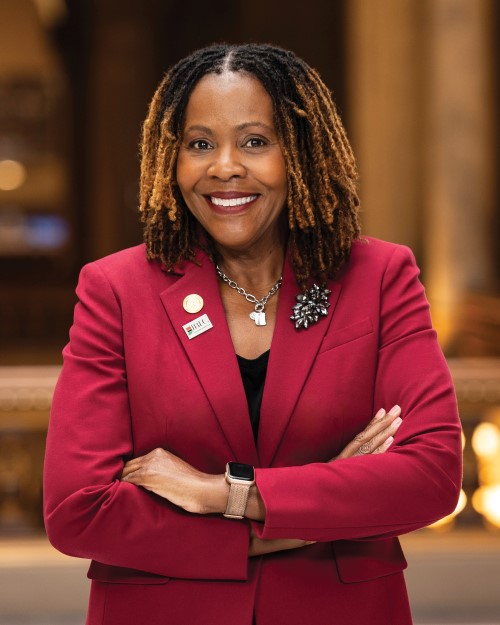
Rep. Robin Shackleford
Sponsored bills
Establishes the comprehensive student support program (program) for the purposes of: (1) funding the formation and staffing of school based and district level comprehensive student support teams; (2) improving staffing ratios for student support personnel; (3) supporting the creation, expansion, and work of multidisciplinary school teams to address the school environment, school safety, school improvement, and crisis intervention and emergency preparedness; and (4) professional development for student support personnel. Provides that the board of education administers the program. Establishes the comprehensive student support program fund for the purpose of funding the program, and annually appropriates to the fund $1,000,000 from cigarette tax revenue, registration fees, fines, and penalties deposited in the state general fund.
Adds "crime" and "juvenile justice" to the list of issues that the youth advisory council (council) is to provide information about to the general assembly. Modifies the membership of the council to include members who represent a racial minority and members who have been held in juvenile detention, are participating in or have participated in foster care, or are attending or have attended an alternative school. Provides that juvenile court judges, alternative schools, and community youth organizations shall appoint members to the council.
Celebrating Black History Month.
Allows pharmacists to prescribe and dispense self-administered oral hormonal contraceptives and hormonal contraceptive patches (contraceptives). Establishes requirements for pharmacists who want to prescribe and dispense contraceptives. Requires the Indiana board of pharmacy to adopt rules. Requires health plans to provide coverage for contraceptives and certain services. Establishes an exception for nonprofit religious employers.
Defines "principal dwelling land contract" (contract) as a land contract for the sale of real property: (1) designed for the occupancy of one to two families; and (2) that is or will be occupied by the buyer as the buyer's principal dwelling. Provides that the seller under a contract must provide the buyer with certain disclosures at least 10 days before the contract is executed. Sets forth disclosures that must be included in a contract. Provides a three day cancellation period for the buyer. Specifies certain recording provisions for principal dwelling land contracts. Permits a person to expunge records in connection with certain eviction actions in which the person was a defendant. Requires a landlord who denies an applicant's application for the rental of a dwelling unit based on information in a tenant screening report to provide the applicant with a copy of the tenant screening report. Adds a housing court as a problem solving court that may be established by a city court or a county court. Provides that a violation of disclosure provisions related to land contracts and a failure to investigate an alleged error in a tenant screening report constitute deceptive acts under the deceptive consumer sales act.
Provides that the state health data center (center) shall maintain statistics concerning race and ethnicity, sex, primary language, and disability status. (Under current law, the center is required to maintain statistics concerning gender and ethnicity.) Requires the center to adopt and implement the data collection standards established by the United States Department of Health and Human Services. Provides that the state department of health, with the assistance of the office of minority health, shall establish a cultural awareness and competence training program for health care professionals. Provides that a health care professional must complete two hours of cultural awareness and competence training each year.
Specifies that an individual's incarceration, hospitalization, or other temporary cessation in substance or chemical use may not be used as a factor in determining the individual's eligibility for coverage in: (1) a state employee health care plan; (2) Medicaid; (3) the healthy Indiana plan; (4) a policy of accident and sickness insurance; or (5) a health maintenance health care contract. Requires an opioid treatment program to: (1) provide a patient of the facility referral for continuing care before releasing the patient from care by the facility; and (2) counsel female patients concerning the effects of the program treatment if the female is or becomes pregnant and provide to the patient birth control if requested by the patient. Requires the division of mental health and addiction to annually perform an audit of 20% of an opioid treatment program facility's patient plans to ensure compliance with federal and state laws and regulations. Requires the division of mental health and addiction to establish a mental health and addiction program to reduce the stigma of mental illness and addiction. Requires hospitals to establish emergency room treatment protocols concerning treatment of a patient who is overdosing, has been provided an overdose intervention drug, or is otherwise identified as having a substance use disorder.
Requires Medicaid to provide community health services at a calendar month of either: (1) not more than 30 units; or (2) a greater monthly unit amount, as determined by the office of the secretary of family and social services. Includes community health workers as a provider of telemedicine under the Medicaid program.
Establishes the healthy food incubator program fund (fund) and healthy food incubator program (program) under the administration of the Indiana housing and community development authority (IHCDA). Provides that the purpose of the fund is to provide financing in the form of loans or grants for projects that increase the availability of fresh and nutritious food in underserved communities. Defines an "underserved community" as a census tract determined to be an area with low supermarket access: (1) by the United States Department of Agriculture; or (2) as identified through a methodology used by another healthy food initiative. Provides that the IHCDA may contract with one or more nonprofit organizations or community development financial institutions to administer the program through a public-private partnership. Provides that an applicant for a grant or a loan must demonstrate the capacity to successfully implement the project and the ability to repay the loan. Provides that an applicant for a grant or a loan must agree to satisfy certain conditions. Requires the IHCDA to monitor projects receiving financing and submit a report annually to the legislative council that includes the number and types of jobs created, and the health initiatives associated with the program. Continuously appropriates money in the fund. Makes an appropriation to the fund.