

Amends provisions, beginning July 1, 2027, regarding use of the Pokagon Indiana education fund to make payments to Indiana public or private institutions of higher learning or workforce development and training programs. Provides that, in addition to conditions established in current law to convert an existing public elementary or secondary school, an existing public elementary or secondary school may be converted into a charter school if certain other conditions apply. Allows, if the conditions are met, the governing body of a school corporation to: (1) convert more than one existing public elementary or secondary school within the school corporation; and (2) operate two or more conversion charter schools under a single charter. Prohibits the governing body of a school corporation from being the authorizer of a charter school and entering into or having a participating innovation network charter school agreement with the charter school at the same time. Amends provisions regarding participating innovation network charter schools to allow an organizer to enter into an agreement with more than one school corporation. Amends requirements regarding the location of a participating innovation network charter school and terms of an agreement. Amends the duties of the department of education with regard to participating innovation network charter schools. Makes conforming changes, including changes to the complexity index. Requires parental notification if a school determines a student is at risk of not achieving grade level proficiency in mathematics.
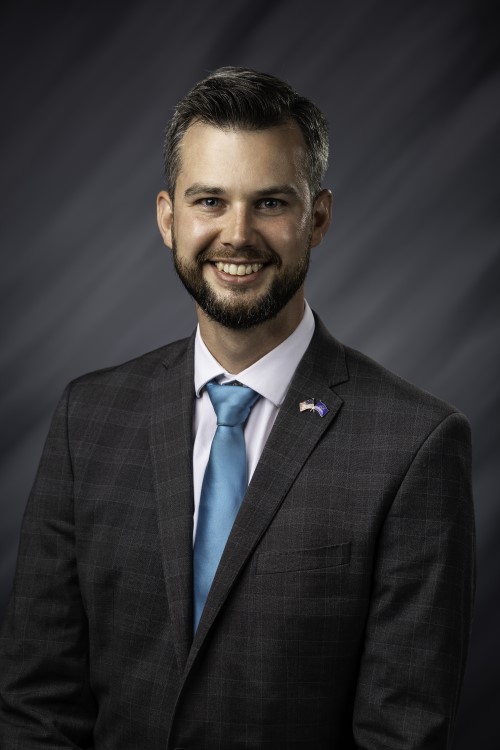
Rep. Ethan Lawson
Sponsored bills
Requires a vendor or provider of an ignition interlock device to register an ignition interlock device with the department of toxicology. Eliminates a requirement for the director of the state department of toxicology to provide periodic reports to the Indiana criminal justice institute (institute) regarding the number of ignition interlock devices used in Indiana. Provides that a registered ignition interlock device must be installed in a motor vehicle in accordance with the manufacturer's instructions for installing the registered ignition interlock device. Codifies administrative rules adopted by the state department of toxicology relating to ignition interlock devices. Provides that prior to being issued an initial license to operate a child care center, the child care center must be inspected and found to be in substantial compliance with applicable building and fire safety laws by the department of homeland security. (Current law provides that a license may be issued only if the child care center is in substantial compliance with the fire and life safety rules as determined by the state fire marshal under rules adopted by the division of family resources (division) or in accordance with a variance or waiver approved by the division.) Provides that prior to being issued an initial registration to operate a child care ministry, the unlicensed child care ministry must be inspected and found to be in substantial compliance with applicable building and fire safety laws by the department of homeland security. Provides that the department of homeland security shall perform inspections of: (1) child care ministries; (2) child care centers; (3) child caring institutions; and (4) group homes. Provides that a license or registration to operate a child care center or child care ministry may be revoked if the division determines that the operator has failed to comply with an order of the department of homeland security. Provides that the operator of an unlicensed child care ministry shall maintain a copy of the most recent department of homeland security inspection findings in a conspicuous place in the unlicensed child care ministry. Provides that the department of child services is not required to consult with the fire prevention and building safety commission when adopting administrative rules pertaining to the licensing and inspection of child care institutions, foster family homes, group homes, and child placing agencies. Provides that administrative rules of the fire prevention and building safety commission must include minimum building and safety requirements applicable for child caring institutions. Provides that prior to being issued an initial license to operate a child caring institution or group home, the child caring institution or group home must be inspected and found to be in substantial compliance with applicable building and fire safety laws by the department of homeland security. Provides that a license or registration to operate a child caring institution or group home may be revoked if the department of child services determines that the operator has failed to comply with an order of the department of homeland security. Provides that in order for an individual to receive a license from the emergency medical services commission, the individual must obtain a national criminal history background check and authorize release of the results of the check to the department of homeland security. Eliminates the requirement for the institute to adopt administrative rules relating to the child restraint system account. Provides that inspections conducted by the department of homeland security shall be conducted periodically in lieu of established periods. Changes a reference, from the department of education to the office of school safety, relating to the duties of a school safety specialist. Repeals: (1) provisions relating to public safety improvement areas; (2) a provision requiring the board of trustees of the institute to adopt rules relating to the law enforcement assistance fund; (3) a provision that authorizes the state fire marshal to charge a child care ministry a $50 fee for processing a registration; (4) a provision requiring the institute to review characteristics of offenders committed to the department of correction over such period of time it deems appropriate and of the offenses committed by those offenders in order to ascertain norms used by the trial courts in sentencing; (5) a provision requiring the bureau of motor vehicles and the institute to enter into a memorandum of understanding to administer the provisions relating to ignition interlock devices; and (6) a provision that requires the institute to adopt rules relating to ignition interlock devices.
Allows the alcohol and tobacco commission to issue a permit for the sale of alcoholic beverages on the grounds of a county fair conducted by a local board, subject to certain limitations and requirements. Adds participation in an event sponsored by a local board to the activities permissible within the scope of a permit held by a farm winery, a small brewer, an artisan distiller, a beer retailer, a liquor retailer, and a wine retailer. Adds the state fair and a county fair that is issued a permit to the exceptions to the minor loitering statute.
Maddy summarySB 12 prohibits local governments from using ranked choice voting in municipal or school board elections. It directly affects communities that had adopted or planned to adopt this voting method. The bill's key provision bans the implementation of ranked choice voting systems by local election authorities. The bill passed the House on January 20, 2026, with 38 votes in favor and 9 against. This legislation prevents any future use of ranked choice voting for local elections in the state.
Maddy summaryThis is a non-binding House resolution (HR 28) that formally recognizes the U.S. national debt as a threat to national security. It does not propose new laws or policies, but serves as a symbolic statement acknowledging the concern. The resolution was adopted unanimously by the House (91-0) on February 18, 2026, with multiple representatives added as co-authors. It directly affects congressional discourse but has no legal effect on debt management or security policies.
Moves, as a general rule, elections of town officers to even-numbered years. Allows a town with a population of more than 10,000 to opt out of the general rule by resolution. Allows a city to pass a resolution to opt in to the general rule. Makes conforming changes.
Maddy summaryHR 36 designates March 17, 2026, as "Profound Autism Day" and recognizes April as "National Autism Month" through a symbolic congressional resolution. The bill does not create new laws, allocate funding, or directly affect individuals or organizations - it serves solely as a formal recognition of autism awareness. It was introduced by Rep. Olthoff with 25 co-sponsors and passed its first reading on February 10, 2026. This type of resolution is common for ceremonial observances and has no binding policy impact.
A CONCURRENT RESOLUTION urging the Indiana Department of Transportation to rename that portion of U.S. Highway 30 from mile marker 15 to mile marker 16 the "Sergeant William Gilbert Paterson Memorial Mile".
Maddy summarySCR 8 is a concurrent resolution recognizing the importance of Indiana's horse racing industry to the state's economy and cultural heritage. It formally acknowledges the industry's contributions but does not create new laws, regulations, or funding. As a symbolic gesture, it has no direct effect on businesses, workers, or policy changes within the industry. This procedural resolution was referred to committees in early 2026 and remains pending.
A CONCURRENT RESOLUTION urging the Indiana Department of Transportation to rename the eastbound bridge on U.S. Highway 50 over Tanners Creek in Lawrenceburg the “Lary D. Fogle Memorial Bridge” and the westbound flyover bridge on U.S. Highway 50 in Lawrenceburg the “Thomas G. Denning Memorial Bridge”.