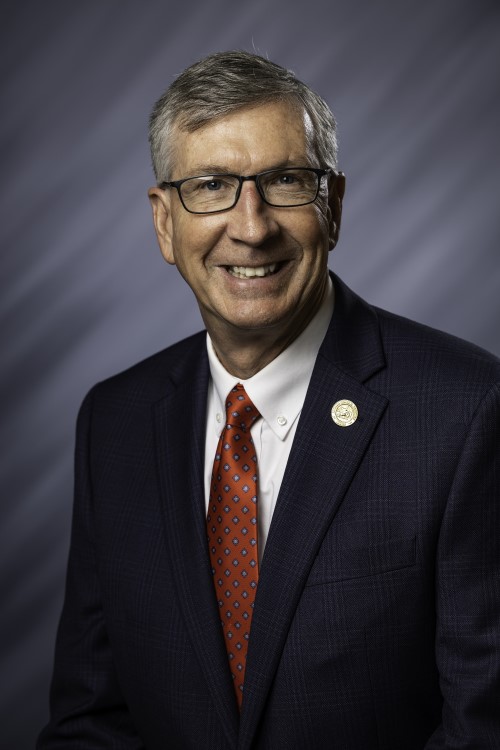
Photo of Jack Jordan
R Indiana House · District 17 On the 2026 ballot

Rep. Jack Jordan

Compare
Total votes
2,408
all sessions
Attendance
98%
38 missed
Near the chamber average
With party
97%
of cast votes
Near the chamber average
Bipartisan score
1%
crosses aisle rarely
Near the chamber average
Sponsored
156
bills & resolutions
Lower than 98% of chamber peers
Committees
3
assignments
156 bills and resolutions

Sponsored bills

Total
156
Primary
26
Co-sponsor
130
This page
156
matching current filters
Co-sponsor HB 1035
In committee · Indiana House · Co-sponsor
Elimination of school improvement plans.

Repeals the requirement that a public school or a state accredited nonpublic school develop an initial three year strategic and continuous school improvement and achievement plan. Removes language referencing school improvement and achievement plans.

In committee Jan 16, 2024 1 co-sponsor
Co-sponsor HB 1134
In committee · Indiana House · Co-sponsor
Local income tax.

Provides that, for the purpose of distributing the local income tax (LIT), if two or more school corporations or civil taxing units merge or consolidate to form a single school corporation or civil taxing unit, the school corporation or civil taxing unit is entitled to the combined pro rata distribution of the LIT revenue allocated to each applicable school corporation or civil taxing unit in existence on January 1 of the immediately preceding calendar year prior to the merger or consolidation. Provides that the department of local government finance shall make certain adjustments pertaining to the distribution of LIT for Floyd County in 2025, which provide that the Highlander Fire Protection District (district) shall receive an amount equal to the combined distribution that would have been distributed to the Greenville Fire Protection District (FPD) and the Lafayette Fire Protection District (FPD) in 2024, but for their elimination resulting from the merger to establish the district. Requires corresponding adjustments in 2025 to reduce the distribution for each applicable civil taxing unit and school corporation in Floyd County, excluding the district, by an amount that equals the proportionate share of the amount of LIT received in 2024 of the combined distribution that would have been distributed to the Greenville FPD and the Lafayette FPD in 2024, but for their elimination. Provides, for purposes of calculating distributions of the financial institutions tax to local taxing units, how to calculate distributions for a taxing unit that did not receive distributions in 2012 because the unit was subsequently established from the merger or consolidation of two or more taxing units that received distributions from the financial institutions tax fund in 2012. Provides, for purposes of calculating qualified distributions of the commercial motor vehicle excise tax to local taxing units, how to calculate base revenue distributions for a taxing unit that did not receive a base revenue distribution in 2001 because the taxing unit was subsequently established from the merger or consolidation of two or more taxing units that received base revenue distributions in 2001. Provides that, for purposes of determining the apportionment or distribution of the motor vehicle excise tax, that the county auditor may make adjustments to reflect the merger or consolidation of two or more taxing units. Makes technical corrections.

In committee Jan 16, 2024 1 co-sponsor
Co-sponsor HB 1623
Signed into law · Indiana House · Co-sponsor
Administrative law.

Establishes the government reform task force (task force). Provides for members of the task force. Requires the task force to submit a report. Prohibits the consideration of the number or amount of fines or civil penalties imposed on regulated entities by an employee in an agency's evaluation or compensation of the employee. Makes various procedural changes concerning the adoption of administrative rules, including the following: (1) Requires budget agency and office of management and budget review of a regulatory analysis of all proposed rules. (2) Requires a state budget committee review of rules adding or increasing fees, fines, or civil penalties. (3) Requires publication of the text of a proposed rule in the first public comment period and allows a proposed rule to be adopted after one public comment period if no substantive public testimony is received and the rule is not more stringent than applicable federal standards. (4) Replaces various laws granting emergency rulemaking authority with a description of the circumstances when emergency rulemaking (renamed "provisional" rules and "interim" rules) may be used, increases governor and attorney general oversight of provisional or interim rules, and adds a public comment period for interim rules. (5) Reduces from seven to five years the time in which rules need to be readopted to remain effective. (6) Requires agencies to webcast public hearings and allow remote testimony. Prohibits state standards for disposal of coal combustion residuals to be more stringent than federal standards. Allows for certain rules on certain pesticides that are more stringent than federal law. Permits a person to recover attorney's fees if an agency issues an order that is based on an invalid rule or issued without legal authority. Permits an applicant or licensee to recover damages if a professional or occupational licensing agency fails to adopt a rule required to obtain a license. Repeals superseded statutes and makes cross-reference, name, and other conforming changes.

Signed into law May 4, 2023 1 co-sponsor
Co-sponsor SB 417
Signed into law · Indiana Senate · Co-sponsor
Various tax matters.

Makes certain changes to the nonprofit organization sales tax exemption threshold after which nonprofit organizations are required to collect state sales tax. Authorizes a county to impose a local income tax (LIT) rate for county staff expenses of the state judicial system in the county. Provides that the expenses paid from the LIT revenue may not comprise more than 50% of the county's total budgeted operational staffing expenses related to the state judicial system in any given year. Requires certain reporting requirements related to the use of the LIT revenue. Specifies a three business day grace period following the postmark date of a document during which the department of state revenue will consider the document received to be timely filed for purposes of a due date. Makes certain changes to the nonprofit organization sales tax exemption threshold after which nonprofit organizations are required to collect state sales tax.

Signed into law May 4, 2023 1 co-sponsor
Co-sponsor SB 326
Signed into law · Indiana Senate · Co-sponsor
Professional sports and convention development areas.

Adds certain city facilities located in the city of South Bend to the tax area of the South Bend professional sports and convention development area (PSCDA). Increases the maximum amount of covered taxes that may be captured in the PSCDA from $2,000,000 to $5,000,000. Provides that the first $2,500,000 of captured taxes each year shall be transferred to the city of South Bend to be used for capital improvements for a facility owned by the city and used by a professional sports franchise. Provides that the remaining captured taxes each year shall be transferred to the city of South Bend to be used consistent with specified uses under current law. Provides that the South Bend PSCDA terminates not later than June 30, 2044. Increases the amount of revenue that may be captured in a PSCDA (other than a PSCDA in Allen County or South Bend) to an amount that may not exceed $10 (instead of $5 under current law) per resident. Authorizes the city of Fishers to establish a professional sports development area. Provides that, for a professional sports development area established in the city of Fishers, the maximum amount of covered taxes that may be captured is $2,000,000 per year. Specifies the uses of the captured tax revenue. Provides that the professional sports development area terminates not later than June 30, 2044.

Signed into law May 4, 2023 1 co-sponsor
Co-sponsor HB 1638
Signed into law · Indiana House · Co-sponsor
Education matters.

Requires the department of education (department) to report to the legislative council findings and recommendations for reducing the amount of redundant data that schools are required to submit to state agencies. Provides that a student presently enrolled in a public high school may retake a virtual course that was previously completed by the student at the same public high school under certain conditions. Provides that if a student elects to retake a virtual course, the retaken course must meet certain criteria. Provides that a student who has retaken a course before July 1, 2023, must receive full credit and a replacement grade for the course under certain conditions. Provides that the department shall require publication of a corrected graduation rate as prescribed by the department (instead of in the next school year's report). Provides that before July 1, 2024, the department may establish or license for use an online platform to provide certain required training programs. Moves up deadlines for recommending and approving streamlined academic standards in order to implement the new standards in the 2023-2024 school year. Provides that the department shall: (1) consider the skills, knowledge, and practices that are necessary to understand and utilize emerging technologies and that may be rendered obsolete by emerging technologies; (2) consider for removal any academic standards that may be obsolete as a result of emerging technologies; and (3) provide support to school corporations regarding the implementation of revised academic standards that have an emerging technologies component. Provides that individuals appointed to an academic standards committee must be racially and geographically diverse. Requires employers to report the employment of students enrolled in work based learning courses to the department of workforce development. Requires a secondary or postsecondary educational institution to ensure that a student's completion of a work based learning course is indicated on the student's transcript. Establishes a science of reading grant. Repeals: (1) the school corporation annual performance report law; (2) the charter school obligation to publish an annual performance report; (3) the performance based awards law; and (4) annual financial reports by school corporations.

Signed into law May 4, 2023 1 co-sponsor
Co-sponsor SB 486
Signed into law · Indiana Senate · Co-sponsor
Education matters.

Repeals teacher training requirements regarding: (1) criminal gang organizations awareness; (2) certain information concerning homeless students; and (3) recognizing the signs and symptoms of seizures and the appropriate steps to be taken to respond to the symptoms; and requires that information concerning these subjects be included within the curriculum of teacher preparation programs. Provides that the department of education (department) may establish or license for use an online platform to provide information and training concerning these and other subjects. Removes certain requirements regarding annual performance evaluation plans for certificated employees, including: (1) certain content requirements; and (2) certain requirements that a plan be discussed. Amends requirements to be considered a probationary teacher and professional teacher. Provides that, after a school corporation has assigned an evaluator to perform a certificated employee's evaluation, the certificated employee may request the school corporation to assign another evaluator. Urges the legislative council to assign to an appropriate interim study committee the task of studying current school assessments in an effort to reduce and streamline assessments for Indiana students. Removes a provision that requires a school employer to discuss certain items with the exclusive representative of certificated employees and provides that a school employer may discuss: (1) with a certificated employee or group of certificated employees; or (2) at one or more meetings that are open to all certificated employees; any topic that significantly impacts a certificated employee's working conditions or impacts the educational quality of the school employer's students. Repeals provisions concerning: (1) requirements regarding the adoption of model evaluation plans and an approval process for the plans; (2) the obligation to discuss certain items not requiring either party to enter into a contract, agree to a proposal, or make a concession; and (3) the definition of "discuss" for purposes of the collective bargaining provisions.

Signed into law May 4, 2023 1 co-sponsor
Co-sponsor HB 1008
Signed into law · Indiana House · Co-sponsor
Pension investments.

Specifies certain entities, actions taken, or factors considered to which the ESG commitment provisions do not apply. Provides that if the treasurer of state concludes that the service provider has made an ESG commitment, the treasurer of state shall provide the name of the service provider and research supporting the conclusion to the board of trustees of the Indiana public retirement system (board). Prohibits the board from making an investment decision with the purpose of influencing any social or environmental policy or attempting to influence the governance of any corporation for nonfinancial purposes. Prohibits the Indiana public retirement system (system) from making an ESG commitment with respect to system assets. Provides that in making and supervising investments of the system, the board shall discharge its duties solely in the financial interest of the participants and beneficiaries of the system for the exclusive purposes of providing financial benefits to participants and beneficiaries and defraying reasonable expenses of administering the system. Provides that the board, in accordance with certain fiduciary duties, shall make investment decisions with the primary purpose of maximizing the target rate of return on the board's investments. Prohibits the board from entering a contract or modifying, amending, or continuing a contract with a service provider that has made an ESG commitment unless taking the action violates the board's fiduciary duty to the system's participants and beneficiaries. Requires the board to continue contracting with a service provider that has made an ESG commitment if the board determines that there is not a comparable service provider to replace the service provider. Requires the board to, at least annually, tabulate and report all proxy votes made by a service provider that is not a private market fund in relation to the administration of the system. Specifies certain persons and entities that are immune from civil liability and entitled to indemnification. Requires the board to: (1) ensure that reasonable efforts are made during the due diligence process before an investment is made and in monitoring investments in the public employees' defined contribution plan, an annuity savings account for the public employees' retirement fund or the Indiana state teachers' retirement fund, the teachers' defined contribution plan, the legislators' defined contribution plan, and a private market fund to determine whether any investments would violate the requirement that the board discharge its duties solely in the financial interest of the participants and beneficiaries of the system; and (2) take appropriate action, if necessary, consistent with the board's fiduciary duties. Defines terms and makes conforming amendments.


Signed into law May 4, 2023 1 co-sponsor
Co-sponsor HB 1200
Signed into law · Indiana House · Co-sponsor
Alcoholic beverages and tobacco.

Adds the following to the definition of "entertainment complex": (1) A premises located within a five mile (instead of four mile) radius of the center of a consolidated city. (2) A premises used as a museum of fine arts. (3) A premises that has a 200 person audience capacity and artist housing. Provides that a primary source of supply, manufacturer, or wholesaler may supply equipment on a temporary and nondiscriminatory basis to the holder of a retailer permit or a temporary permit for the purpose of holding, storing, and dispensing product to consumers for a special event for the duration of the special event. Makes the following changes regarding breweries: (1) Removes a requirement that the 90,000 barrel limit per calendar year applies to beer manufactured at a brewery located in Indiana. (2) Allows a small brewery to receive, bottle, and package beer from another small brewery if certain requirements are met. (3) Allows a small brewery to sell or transfer beer to certain food manufacturers for the purpose of adding or integrating the beer into a product or recipe. (4) Provides that a product that contains transferred beer may not contain more than 0.5% of alcohol by volume when the product leaves the food manufacturer's facility. Provides for permits for beer or liquor dealer employees who deliver alcoholic beverages. Increases, within a certain historic district, the number of alcoholic beverage restaurant permits from 10 to 15, and changes certain other requirements. Allows the alcohol and tobacco commission (commission) to issue a certain number of three-way permits to sell alcoholic beverages for on-premises consumption in the: (1) cities of Auburn, Kendallville, and Warsaw; and (2) towns of Winona Lake and Syracuse. Permits the issuance of three new three-way permits and three new two-way permits to the town of Whitestown. Requires the commission to issue a beer dealer's permit and a wine dealer's permit to an eligible grocery store. Increases the limit on the amount of liquor that an artisan distiller may produce in a calendar year from 10,000 to 20,000 gallons. Amends the conditions in which a minor can lawfully be in a room on a licensed premises in which is located a bar over which alcoholic beverages are sold or dispensed by the drink. Modifies the definition of "tobacco product", for purposes of the law concerning issuance of a tobacco sales certificate, to include a product that contains nicotine and is not approved by the federal Food and Drug Administration for tobacco cessation. Provides that an e-liquid distributor shall purchase and distribute e-liquid from an: (1) Indiana e-liquid manufacturer that has a valid e-liquid manufacturing permit; or (2) Indiana e-liquid distributor that has a valid e-liquid manufacturing permit or a valid tobacco distributor's license.

Signed into law May 4, 2023 1 co-sponsor
Co-sponsor HB 1528
Signed into law · Indiana House · Co-sponsor
Next generation Hoosier educators scholarship program.

Provides that an individual enrolled in a transition to teaching program may apply for a one time scholarship under the next generation Hoosier educators scholarship program. Establishes requirements to qualify for the one time scholarship. Provides that the maximum amount of a scholarship is $10,000. Provides that the total annual amount of scholarships awarded from the next generation Hoosier educators scholarship fund to individuals enrolled in a transition to teaching program may not exceed $1,000,000. Requires that an awarded scholarship must be repaid under certain conditions.

Signed into law May 4, 2023 1 co-sponsor
Showing 51 to 60 of 156 bills
Previous 1 … 5 6 7 … 16 Next