

FEMA Climate Change Preparedness Act This bill requires the Federal Emergency Management Agency (FEMA) to (1) revise its 2018-2022 Strategic Plan to ensure that the plan explicitly mentions climate change and addresses the implications of climate change on homeland security and near- and long-term national disaster risk, and (2) ensure that future strategic plans do likewise. The Department of Homeland Security must establish, as a subcommittee of the National Advisory Council, the Climate Change Subcommittee, which shall advise FEMA on how to best incorporate climate change, including risk assessments and strategies for adaptation and mitigation, into and throughout FEMA's policies, plans, programs, and operations. FEMA must publish as a report, submit to specified congressional committees, and make available to Congress and the public, a comprehensive assessment of climate change risks and preparedness.
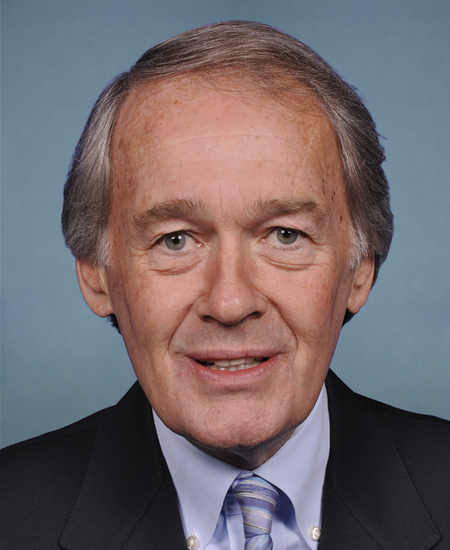
Sen. Edward J. Markey
Sponsored bills
Coronavirus Vaccine Act This bill directs the National Institute of Allergy and Infectious Diseases to conduct or support research to develop a universal coronavirus vaccine.
Hong Kong Safe Harbor Act This bill designates certain Hong Kong residents with priority status for refugee consideration and contains other related provisions. An individual and certain family members shall have such priority status if the individual (1) is a Hong Kong resident who suffered persecution or has a well-founded fear of persecution as a result of peaceful political activity; or (2) has been formally charged, detained, or convicted for certain peaceful actions. An individual receiving refugee status under this bill shall not be counted against various numerical limitations. When determining whether an individual shall be admitted as a refugee, an individual whose citizenship, nationality, or residency was revoked for submitting a nonfrivolous application for a U.S. immigration benefit shall be considered to have suffered persecution on account of political opinion. The general presumption that an alien is seeking immigrant status shall not apply to certain Hong Kong residents seeking asylum into the United States. (Typically, an alien seeking admission as a nonimmigrant must establish that the alien does not intend to immigrate to the United States.) This exception to the presumption shall apply to certain individuals involved in the 2019 and 2020 protests against China's encroachment into Hong Kong's autonomy (Hong Kong is a part of China but has a separate legal and economic system). An individual from Hong Kong may not be denied admission into the United States if the primary reason for the denial is a politically motivated government action against the individual's involvement in protests.
Medicaid Reentry Act of 2021 This bill allows Medicaid payment for medical services furnished to an incarcerated individual during the 30-day period preceding the individual's release. The Medicaid and Children's Health Insurance Program (CHIP) Payment and Access Commission must report on specified information relating to the accessibility and quality of health care for incarcerated individuals, including the impact of the bill's changes.
National Office of New Americans Act This bill establishes the National Office of New Americans (NONA) within the Executive Office of the President to promote and support the integration of immigrants and refugees into the social, cultural, economic, and civic life of the United States. The NONA shall also establish the Federal Initiative on New Americans. The initiative shall establish a coordinated federal program to respond effectively to immigrant and refugee integration issues such as language learning, adult education and workforce training, health care, and naturalization.
Safe Environment from Countries Under Repression and Emergency Act or the SECURE Act This bill allows qualified nationals of a country that has or had a temporary protected status designation to obtain permanent resident status. Such an alien qualifies for permanent residence if the alien had temporary protected status, qualified for such status on certain dates, or was present in the United States due to having been granted deferred enforced departure status that extended past a certain date; has been continuously present in the United States for three years before applying for adjustment or before being removed after a certain date; is not inadmissible or deportable for certain reasons; and passes applicable background checks. The continuous presence requirement may be waived in certain instances. A spouse, domestic partner, child, or unmarried child of a qualifying alien may also obtain permanent resident status under the bill upon meeting certain requirements. An alien with a pending application shall receive work authorization and be eligible for travel authorization. An alien may not be removed if the alien (1) has a pending application, or (2) is prima facie eligible for permanent resident status under this bill and intends to apply. Information from applications may not be used or shared for immigration enforcement, with limited exceptions such as for identifying fraudulent claims. The Department of Homeland Security must report to Congress when terminating a country's temporary protected status designation with an explanation justifying the termination.
Arctic Refuge Protection Act of 2021 This bill designates approximately 1,559,538 acres of land within Alaska in the Arctic National Wildlife Refuge as a component of the National Wilderness Preservation System.
Gun Violence Prevention Research Act of 2021 This bill authorizes the Centers for Disease Control and Prevention to conduct or support research on firearms safety or gun violence prevention.
Essential Transportation Employee Safety Act of 2021 This bill requires the Department of Transportation (DOT) to support the efforts of state and local governments to prioritize COVID-19 (i.e., coronavirus disease 2019) testing of transportation workers who are categorized as essential critical infrastructure workers. Essential critical infrastructure employees include those who work in industries such as medical and health care, telecommunications, information technology systems, defense, food and agriculture, transportation and logistics, energy, water and wastewater, law enforcement, and public works. Additionally, during the COVID-19 pandemic, DOT must require (1) the owners and operators of equipment or facilities used by passenger or freight transportation employers to implement personal protective equipment and disinfection and sanitization procedures; and (2) an air carrier to submit to the Federal Aviation Administration (FAA) a proposal to permit pilots to wear masks or protective face coverings in the flight deck, including a safety risk assessment with respect to such proposal. The bill sets forth requirements for owners or operators who cannot acquire necessary personal protective equipment due to market unavailability. For the duration of the COVID-19 national emergency, the FAA must (1) provide certain employees, including air traffic controllers and airway transportation systems specialists, with personal protective and sanitizing equipment; (2) ensure that air traffic control facilities are cleaned, disinfected, and sanitized frequently; and (3) ensure its contractors provide their employees with personal protective equipment.
Research Investment to Spark the Economy Act of 2021 or the RISE Act of 2021 This bill authorizes the Departments of Agriculture, Commerce, Defense, Education, Energy, the Interior, Health and Human Services, and Transportation, National Aeronautics and Space Administration (NASA), National Science Foundation, and Environmental Protection Agency to provide support for research regarding COVID-19 (i.e., coronavirus disease 2019) or research disrupted by the COVID-19 pandemic. Support may be used to provide supplemental funding to extend the duration of a grant to a research institution, national laboratory, or individual that was awarded prior to the enactment of this bill, or to expand the purposes of such a grant as specified; issue awards to research the effects of the current pandemic and potential future pandemics; and provide flexibility on awards to account for facility closures or other limitations during the COVID-19 public health emergency. Agencies must provide the support as rapidly as possible. Provided funds shall remain available through FY2021.