

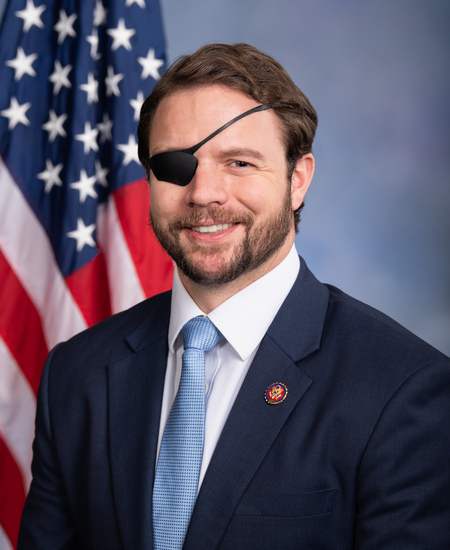
Photo of Dan Crenshaw
R United States House · District 2 · Texas

Rep. Dan Crenshaw

Compare
Total votes
2,818
all sessions
Attendance
92%
222 missed
Lower than 89% of chamber peers
With party
95%
of cast votes
Higher than 82% of chamber peers
Bipartisan score
3%
crosses aisle rarely
Lower than 81% of chamber peers
Sponsored
1,056
bills & resolutions
Near the chamber average
Committees
7
assignments
1,056 bills and resolutions

Sponsored bills

Total
1,056
Primary
75
Co-sponsor
981
This page
1,056
matching current filters
Co-sponsor HR 4299
In committee · Illinois House · Co-sponsor
Protecting Patient Access to Cancer and Complex Therapies Act

Maddy summaryThis bill requires drug manufacturers to pay rebates to Medicare when their "selected drugs" (cancer and complex therapies subject to negotiated maximum fair prices) are used. Manufacturers must calculate rebates based on the difference between current Medicare payment rates (ASP+6) and new negotiated rates (MFP+6), covering the gap for beneficiaries. This lowers patient coinsurance from the current 20% of ASP+6 to 20% of MFP+6 for these specific drugs during the negotiated price period. The rebates are paid to the Medicare trust fund and apply to Medicare Part B beneficiaries using these drugs, directly affecting drug manufacturers and patients covered under Medicare Part B.

In committee Jul 7, 2025 1 co-sponsor
Co-sponsor HR 4191
In committee · Illinois House · Co-sponsor
MAPS Act

Maddy summaryThe MAPS Act requires the U.S. Department of Health and Human Services to maintain an Essential Medicines List focusing on drugs critical for public health emergencies, high-risk shortages, and chronic conditions. It mandates annual risk assessments of supply chains for these medicines, identifying vulnerabilities like single-source suppliers or foreign dependencies, and requires mapping of manufacturing and distribution pathways. The law directs HHS to publish the list and submit annual reports to Congress on supply chain risks, including cybersecurity threats and gaps in domestic manufacturing. This directly affects national health security planning and federal efforts to prevent drug shortages impacting patients and emergency response systems.

In committee Jun 26, 2025 1 co-sponsor
Co-sponsor HR 4207
In committee · Illinois House · Co-sponsor
No WHO Pandemic Preparedness Treaty Without Senate Approval Act

Maddy summaryThis bill requires the U.S. government to treat any World Health Organization (WHO) pandemic prevention or response agreement as a treaty needing Senate approval with a two-thirds vote. It directly affects U.S. foreign policy decisions regarding WHO agreements, ensuring the Senate must consent before such treaties take effect. The bill mandates that any WHO pandemic agreement - like the one adopted at the 2025 World Health Assembly - must follow the constitutional treaty process, not be implemented as a less formal executive agreement. This policy change aims to address concerns about WHO's pandemic management and independence, as highlighted by congressional findings.

In committee Jun 26, 2025 1 co-sponsor
Primary HR 4165
In committee · Illinois House · Lead sponsor
To amend the Public Health Service Act to provide for the inclusion of a biological attribution strategy, and an early warning strategy and implementation plan, in the National Health Security Strategy, and for other purposes.

Maddy summaryThis bill requires federal health agencies to develop two new strategies within the National Health Security Strategy. First, a "biological attribution strategy" to clarify which agencies handle identifying the source of biological threats (like disease outbreaks) and how they coordinate, including using new technologies for detection. Second, an "early warning strategy" focused on rapidly spotting emerging health threats (biological, chemical, or radiological) through tools like wastewater testing and airport screenings, while avoiding duplicated efforts. It mandates coordination with state health departments, private labs, and intelligence agencies to streamline response capabilities. The bill directly affects federal agencies (like CDC and National Intelligence) and their coordination with state/local partners, without creating new funding or altering existing laws.

In committee Jun 26, 2025 0 co-sponsors
Co-sponsor HR 4107
In committee · Illinois House · Co-sponsor
GOLDEN DOME Act of 2025

Maddy summaryThe GOLDEN DOME Act of 2025 establishes a comprehensive homeland missile defense system designed to protect U.S. citizens and critical infrastructure from ballistic, hypersonic, cruise, and unmanned system threats. The bill creates a new Golden Dome Direct Report Program Manager with significant authority to accelerate development, testing, and deployment of integrated missile defense capabilities across all domains (land, sea, air, space, and cyberspace). It requires a holistic strategy with all-domain awareness, mandates accelerated testing schedules including live-fire exercises, and allocates specific funding for components like space-based sensors, interceptors, and command and control systems. The legislation also includes provisions to protect the space industrial base and secure critical supply chains for missile defense systems.

In committee Jun 24, 2025 1 co-sponsor
Co-sponsor HJRES 87
Signed into law · Illinois House · Co-sponsor
Providing congressional disapproval under chapter 8 of title 5, United States Code, of the rule submitted by the Environmental Protection Agency relating to "California State Motor Vehicle and Engine Pollution Control Standards; Heavy-Duty Vehicle and Engine Emission Warranty and Maintenance Provisions; Advanced Clean Trucks; Zero Emission Airport Shuttle; Zero-Emission Power Train Certification; Waiver of Preemption; Notice of Decision".

Maddy summaryH.J. Res. 87 (Public Law 119-15) is a congressional disapproval resolution that prevents an Environmental Protection Agency (EPA) rule from taking effect. The rule, submitted by the EPA on April 6, 2023 (88 Fed. Reg. 20688), related to California’s authority to enforce stricter vehicle emission standards, including for heavy-duty trucks, zero-emission airport shuttles, and advanced clean truck requirements. By disapproving this rule, Congress blocks California from implementing these specific pollution controls under its existing waiver authority. This directly affects California’s ability to regulate motor vehicle emissions independently, as the rule would have allowed the state to enforce its own standards beyond federal requirements.

Signed into law Jun 12, 2025 1 co-sponsor
Co-sponsor HJRES 88
Signed into law · Illinois House · Co-sponsor
Providing congressional disapproval under chapter 8 of title 5, United States Code, of the rule submitted by the Environmental Protection Agency relating to "California State Motor Vehicle and Engine Pollution Control Standards; Advanced Clean Cars II; Waiver of Preemption; Notice of Decision".

Maddy summaryH.J.Res. 88 disapproves an Environmental Protection Agency (EPA) rule that would have allowed California to enforce its "Advanced Clean Cars II" vehicle emission standards. This rule, submitted by the EPA on January 6, 2025, sought to grant California a waiver to override federal preemption for its stricter vehicle pollution controls. The resolution, passed by Congress and signed into law on June 12, 2025, formally nullifies the EPA rule, preventing California from implementing its Advanced Clean Cars II program under this specific waiver. The bill directly affects California's ability to set its own vehicle emission standards for passenger cars and light trucks.

Signed into law Jun 12, 2025 1 co-sponsor
Co-sponsor HJRES 89
Signed into law · Illinois House · Co-sponsor
Providing congressional disapproval under chapter 8 of title 5, United States Code, of the rule submitted by the Environmental Protection Agency relating to "California State Motor Vehicle and Engine and Nonroad Engine Pollution Control Standards; The "Omnibus" Low NOX Regulation; Waiver of Preemption; Notice of Decision".

Maddy summaryHJRES 89 is a congressional disapproval resolution that blocks an Environmental Protection Agency (EPA) rule concerning California's vehicle and engine pollution standards. The resolution specifically targets the EPA's "Omnibus Low NOX Regulation" and waiver of preemption, which would have allowed California to enforce stricter emissions rules. By disapproving this rule under Chapter 8 of Title 5 U.S. Code, Congress has nullified the EPA's action, meaning the regulation will have no legal effect. This directly affects the EPA's authority to approve California's state-level pollution control standards for motor vehicles.

Signed into law Jun 12, 2025 1 co-sponsor
Co-sponsor HR 3921
In committee · Illinois House · Co-sponsor
STOP CSAM Act of 2025

Maddy summaryThe STOP CSAM Act of 2025 would strengthen protections for child victims and witnesses in federal court by creating a new definition of "covered person" to include minors under 18 who are victims or witnesses of abuse, exploitation, or kidnapping. The bill requires internet service providers to report apparent child sexual exploitation to the CyberTipline within 60 days, with civil penalties of $50,000-$250,000 per violation and criminal fines up to $1 million for non-compliance. It also creates new civil remedies allowing victims to sue platforms that host or promote child sexual exploitation, with minimum $300,000 in damages. Additionally, large platforms would be required to submit annual reports to the Attorney General and FTC detailing their safety measures and child exploitation on their platforms.

In committee Jun 11, 2025 1 co-sponsor
Primary HR 3859
In committee · Illinois House · Lead sponsor
Returning Illegals over Turmoil Act

Maddy summaryThis bill would make non-citizens deportable if they incite or participate in riots during civil unrest involving assaults on law enforcement or military personnel, or destruction of public property, and who were unlawfully present, had DACA, or were lawful permanent residents at the time of the offense. It permanently bars such individuals from reentering the U.S. or accessing any relief from deportation, including asylum, cancellation of removal, or future DACA benefits. During declared emergencies (such as national disasters or state emergencies), the law mandates expedited removal and mandatory detention for those covered, with no discretion for enforcement.

In committee Jun 10, 2025 0 co-sponsors
Showing 121 to 130 of 1,056 bills
Previous 1 12 13 14 106 Next