

PrEP Access and Coverage Act This bill requires private health insurance plans to cover prescription drugs that prevent HIV, including related screenings, diagnostic procedures, administrative fees, and clinical follow-ups, without any cost-sharing obligation for the plan holder. Further, insurance plans must not impose any preauthorization requirement for this coverage. These coverage requirements also apply to public health insurance programs, including Medicare, Medicaid, and the Children's Health Insurance Program. Additionally, the bill prohibits denying, limiting, or qualifying coverage or increasing premiums for disability insurance, long-term care insurance, or life insurance policies based on an individual taking medication for HIV prevention. The bill further requires the Department of Health and Human Services to award grants to states, or directly to eligible local organizations, to provide uninsured individuals and underinsured individuals access to prescription drugs and related services that prevent HIV. The Centers for Disease Control and Prevention also must develop a public awareness campaign that focuses efforts in communities with a high need for HIV prevention treatment.
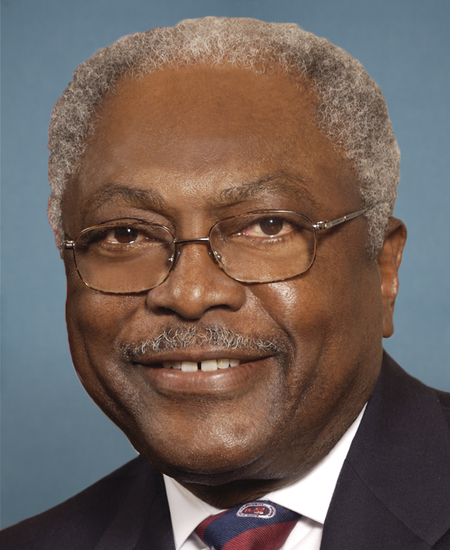
Rep. James E. Clyburn
Sponsored bills
Maddy summaryHRES 834 is a ceremonial resolution honoring the late Congresswoman Carrie Pittman Meek (1926-2021) for her congressional service and legacy. It commends her dedication to public service, her role as a trailblazer for Black women in politics, and her advocacy for communities in Florida. The resolution specifically recognizes her work securing hurricane relief funding after Hurricane Andrew and her service in the Florida State Senate and U.S. Congress. As a commemorative resolution, it contains no policy changes or funding provisions.
This bill modifies factors that must be considered in allocating community development disaster recovery block grants. Specifically, the bill prohibits the Department of Housing and Urban Development (HUD) from establishing a minimum threshold dollar amount when determining whether a ZIP code's damages related to housing are sufficient to qualify. Instead, the bill requires HUD to consider any ZIP code for which the median household income is less than 75% of the national median household income as having sufficient damage for that purpose.
Sgt. Isaac Woodard, Jr. and Sgt. Joseph H. Maddox GI Bill Restoration Act of 2021 This bill expands eligibility for Post-9/11 GI bill educational assistance benefits and the Department of Veterans Affairs (VA) home loan program. Specifically, the bill explicitly includes the following persons as eligible veterans: Black veterans who served on active duty during World War II who can certify they were denied a specific benefit on the basis of race; and the living surviving spouses, children, grandchildren, or other direct descendants of such veterans described above who can certify the veteran was denied a specific benefit on the basis of race. Such veterans described above must apply for educational or home loan benefits within the five-year period after the passage of this bill to be eligible for benefits. The Government Accountability Office must report on the number of individuals who received educational or housing loan benefits and the total value of such benefits administered by the VA due to the amendments made by the bill. Finally, the VA must appoint a panel of independent experts to develop recommendations regarding additional benefits and assistance for female and minority members of the Armed Forces.
Catawba Indian Nation Lands Act This bill ratifies and confirms the actions of the Department of the Interior to take into trust approximately 17 acres of land in Cleveland County, North Carolina, for the benefit of the Catawba Indian Nation. The land is made part of the Catawba Reservation. The bill allows gaming on the land taken into trust for the tribe.
Social Security 2100: A Sacred Trust This bill makes changes to Social Security benefits, taxes, and other aspects of the program, including by raising the primary insurance amount, increasing the maximum taxable earnings that are subject to Social Security payroll taxes, and requiring Social Security account statements to be mailed unless the individual recipient opts for electronic delivery.
Voter Empowerment Act of 2021 This bill expands voter registration and voting access. Specifically, the bill expands voter registration by requiring states to (1) make available online voter registration, (2) establish automatic voter registration systems, (3) permit same-day voter registration, and (4) accept voter registration applications from individuals under age 18. Further, the bill limits removing voters from voter rolls and prohibits interference with voter registration or voting. Next, the bill requires states to allow individuals with disabilities to use absentee registration procedures and to vote by absentee ballot in federal elections. The bill also prohibits voter caging (the practice of sending mail to addresses on voter rolls, compiling a list of the undeliverable mail, and using the list to remove registered voters from voter rolls). Next, the bill expands voting access by requiring states to allow early voting and voting by mail without additional conditions. It also requires states to provide secured drop boxes at which individuals may drop off their completed absentee ballots. In addition, the bill declares that the right of a U.S. citizen to vote in any federal election shall not be denied or abridged because that individual has been convicted of a criminal offense unless, at the time of the election, such individual is serving a felony sentence. Finally, the bill permanently reauthorizes the Election Assistance Commission (EAC). It also directs the EAC to make grants to states for specified activities, including to implement automatic voter registration systems.
Maddy summaryHR 1041 would permanently remove the statutory debt ceiling by repealing sections 3101 and 3101A of title 31, U.S. Code. This would eliminate the legal limit on how much the federal government can borrow to pay its existing obligations. The bill directly affects the Treasury Department's borrowing authority, allowing it to issue debt without needing congressional approval for each increase. It represents a structural change to federal fiscal management, removing a recurring legislative hurdle. The bill does not alter current spending or revenue levels.
John R. Lewis Voting Rights Advancement Act of 2021 This bill establishes new criteria for determining which states and political subdivisions must obtain preclearance before changes to voting practices may take effect. Preclearance is the process of receiving preapproval from the Department of Justice (DOJ) or the U.S. District Court for the District of Columbia before making legal changes that would affect voting rights. A state and all of its political subdivisions shall be subject to preclearance of voting practice changes for a 10-year period if 15 or more voting rights violations occurred in the state during the previous 25 years; 10 or more violations occurred during the previous 25 years, at least 1 of which was committed by the state itself; or 3 or more violations occurred during the previous 25 years and the state administers the elections. A political subdivision as a separate unit shall also be subject to preclearance for a 10-year period if three or more voting rights violations occurred there during the previous 25 years. States and political subdivisions that meet certain thresholds regarding minority groups must preclear covered practices before implementation, such as changes to methods of election and redistricting. Further, states and political subdivisions must notify the public of changes to voting practices. Next, the bill authorizes DOJ to require states or political subdivisions to provide certain documents or answers to questions for enforcing voting rights. The bill also outlines factors courts must consider when hearing challenges to voting practices, such as the extent of any history of official voting discrimination in the state or political subdivision.
Harlem Hellfighters Congressional Gold Medal Act This bill provides for the award of a Congressional Gold Medal to the 369th Infantry Regiment, commonly known as the Harlem Hellfighters, in recognition of their bravery and outstanding service during World War I.