Stop Foreign Donations Affecting Our Elections Act This bill requires political committees, when accepting a credit card contribution over the internet, to collect the credit card's verification value. The card's billing address must be in the United States unless the contributor is a U.S. citizen living outside of the United States, in which case the contributor must provide his or her voter registration address.
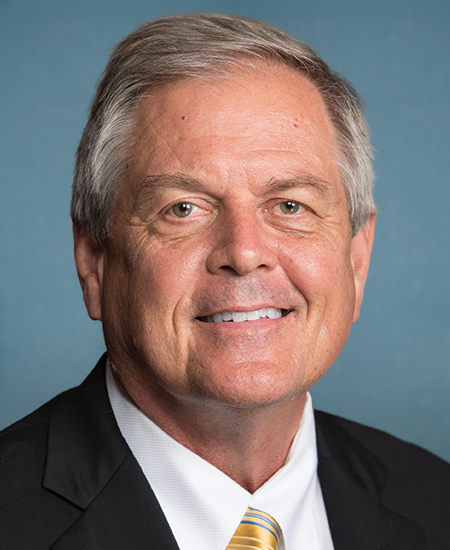
Rep. Ralph Norman
Sponsored bills
Creating Hope and Opportunity through Increased Choice in Education Act or the CHOICE Act This bill directs the Department of Education to make grants to parents of eligible students for certain education-related expenses. Eligible student refers to a student who (1) is served by a local educational agency that will not provide in-person instruction in a manner consistent with the 2019-2020 school year, and (2) is from a household with a household income that is less than 200% of the reduced-price lunch rate income. Grant funds may be used for tuition and fees for private elementary or secondary schools, private tutoring, home school expenses, or educational materials.
Retirement Freedom Act This bill allows an individual to opt out of Medicare hospital services benefits without also having to opt out of Old Age, Survivors, and Disability Insurance benefits and without having to repay Medicare hospital services benefits already received. The bill also allows an individual to opt back in with no penalty.
Opposing Business with Chinese Military Companies Act This bill requires the President to exercise certain economic powers, such as investigating or prohibiting payments, with respect to an entity that is engaging in economic activities in the United States and is (1) affiliated with China's government or military, or (2) owned or controlled by an entity affiliated with China's defense industrial base. (The President currently has such powers but is not required to exercise them.) The bill extends to December 31, 2026, a provision requiring the Department to Defense to annually report to Congress an updated list of such entities.
This resolution requests that the President transmit to the House of Representatives documents related to the amount of funding that was provided in specified laws regarding COVID-19 (i.e., coronavirus disease 2019) and is currently unspent. The specified laws include the Coronavirus Preparedness and Response Supplemental Appropriations Act, 2020; the Families First Coronavirus Response Act; the Coronavirus Aid, Relief, and Economic Security Act (CARES Act); the Paycheck Protection Program and Health Care Enhancement Act; and Division N of the Consolidated Appropriations Act, 2021.
Renewable Energy Certainty Act This bill authorizes long-term contracts for federal purchases of renewable energy and establishes related requirements. Specifically, the bill authorizes federal agencies to enter into contracts for the acquisition of energy generated from renewable energy sources or from cogeneration facilities for a period of up to 30 years. In addition, the bill requires the Federal Energy Management Program to publish a standardized energy purchase agreement that an agency may use for such an acquisition.
This joint resolution nullifies the action of the District of Columbia Council in approving the Minor Consent for Vaccinations Amendment Act of 2020, enacted by the council on December 23, 2020, and transmitted on February 1, 2021, to Congress pursuant to the District of Columbia Home Rule Act. The act authorizes a minor, 11 years of age or older, to consent to receive a vaccine if the minor is capable of meeting the informed consent standard and the vaccine is recommended by the United States Advisory Committee on Immunization Practices and will be provided in accordance with its recommended immunization schedule.
This resolution acknowledges the importance of the U.S.-Egypt partnership and Egypt's role in the fight against terrorism and violent extremism. It also urges the Egyptian government to (1) enact serious and legitimate reforms to ensure that Coptic Christians have the same rights and opportunities as other Egyptian citizens, (2) complete the process of church certification, and (3) take steps to end the culture of impunity for attacks on Christians.
Lessening Regulatory Costs and Establishing a Federal Regulatory Budget Act of 2021 This bill establishes procedures and provides statutory authority to reduce the number of federal regulations. Specifically, it requires each agency to establish a regulatory reform task force chaired by a designated regulatory reform officer. Each task force must, among other duties (1) review each existing agency regulation; (2) estimate the potential cost savings of repealing or modifying each regulation; and (3) identify regulations that are appropriate for repeal, replacement, or modification based on cost, effectiveness, and impact on employment. The bill further provides statutory authority for the executive order prohibiting agencies from issuing a new regulation with an economic impact of at least $100 million without identifying two regulations for repeal that will offset the cost of the proposed new regulation. Agencies also must submit a list of all planned regulatory actions for inclusion in the semiannual Unified Agenda of Federal Regulatory and Deregulatory Actions, including (1) the estimated economic effect of each action, and (2) proposed deregulatory actions to offset the cost of each proposed new regulation. Additionally, the Office of Management and Budget must establish an annual regulatory budget for each federal agency that specifies the net allowable increase in regulatory costs for each agency during the next fiscal year.

No taxpayer funding for United Nations Human Rights Council Act This bill prohibits the Department of State from making contributions to the United Nations Human Rights Council, either as a percentage of the U.S. contribution to the regular budget of the United Nations or as a voluntary contribution to the council.