

Amends the Juvenile Court Act of 1987. Provides that if a minor is committed to the Department of Juvenile Justice the clerk of the court shall forward to the Department all police reports for sex offenses allegedly committed or committed by the minor. Amends the Unified Code of Corrections. Provides that the Department of Juvenile Justice shall maintain and administer all State youth centers. Deletes provision permitting a person committed to the Department of Juvenile Justice to be isolated for disciplinary reasons. Provides that all sentences imposed by an Illinois court under the Code shall run concurrent to any and all sentences under the Juvenile Court Act of 1987. Provides that the target release date for youth committed to the Department as a Habitual Juvenile Offender or Violent Juvenile Offender under the Juvenile Court Act of 1987 shall be extended by not less than 12 months. Creates the Department of Juvenile Justice Reimbursement and Education Fund in the State treasury. Amends the State Finance Act to make conforming changes. House Floor Amendment No. 1 Adds an immediate effective date to the bill.
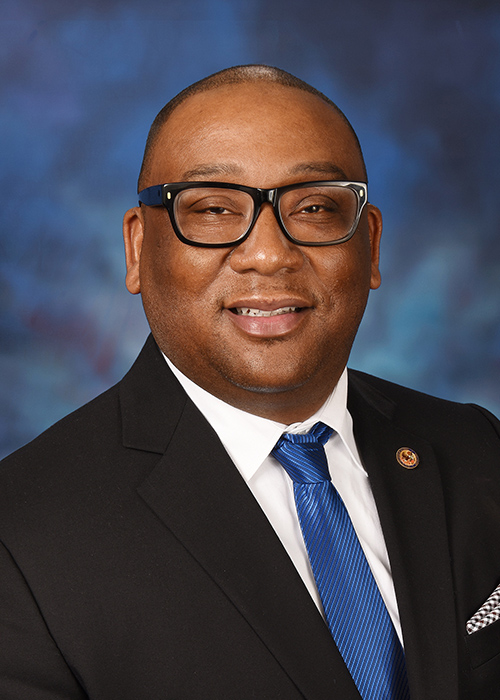
Sen. Christopher Belt
Sponsored bills
Amends the Dual Credit Quality Act. Makes a technical change in a Section concerning the short title. Senate Floor Amendment No. 1 Deletes reference to: 110 ILCS 27/1 Adds reference to: 105 ILCS 5/2-3.182 new Replaces everything after the enacting clause. Amends the School Code. Requires the State Board of Education to develop and implement a School Unused Food Program that allows public schools in this State to provide food that is unused by the school to needy children who are students of that school. Provides that unused food under the Program shall be provided at no cost to the student. Provides that a school participating in the Program may contract with third parties to provide services under the Program. Provides for the adoption of rules. Defines "needy children". Effective immediately. House Committee Amendment No. 1 Adds reference to: 110 ILCS 805/3-8 from Ch. 122, par. 103-8 110 ILCS 805/3-10 from Ch. 122, par. 103-10 110 ILCS 805/3-33.6 from Ch. 122, par. 103-33.6 Replaces everything after the enacting clause. Reinserts the contents of the engrossed bill with the following addition. Amends the Public Community College Act. Provides that the position of secretary of a board of trustees of a community college district may be held by a member of the board. Provides that if the secretary is not a member of the board, the secretary may receive compensation as fixed by the board prior to the election of the secretary. Provides that if a district abolishes its working cash fund, the transfer of any balance must take place at the close of the then current fiscal year. Allows a community college district to abate its working cash fund upon the adoption of a resolution and transfer part of the balance at any time. Provides that if a community college district elects to abolish or abate its working cash fund, it shall have the authority to again create a working cash fund at any time (rather than if a district elects to abolish its working cash fund, it shall not establish another working cash fund unless approved by the voters). Effective immediately. House Committee Amendment No. 2 Deletes reference to: 110 ILCS 805/3-8 110 ILCS 805/3-10 110 ILCS 805/3-33.6 Replaces everything after the enacting clause. Amends the School Code. Requires school districts to establish a food sharing plan for unused food with a focus on needy students. Provides that each school district shall incorporate the plan into its local wellness policy. Requires the plan to be developed and supported jointly by the district's local health department. Provides that participants in the child nutrition programs, the National School Lunch Program and National School Breakfast Program, the Child and Adult Care Food Program (CACFP), and the Summer Food Service Program (SFSP) shall adhere to the provisions of the Richard B. Russell National School Lunch Act, as well as accompanying guidance from the U.S. Department of Agriculture on the Food Donation Program, to ensure that any leftover food items are properly donated in order to combat potential food insecurity in their communities. Effective immediately.
Amends the Children and Family Services Act. Provides that no later than December 31, 2022, and no later than December 31 of each year thereafter, the Department of Children and Family Services shall prepare and submit an annual report, covering the previous fiscal year, to the General Assembly regarding racial disparities for children and families involved in the child welfare system. Provides that the report shall be conducted by a research institution at a public university and must include, at a minimum, the following de-aggregated data by race as compared, where appropriate, to population-level data: (1) education success, health and behavioral health, housing, jobs or economic justice, criminal justice, and other key metrics that serve as indicators of child and family well-being and can measure socioeconomic conditions in communities; and (2) children and families involved in a safety plan, the number of protective custodies, the number of investigations of each type of abuse and neglect allegation described in a specified provision of the Illinois Administrative Code and the findings of such investigations, the number of Department recommended court filings for each allegation type, the number of intakes into the foster care system, placement settings, lengths of stay, and permanency outcomes. House Committee Amendment No. 1 Deletes reference to: 20 ILCS 505/41.5 new Adds reference to: 20 ILCS 505/1.1 from Ch. 23, par. 5001.1 Replaces everything after the enacting clause. Amends the Children and Family Services Act. Makes a technical change in a Section concerning the short title. House Floor Amendment No. 2 Deletes reference to: 20 ILCS 505/1.1 from Ch. 23, par. 5001.1 Adds reference to: 705 ILCS 35/1 from Ch. 37, par. 72.1 705 ILCS 35/2f-2 705 ILCS 35/2f-12 new 705 ILCS 35/37 new 705 ILCS 40/2 from Ch. 37, par. 72.42 Replaces everything after the enacting clause. Amends the Circuit Courts Act. Reorganizes the counties (other than Cook County) into 24 (currently 23) judicial circuits. Provides that the General Assembly shall divide the 19th circuit into at least 10 subcircuits. Provides that, upon the division of the 19th circuit: each resident judgeship shall be assigned to the newly drawn subcircuit in which the judge of the resident judgeship in question resides; and each at-large judgeship shall be converted to a resident judgeship and be assigned to the subcircuit in which the judge of the converted judgeship in question resides. Provides that, when a vacancy occurs in a resident judgeship, the resident judgeship shall be allotted by the Supreme Court and filled by election. Provides that the 19th judicial circuit shall have additional resident judgeships to be allotted by the Supreme Court. Provides that in addition to the 2 judgeships filled by election at the 2022 election, any judgeship that became vacant after January 1, 2020 and on the effective date of the amendatory Act is held by an individual appointed by the Supreme Court shall also be filled by election at the 2022 general election. Provides that nothing in the provisions shall affect the tenure of any circuit judge serving on the effective date of the amendatory Act. Provides that no circuit judge serving on the effective date of the amendatory Act shall be required to change his or her residency in order to continue serving in office or to seek retention or reappointment. Provides that any circuit judge elected to that office prior to the effective date of the amendatory Act who files to run for retention after the effective date of the amendatory Act shall have the right to seek retention in the circuit the judge was elected from or to seek retention in the circuit created by the amendatory Act. Makes a conforming change in the Judicial Vacancies Act. Effective immediately.
Creates the Fair Food Delivery Act. Prohibits a third-party delivery service from using the likeness, registered trademark, or intellectual property belonging to a merchant without obtaining written consent from the merchant for the use of the likeness, trademark, or other intellectual property. Provides that an agreement subject to the Act may not include a provision that requires a merchant to indemnify a third-party delivery service, an independent contractor acting on behalf of the third-party delivery service, or a registered agent of the third-party delivery service for any damages or harm that may occur after the merchant's product leaves the merchant's place of business. Authorizes recovery of actual damages or $5,000, whichever is greater. Imposes a civil penalty of not more than $1,000 per violation. Provides that each day a violation occurs constitutes a separate violation. Defines terms. Effective immediately. Senate Floor Amendment No. 1 Removes a provision concerning third-party use of merchant trademarks and likenesses and instead provides that a third-party delivery service may not purchase or use the name, likeness, registered trademark, or intellectual property belonging to a merchant, and may not take or arrange for the pickup or delivery of an order from a merchant, without first obtaining written consent from the merchant. Provides that an agreement subject to the Fair Food Delivery Act may not include a provision that requires a merchant to indemnify a third-party delivery service, an independent contractor of the third-party delivery service, or a registered agent of the third-party delivery service for any damages or harm partially or wholly caused by or resulting from the third-party delivery service, an independent contractor of the third-party delivery service, or a registered agent of the third-party delivery service. Removes the immediate effective date. Senate Floor Amendment No. 2 Replaces everything after the enacting clause. Reinserts the provisions of the bill as amended by Senate Amendment No. 1 with the following changes. Removes bars from the definition of "merchant". Provides that a merchant whose likeness is used (rather than whose likeness is used, or pickup or delivery is arranged through the marketplace) by a third-party delivery service in violation of the Act may bring an action in the circuit court in the county in which the merchant or third-party delivery service conducts business to recover actual damages or $5,000, whichever is greater. Makes grammatical and other changes. House Committee Amendment No. 1 Deletes reference to: New Act Adds reference to: 820 ILCS 90/5 820 ILCS 90/7 new 820 ILCS 90/10 820 ILCS 90/15 new 820 ILCS 90/20 new 820 ILCS 90/25 new 820 ILCS 90/30 new 820 ILCS 90/35 new 820 ILCS 90/97 new Replaces everything after the enacting clause. Amends the Illinois Freedom to Work Act. Provides that a covenant not to compete shall not be valid or enforceable unless the employee's actual or expected annualized rate of earnings exceeds $75,000 per year on the effective date of the amendatory Act, $80,000 per year beginning on January 1, 2027, $85,000 per year beginning on January 1, 2032, or $90,000 per year beginning on January 1, 2037 (rather than no employer shall enter into a covenant not to compete with any low-wage employee of the employer). Provides that a covenant not to solicit shall not be valid or enforceable unless the employee's actual or expected annualized rate of earnings exceeds $45,000 per year and increasing in steps to $52,500 per year in 2037. Provides that a covenant not to compete is void and illegal for any employee who an employer terminates or furloughs or lays off as the result of business circumstances or governmental orders related to the COVID-19 pandemic, or under circumstances that are similar to the COVID-19 pandemic, unless enforcement of the covenant not to compete includes compensation equivalent to the employee's base salary at the time of termination for the period of enforcement minus compensation earned through subsequent employment during the period of enforcement. Provides that a covenant not to compete is void and illegal for individuals covered by a collective bargaining agreement under the Illinois Public Labor Relations Act or the Illinois Educational Labor Relations Act or individuals employed in construction. Establishes exclusions for management professional personnel engaged in the construction industry. Provides a procedure for enforcement by the Attorney General. Contains provisions concerning the enforceability of a covenant not to compete or a covenant not to solicit; notice requirements for employers under a covenant not to compete or a covenant not to solicit; remedies for employees who prevail against an employer's civil action to enforce a covenant not to compete or a covenant not to solicit; and certain factors a court may consider when determining whether to reform a covenant not to compete or a covenant not to solicit. Defines "adequate consideration"; "covenant not to compete"; "covenant not to solicit"; "earnings"; "employee"; and "construction". Removes the definition for the term "low-wage employee". Contains a severability clause. Effective January 1, 2022.
Creates the Interstate Contracts for Mental Health and Substance Use Disorder Treatment Act. Provides that the purpose of the Act is to enable Illinois and Wisconsin residents who are subject, by court order, to involuntary admission on an inpatient basis for the treatment of a mental health or substance use disorder to obtain appropriate treatment across state lines in qualified hospitals and facilities that are closer to their homes than are facilities available in their home states. Permits mental health facilities located in certain northern border counties to contract with Wisconsin county departments to provide substance use or mental health treatment to Wisconsin residents who are subject to involuntary commitment orders for treatment issued by Wisconsin courts, except that no services may be provided to Wisconsin residents who are involved in a criminal proceeding. Permits mental health facilities located in certain northern border counties to contract with Wisconsin county departments to secure substance use or mental health treatment for Illinois residents who are subject to involuntary commitment orders for treatment issued by State courts, except that no services may be secured for Illinois residents who are committed under specified provisions of the Code of Criminal Procedure or the Unified Code of Corrections. Contains provisions concerning involuntary commitment court orders, treatment records, transfers between facilities, required contract provisions, and other matters. Senate Floor Amendment No. 1 Changes the short title of the Act to the Interstate Contracts for Mental Health Disorder Treatment Act (rather than the Interstate Contracts for Mental Health and Substance Use Disorder Treatment Act). Removes all references to treatment for a substance use disorder and instead provides that the purpose of the Act is to enable Illinois and Wisconsin residents who are subject, by court order, to involuntary admission on an inpatient basis for the treatment of a mental health disorder to obtain appropriate treatment across state lines in qualified private hospitals and facilities that are closer to their homes than are facilities available in their home states. Provides that the Act does not apply to state-operated or public facilities or hospitals located in Wisconsin or Illinois.
Amends the Courses of Study Article of the School Code. Provides that a course in financial literacy may be taken towards the fulfillment of the mathematics requirement that each pupil entering the 9th grade must successfully complete to receive a high school diploma. Senate Floor Amendment No. 1 Replaces everything after the enacting clause. Amends the Courses of Study Article of the School Code. Provides that of the 2 years of social studies required to receive a high school diploma, one semester, or part of one semester, may include a financial literacy course beginning with pupils entering the 9th grade in the 2021-2022 school year and each school year thereafter. Effective immediately.
Amends the School Code. Provides that all public schools shall provide daily time for supervised, unstructured, child-directed play for all students in kindergarten through grade 8. Specifies further requirements concerning play time. Provides that play time shall not count as a course of physical education. Provides that play time shall be considered clock hours for purposes of the Code. Provides for the inclusion of students with disabilities in play time. Provides that public schools shall prohibit the withholding of play time as a disciplinary or punitive action, except when a student's participation in play time poses an immediate threat to the safety of the student or others. Effective July 1, 2021. House Floor Amendment No. 1 Replaces everything after the enacting clause. Reinserts the contents of the engrossed bill, and makes the following changes. Provides that play time shall be for all students in kindergarten through grade 5 (rather than for all students in kindergarten through grade 8). Requires play time to be for at least 30 minutes (rather than 60 minutes) on any school day that is 5 clock hours or longer in length. Provides that, for any school day less than 5 clock hours, play time shall be at least one-tenth (rather than one-fifth) of a day of attendance. Removes the requirement that, to the extent appropriate, students with disabilities shall participate in play with students who do not have a disability; provides instead that play time must comply with a student's applicable individualized education program (IEP) or federal Section 504 plan. Effective July 1, 2021. Fiscal Note, House Floor Amendment No. 1 (State Board of Education) As amended by HA 1, SB 654 will have no fiscal impact annually to the State Board of Education. The amendment will have an unknown fiscal impact on school districts. Fiscal Note, House Floor Amendment No. 1 (State Board of Education) As amended by HA 1, SB 654 will have no fiscal impact annually to the State Board of Education. The amendment will have an unknown fiscal impact on school districts.
Amends the State Commemorative Dates Act. Provides that Juneteenth National Freedom Day shall be observed on June 19 of each year as a holiday throughout the State (currently, not a holiday and is observed on the third Saturday of June of each year). Provides that when June 19 falls on a Sunday, the following Monday shall be held and considered the holiday. Amends the Election Code, the Illinois Procurement Code, the School Code, and the Promissory Note and Bank Holiday Act to include Juneteenth National Freedom Day as a holiday. Effective immediately. Fiscal Note (Dept. of Central Management Services) Senate Bill 1965 will not require additional resources. Salaries will be paid, whether on holiday or at work. What is lost is productivity. If that equates to the cost of salaries, then CMS Bureau of Personnel's estimate is $11.3M statewide.
Amends the Flag Display Act. Provides that no State institution or agency may purchase any American flags or Illinois State flags (currently, only American flags) except those manufactured in the United States of America.
Amends the Prevailing Wage Act. Provides that the electronic database of certified payrolls must be searchable by the general public no later than January 1, 2022. Requires personal identifying information to be redacted. Effective immediately. Senate Committee Amendment No. 1 Replaces everything after the enacting clause. Amends the Prevailing Wage Act. Makes changes in the information that must be searchable in the database capable of accepting and retaining certified payrolls. Provides that beginning January 1, 2022, the Department of Labor shall make accessible to the public on its website by the 16th day of each month following the month the work was performed the following information from certified payrolls submitted under this Act: each worker's (i) name, (ii) classification or classifications, (iii) skill level, such as apprentice or journeyman, (iv) gross wages paid in each pay period, (v) number of hours worked each day, (vi) starting and ending times of work each day, (vii) hourly wage rate, (viii) hourly overtime wage rate, and (ix) hourly fringe benefit rate. Provides that the database shall be searchable by contractor name, project name, county in which the work is performed, and contracting public body. Effective immediately. Senate Floor Amendment No. 2 Removes the employee's name from the information the Department of Labor shall make accessible to the public from certified payrolls.