

Amends the Illinois Power Agency Act. In provisions concerning the renewable portfolio standards, specifies the goals for procurement of renewable energy credits and cost-effective renewable energy resources that shall be included in the long-term renewable resources procurement plan and makes other changes concerning these procurements and provides for the calculation of the cost of equity for the purposes of recovering all reasonable and prudently incurred costs of energy efficiency measures from retail customers. Provides that savings of fuels other than electricity achieved by measures that educate about, incentivize, encourage, or otherwise support the use of electricity to power vehicles shall count towards the applicable annual incremental goal and shall not be included in determining certain limits. Amends the Public Utilities Act. Provides that an electric utility that serves less than 3,000,000 retail customers but more than 500,000 customers in this State may plan for, construct, install, control, own, manage, or operate photovoltaic electricity production facilities and any energy storage facilities that are planned for, constructed, installed, controlled, owned, managed, or operated in connection with photovoltaic electricity production facilities without obtaining a certificate of public convenience and necessity subject to specified terms and conditions. Provides that a public utility that provided electric service to at least 1,000,000 retail customers in Illinois and gas service to at least 500,000 retail customers in Illinois may elect to recover its natural gas delivery services costs through a performance-based rate. Provides that, beginning in 2022, without obtaining any approvals from the Commission or any other agency, regardless of whether any such approval would otherwise be required, a participating utility that is a combination utility shall pay $1,000,000 per year for 10 years to the energy low-income and support program. Adds provisions authorizing certain utilities to plan for, construct, install, control, own, manage, or operate electric vehicle charging infrastructure. Amends the Prevailing Wage Act to include specified facilities financed in whole or in part with renewable energy resources in the definition of "public works". Makes other changes. Effective immediately.
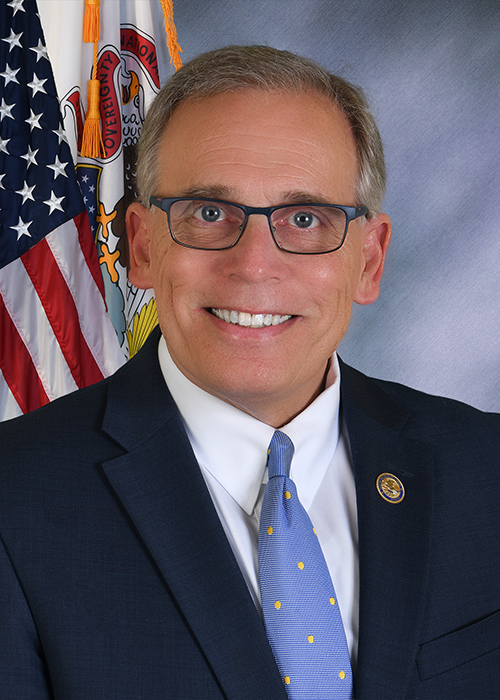
Sen. Dave Syverson
Sponsored bills
Amends the Firearm Concealed Carry Act. Provides that the prohibition against a licensee carrying a firearm into any building, parking area, or portion of a building under the control of an officer of the executive or legislative branch of government does not apply to any rest areas under the control of the Department of Transportation or to buildings located in rest areas under the control of the Department of Transportation. Eliminates a provision that a licensee shall not knowingly carry a firearm on any bus, train, or form of transportation paid for in whole or in part with public funds, and any building, real property, and parking area under the control of a public transportation facility paid for in whole or in part with public funds. Eliminates a provision that a licensee shall not knowingly carry a firearm in any public park, athletic area, or athletic facility under the control of a municipality or park district. Effective immediately.
Repeals the Firearm Owners Identification Card Act. Amends various Acts to make conforming changes. Effective immediately.
Amends the Juvenile Court Act of 1987. Provides that any minor 10 years of age or older arrested or taken into custody under the Act for vehicular hijacking or aggravated vehicular hijacking shall be detained in an authorized detention facility until a detention or shelter care hearing is held to determine if there is probable cause to believe that the minor is a delinquent minor and that: (1) secure custody is a matter of immediate and urgent necessity for the protection of the minor or of the person or property of another; (2) the minor is likely to flee the jurisdiction of the court; or (3) the minor was taken into custody under a warrant. Provides that, if the court makes that determination, the minor shall continue to be held until the disposition of an adjudicatory hearing under the Delinquent Minors Article of the Act. Provides that a minor who at the time of the offense was at least 16 years of age and who is charged with certain aggravated vehicular hijacking violations or certain armed robbery violations is not subject to the Act and shall be prosecuted under the criminal laws of the State.
Creates the Fund the Police Act. Contains findings. Creates the Fund the Police Grant Fund and provides that moneys the Illinois Law Enforcement Training Standards Board receives from the fund must be used for the purpose of make grants to units of local government for the purposes of: (1) hiring, rehiring, and retention of law enforcement officers, including hiring and retention incentives and overtime; (2) funding body camera mandates, including, but not limited to, the purchase, storage, and other necessary expenses for running local body camera programs, and purchasing law enforcement equipment designed to keep officers and their communities safe; (3) funding additional law enforcement training, including funding for Mobile Team In-Service Training Units throughout the State; (4) assisting with outreach and community policing activities; and (5) assisting with mental health treatment for individuals in county jails. Provides that the Board may set rules relating to requirements for the distribution of grant moneys and determine which law enforcement agencies are eligible and shall consider compliance with the Uniform Crime Reporting Act as a factor in awarding grant moneys. Provides that moneys in the Fund the Police Grant Fund may not be appropriated, assigned, or transferred to another State fund. Provides for a continuing appropriation at the beginning of each fiscal year of $125,000,000 from the General Revenue Fund to the Fund the Police Grant Fund. Amends the State Finance Act by making conforming changes.
Amends the Child Care Act of 1969. Provides that the Department of Children and Family Services shall adopt and implement rules to adjust licensing requirements, including, but not limited to, worker qualifications for child care providers within child care deserts that reflect local labor market conditions in order to grant local child care providers enhanced hiring flexibility and expand child care into currently underserved areas. Defines "child care deserts" and "child care provider". Provides that the Department shall submit proposed rules to implement the provisions concerning emergency licensing to the Joint Committee on Administrative Rules no later than December 31, 2023. Effective immediately.
Amends the Illinois Income Tax Act. Provides that, for taxable years ending on or after December 31, 2022, the credit for employee child care shall be in an amount equal to: (1) 50% of the start-up costs expended by the corporate taxpayer to provide a child care facility for the children of its employees; and (2) 20% of the annual amount paid by the corporate taxpayer to (i) provide an on-site child care facility for the children of its employees, (ii) provide child care offsite for the children of its employees, or (iii) a combination of (i) and (ii) (currently, 30% of the start-up costs and 5% of the annual amount paid by the taxpayer in providing the child care facility). Provides that the taxpayer may coordinate with an independent child care facility to provide care for the children of employees. Effective immediately.
Amends the Illinois Emergency Management Agency Act. Provides that after an initial proclamation declaring that a disaster exists, the Governor may only extend that declaration or make further proclamations regarding the same disaster if the General Assembly passes a resolution within 5 calendar days that approves the extension or further proclamation. Provides that if, due to health or safety concerns, the General Assembly is unable to convene in either regular or special session to approve the extension or further proclamation, the extension or further proclamation may continue in effect until the General Assembly is able to convene in regular or special session if the President of the Senate, the Speaker of the House of Representatives, the Minority Leader of the Senate, and the Minority Leader of the House of Representatives submit written certification to the Governor that the General Assembly is unable to convene to provide the necessary approval of the extension or further proclamation. Effective immediately.
Amends the Counties Code. Provides that, if a county board member, county board chairman, State's Attorney, or other countywide elected official is criminally charged with an infamous crime or of any offense involving a violation of his or her official oath, the county board shall review the alleged crimes to determine by a three-fifths vote of all members if the countywide elected official should be placed on administrative leave. Provides that, if the county board believes the official has been criminally charged with an infamous crime or of any offense involving a violation of his or her official oath, the county board shall send their determination to the State's Attorney or, if the determination is regarding the State's Attorney, the determination shall be sent to the Attorney General. Provides that, upon receipt of a determination from the county board, if the State's Attorney or Attorney General believes the crime or crimes to be germane to the official's duties, then the State's Attorney or Attorney General shall file a motion to place the elected official on administrative leave with the circuit court of the county. Provides that, upon receipt of the motion, the circuit court shall review and determine if the official shall be placed on administrative leave. Provides that the court may require the county to pay court costs or reasonable attorney fees, or both, if the court dismisses the action. Provides that, if the official is placed on administrative leave because a conflict exists, the official is barred from county property and performing the official's duties until the case is closed and the county board determines the conflict is resolved. Provides that the official shall continue to receive all compensation and benefits during the official's administrative leave. Provides that, if the county board puts an official on administrative leave, the board shall appoint a replacement for the official while the official is on administrative leave. Amends the Township Code. Makes similar changes. Effective immediately. Senate Committee Amendment No. 1 Replaces everything after the enacting clause. Reinserts the provisions of the introduced bill with the following changes: Provides that if a State's Attorney or township attorney believes the crime or crimes to be germane to the official's duties, or a special State's Attorney (rather than the Attorney General) if the crime or crimes deal with the State's Attorney, such attorney shall file a petition (rather than a motion) with the circuit court for a rule to show cause why not to place the elected official on administrative leave (rather than to have the court place the elected official on administrative leave). Replaces the procedure by which the court determines if an officer shall be placed on administrative leave with the following: provides that the court shall issue a rule requiring the officer to show cause why he or she should not be put on administrative leave and the officer shall have a trial in the date stated in the rule; and provides that, if, after trial, the court determined that the township officer should be placed on administrative leave, the township officer shall be removed from office. Effective immediately. Senate Committee Amendment No. 2 Replaces everything after the enacting clause. Reinserts the provisions of the Senate Amendment No. 1 with the following changes: Provides that the county board shall petition the court for the appointment of a special State's Attorney to review the board's determination if the determination is relating to the State's Attorney or if the State's Attorney has a conflict of interest (rather than only if relating to the State's Attorney). Makes conforming changes. Limits the provisions to counties that have a population of less than 500,000 people and townships within counties that have a population of less than 500,000 people. Effective immediately. Senate Floor Amendment No. 3 Limits the provisions to officials charged with an infamous crime or of any felony in violation of his or her official oath (rather than any offense involving a violation of his or her official oath). Provides that, if the official is removed from office, then the official is barred from county or township property and performing the official's duties until the case is closed and the county or township board determines the conflict is resolved. Makes other changes.
Amends the Business Assistance and Regulatory Reform Act. Modifies requirements concerning the Office of Business Permits and Regulatory Assistance. Provides that the office shall implement reforms to improve interagency coordination that allow for expeditious permitting issuance. Provides that the office shall utilize information technology tools to track project schedules and metrics to improve transparency and accountability of the permitting process, reduce uncertainty and delays, and reduce costs and risks to taxpayers. Modifies provisions and adds requirements concerning the provision of information and the expediting of permit reviews. Provides for the creation of an Interagency Permitting Advisory Committee. Provides additional requirements concerning the permitting process under the Act. Defines terms. Makes other changes.