

Amends the Criminal Identification Act. Provides that the court shall not order the sealing of the records of arrests or charges not initiated by arrest that result in a conviction for financial exploitation of an elderly person or a person with a disability, aggravated identity theft against a person 60 years of age or older or a person with a disability, abuse or criminal neglect of a long term care facility resident, or criminal abuse or neglect of an elderly person or person with a disability. Amends the Criminal Code of 2012. Provides that a person who commits the offense of financial exploitation of an elderly person or a person with a disability may be tried in any one of the following counties in which (1) any part of the offense occurred or (2) the victim or one of the victims reside. Provides that theft by deception from a person with a disability is a Class 2 felony. Provides that consent is not a defense to financial exploitation of an elderly person or a person with a disability if the accused knew or had reason to know that the elderly person or a person with a disability lacked capacity to consent. House Floor Amendment No. 1 Deletes reference to: 20 ILCS 2630/5.2 Deletes the amendatory changes to the Criminal Identification Act that relate to sealing of records of arrest or charges not initiated by arrest that result in an order of supervision or conviction for financial exploitation of an elderly person or a person with a disability, aggravated identity theft committed against a person 60 years of age or older or a person with a disability, abuse or criminal neglect of a long term care facility resident, criminal abuse or neglect of an elderly person or a person with a disability, or a similar provision of a local ordinance.
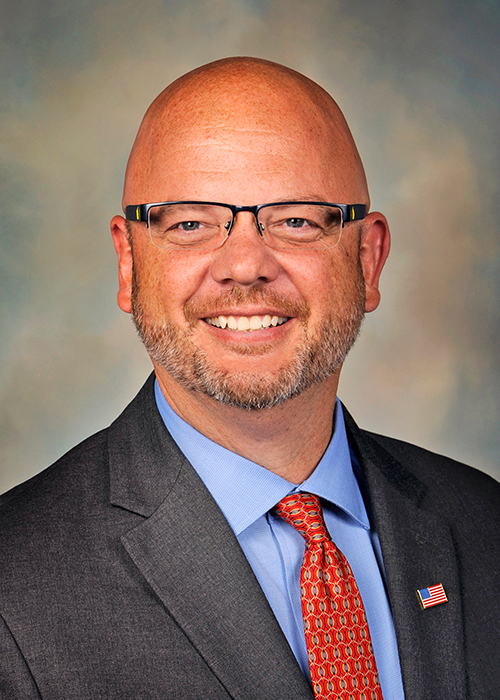
Rep. Jeff Keicher
Sponsored bills
Amends the School Code to create the Office of School Safety within the State Board of Education. Provides for the Office's duties. Requires the Office to create a grant program for expenditures related to improving school safety. Provides that grant funds must be used for school security improvements, including training and safety-related upgrades to school buildings, equipment (including metal detectors and x-ray machines), and facilities. Specifies the grant application requirements. Effective January 1, 2020. Senate Floor Amendment No. 1 Replaces everything after the enacting clause. Amends the School Code. Provides that, subject to appropriation or private donations, the State Board of Education shall award grants to school districts to support school safety and security. Provides that grant funds may be used for school security improvements, including professional development, safety-related upgrades to school buildings, equipment, including metal detectors and x-ray machines, and facilities, including school-based health centers. Requires the State Board to prioritize the distribution of grants to school districts designated as Tier 1 or Tier 2 under the evidence-based funding formula.
Creates the Hotel and Casino Employee Safety Act. Requires hotels and casinos to adopt anti-sexual harassment policies and make panic buttons available to certain employees. Prohibits retaliation against an employee for using a panic button, availing himself or herself of the protections afforded by an anti-sexual harassment policy, or disclosing, reporting, or testifying about violations of the Act. Provides remedies for noncompliance. Limits home rule powers. Effective immediately. Senate Committee Amendment No. 1 Replaces everything after the enacting clause with provisions substantially similar to the introduced bill with the following changes: defines the terms "casino employer" and "hotel employer"; provides for the utilization of a safety device rather than a panic button; requires time off to be granted to file criminal complaints rather than sign police complaints; removes requirement that anti-harassment policies be posted in Polish; limits economic damage awards to $350 per incident; deletes the home rule preemption; provides that before a representative of employees may bring a claim on behalf of employees, the employer must be given 15 calendar days within which to correct the violation. Effective July 1, 2020. Senate Floor Amendment No. 2 Adds a definition. Defines the term "sexual assault" to mean: (1) an act of sexual conduct, as defined in Section 11-0.1 of the Criminal Code of 2012; or (2) any act of sexual penetration, as defined in Section 11-0.1 of the Criminal Code of 2012 and includes, without limitation, acts prohibited under Sections 11-1.20 through 11-1.60 of the Criminal Code of 2012. House Floor Amendment No. 1 Adds reference to: New Act 5 ILCS 140/7.5 20 ILCS 2105/2105-15 710 ILCS 5/1 from Ch. 10, par. 101 775 ILCS 5/1-103 from Ch. 68, par. 1-103 775 ILCS 5/2-101 from Ch. 68, par. 2-101 775 ILCS 5/2-102 from Ch. 68, par. 2-102 775 ILCS 5/2-108 new 775 ILCS 5/2-109 new 775 ILCS 5/2-110 new 775 ILCS 5/7-109.1 from Ch. 68, par. 7-109.1 775 ILCS 5/7A-102 from Ch. 68, par. 7A-102 775 ILCS 5/8-109 from Ch. 68, par. 8-109 775 ILCS 5/8-109.1 new 820 ILCS 180/5 820 ILCS 180/10 820 ILCS 180/15 820 ILCS 180/20 820 ILCS 180/25 820 ILCS 180/30 820 ILCS 180/45 5 ILCS 420/4A-101 from Ch. 127, par. 604A-101 5 ILCS 420/4A-101.5 new 5 ILCS 420/4A-102 from Ch. 127, par. 604A-102 5 ILCS 420/4A-105 from Ch. 127, par. 604A-105 5 ILCS 420/4A-106 from Ch. 127, par. 604A-106 5 ILCS 420/4A-106.5 new 5 ILCS 420/4A-107 from Ch. 127, par. 604A-107 5 ILCS 420/4A-108 5 ILCS 430/5-10.5 5 ILCS 430/20-5 5 ILCS 430/20-10 5 ILCS 430/20-50 5 ILCS 430/20-63 new 5 ILCS 430/25-5 5 ILCS 430/25-10 5 ILCS 430/25-50 5 ILCS 430/25-63 new 5 ILCS 430/70-5 25 ILCS 170/4.7 Replaces everything after the enacting clause with the provisions of the engrossed bill, and makes the following changes: Creates the Workplace Transparency Act. Limits the terms of employment agreements that restrict specified employee rights with respect to allegations of unlawful conduct. Amends the Department of Professional Regulation Law of the Civil Administrative Code of Illinois. Provides that the Division of Professional Regulation of the Department of Financial and Professional Regulation must exchange information with the Department of Human Rights regarding recommendations received regarding a licensee or candidate for licensure who has committed a civil rights violation that may lead to the refusal, suspension, or revocation of a license from the Division of Professional Regulation. Amends the Illinois Human Rights Act. Requires the Department of Human Rights to adopt a model sexual harassment prevention training program and provides that all employers shall use the model or establish a training program that equals or exceeds the minimum standards provided by the model. Makes other changes concerning: definitions; procedures following an employer's failure to post required notices; employer disclosure requirements, and bar and restaurant sexual harassment policies and prevention training. Makes a corresponding change in the Freedom of Information Act. Creates the Sexual Harassment Victim Representation Act. Provides that in any proceeding in which a victim who is a member of a union has accused a perpetrator who is a member of the same union, the victim and the perpetrator may not be represented in the proceeding by the same union representative. Amends the Victims' Economic Security and Safety Act. Defines "gender violence" and makes the Act applicable in instances of gender violence. Amends the Illinois Governmental Ethics Act. Modifies the disclosure of economic interests Article to provide for separate provisions concerning statements of economic interests to be filed with the Secretary of State and the county clerk respectively. Amends the State Officials and Employees Ethics Act and the Lobbyist Registration Act to require annual participation in harassment and discrimination prevention training. Further amends the State Officials and Employees Ethics Act. Makes changes concerning: rights of persons subjected to discrimination, harassment, or sexual harassment; jurisdiction and duties of Executive Inspectors General, the Executive Ethics Commission, the Legislative Inspector General, and the Legislative Ethics Commission; complaint process, reporting, and independent review of allegations of sexual harassment made against an elected official; and other matters. Contains severability language. Effective January 1, 2020, except (i) the Hotel and Casino Employee Safety Act takes effect July 1, 2020; and (ii) the changes to the Illinois Governmental Ethics Act, the State Officials and Employees Ethics Act, and the Lobbyist Registration Act take effect immediately.
Amends the Suicide Prevention, Education, and Treatment Act. Makes changes concerning the findings of the General Assembly. Creates the Office of Suicide Prevention within the Department of Public Health for the purpose of implementing the Act. Requires the Office of Suicide Prevention, in consultation with the Illinois Suicide Prevention Alliance, to submit an annual report to the Governor and General Assembly on the effectiveness of the activities and programs undertaken under the Illinois Suicide Prevention Strategic Plan that includes any recommendations for modification to Illinois law to enhance the effectiveness of the Plan (instead of an annual report by the Illinois Suicide Prevention Alliance). Changes what shall be contained in the Plan. Provides that the Office of Suicide Prevention (in addition to the Department) shall provide technical assistance to the Illinois Suicide Prevention Alliance and implement a general awareness and screening program. Provides that the program shall include an annual statewide suicide prevention conference. Removes provisions requiring the Department to establish 5 suicide prevention pilot programs relating to youth, elderly, special populations, high-risk populations, and professional caregivers. Provides that the Office of Suicide Prevention shall establish programs that are consistent with the Plan. Effective July 1, 2019. Senate Committee Amendment No. 1 Adds reference to: 20 ILCS 2310/2310-455 new Amends the Department of Public Health Powers and Duties Law of the Civil Administrative Code of Illinois. Creates the Office of Suicide Prevention within the Department of Public Health. Provides that the duties of the Office of Suicide Prevention shall include, but shall not be limited to: (1) coordinating suicide prevention, intervention, and postvention programs, services, and efforts statewide; (2) developing and submitting proposals for funding from federal agencies or other sources of funding to promote suicide prevention and coordinate activities; (3) with input from the Illinois Suicide Prevention Alliance, preparing the Illinois Suicide Prevention Strategic Plan and coordinating the activities necessary to implement the recommendations in that Plan; (4) with input from the Illinois Suicide Prevention Alliance, providing an annual report to the Governor and General Assembly; and (5) providing technical support for the activities of the Illinois Suicide Prevention Alliance. Corrects a typographical error. Senate Floor Amendment No. 2 Deletes reference to: 410 ILCS 53/10 410 ILCS 53/11 new Replaces everything after the enacting clause with the provisions of the introduced bill as amended by Senate Amendment No. 1 with the following changes: Provides that the Department of Public Health shall (rather than may) implement specified activities associated with the Suicide Prevention, Education, and Treatment Act. Removes language creating the Office of Suicide Prevention and instead, where applicable, replaces references to the Office with references to the Department. Makes a technical change to the legislative findings. Provides that the bill is effective immediately (rather than on July 1, 2019).
Amends the Environmental Protection Act. Requires that the Agency define "microplastics" and examine the role of microplastics in public drinking water. Requires the Agency to publicly disclose the results of its testing and reporting. Provides that the Agency, if appropriate, is to consider issuing a notification level to aid consumer interpretations. Requires the Agency to accredit qualified laboratories in Illinois to analyze microplastics. Senate Floor Amendment No. 1 Deletes reference to: 105 ILCS 5/14.8 new Adds reference to: 110 ILCS 425/22 new Replaces everything after the enacting clause. Amends the University of Illinois Scientific Surveys Act. Provides that, subject to appropriation, the Prairie Research Institute shall conduct a detailed review of the available scientific literature and federal and State laws, regulations, and rules to identify the threat of microplastics to human health and the environment. Provides that no later than 3 months after completion of the review, the Prairie Research Institute shall submit to the General Assembly a report of its findings that must include any recommendations for legislative or regulatory actions that the State can take to protect human health and the environment from microplastics. Provides that the amendatory Act's provisions are repealed on July 1, 2021.
Amends the Illinois Banking Act and the Illinois Credit Union Act. Provides that the Secretary of Financial and Professional Regulation shall not: issue an order against a financial institution for unsafe or unsound banking practices solely because the entity provides financial services to a cannabis-related legitimate business; prohibit, penalize, or otherwise discourage a financial institution from providing financial services to a cannabis-related legitimate business solely because the entity provides financial services to a cannabis-related legitimate business; recommend, incentivize, or encourage a financial institution not to offer financial services to an account holder or to downgrade or cancel the financial services offered to an account holder solely because the account holder is a manufacturer or producer or is the owner, operator, or employee of a cannabis-related legitimate business, the account holder later becomes an owner or operator of a cannabis-related legitimate business, or the financial institution was not aware that the account holder is the owner or operator of a cannabis-related legitimate business; and take any adverse or corrective supervisory action on a loan made to an owner or operator of a cannabis-related legitimate business solely because the owner or operator owns or operates a cannabis-related legitimate business or an owner or operator of real estate or equipment that is leased to a cannabis-related legitimate business solely because the owner or operator of the real estate or equipment leased the equipment or real estate to a cannabis-related legitimate business. Authorizes the Secretary to furnish confidential supervisory information relating to a financial institution providing financial services to cannabis-related businesses, limited to the name, contact information, and such other information as the Secretary determines is prudent, to the Illinois State Treasurer. Effective immediately. Senate Committee Amendment No. 1 Deletes reference to: 205 ILCS 5/48.3 205 ILCS 305/9.1 Deletes provisions authorizing the Secretary of Financial and Professional Regulation to furnish to the State Treasurer confidential supervisory information concerning financial institutions that provide financial services to cannabis-related businesses. House Floor Amendment No. 1 Deletes reference to: 205 ILCS 5/48 205 ILCS 305/8 Adds reference to: 30 ILCS 500/1-10 35 ILCS 5/201 from Ch. 120, par. 2-201 35 ILCS 105/3-10 35 ILCS 110/3-10 from Ch. 120, par. 439.33-10 35 ILCS 115/3-10 from Ch. 120, par. 439.103-10 35 ILCS 120/2-10 105 ILCS 5/22-33 225 ILCS 60/22 from Ch. 111, par. 4400-22 225 ILCS 65/70-5 was 225 ILCS 65/10-45 225 ILCS 95/21 from Ch. 111, par. 4621 410 ILCS 130/1 410 ILCS 130/7 410 ILCS 130/10 410 ILCS 130/25 410 ILCS 130/30 410 ILCS 130/35 410 ILCS 130/36 410 ILCS 130/40 410 ILCS 130/45 410 ILCS 130/55 410 ILCS 130/57 410 ILCS 130/60 410 ILCS 130/62 410 ILCS 130/75 410 ILCS 130/105 410 ILCS 130/115 410 ILCS 130/130 410 ILCS 130/145 410 ILCS 130/160 410 ILCS 130/173 new 410 ILCS 130/195 410 ILCS 130/200 410 ILCS 130/135 rep. 410 ILCS 130/220 rep. 625 ILCS 5/2-118.2 625 ILCS 5/6-206.1 from Ch. 95 1/2, par. 6-206.1 625 ILCS 5/11-501 from Ch. 95 1/2, par. 11-501 625 ILCS 5/11-501.9 720 ILCS 550/5.3 Replaces everything after the enacting clause. Amends the Nurse Practice Act and the Physician Assistant Practice Act of 1987. Provides that violating the Compassionate Use of Medical Cannabis Program Act is grounds for disciplinary action under the Acts. Amends the Compassionate Use of Medical Cannabis Pilot Program Act. Removes the word "Pilot" from the Act's short title and the Compassionate Use of Medical Cannabis Pilot Program. Makes conforming changes throughout the Act and statutes. Replaces the defined term "bona fide physician-patient relationship" with "bona fide health care professional-relationship" and makes conforming changes throughout the Act. Provides that specified maladies are debilitating medical conditions. Refers to certifying health care professionals (rather than physicians) throughout the Act. Provides that a certifying health care professional may not engage in fee splitting as prohibited under the Medical Practice Act of 1987. Provides that nothing in the Act shall preclude a certifying health care professional from referring a patient for health services, including certification, under the Act. Provides that a qualifying patient under the age of 18 shall not be prohibited from having up to 3 (instead of 2) designated caregivers. Provides that the Department of Public Health shall establish procedures to permit qualified veterans to participate in the Opioid Alternative Pilot Program. Provides that any Department-approved quantity waiver process must be made available to qualified veterans. Requires the Department to provide for immediate changes to a registered qualifying patient's designated registered dispensing organization. Provides that the Department of Financial and Professional Regulation shall adopt rules permitting returns, and potential refunds, for damaged or inadequate products. Allows the Department of Financial and Professional Regulation to issue nondisciplinary citations for minor violations which may be accompanied by a civil penalty not to exceed $10,000 per violation and shall contain specified information. Provides that if the licensee does not dispute the matter in the citation with the Department of Financial and Professional Regulation within 30 days after the citation is served, then the citation shall become final and shall not be subject to appeal. Repeals a provision concerning changing a designated dispensing organization. Repeals a provision repealing the Act on July 1, 2020. Makes other changes. Effective immediately. House Floor Amendment No. 2 Adds reference to: 55 ILCS 5/5-1006.8 Provides that if and only if House Bill 1438 becomes law, then the Counties Code is amended. Provides that County Cannabis Retailers' Occupation Tax may not exceed: (i) 3.75% of the gross receipts of sales made in unincorporated areas of the county; and (ii) 3% of the gross receipts of sales made in a municipality located in the county (removing provisions limiting to 0.75% of the gross receipts of sales made in a municipality located in a non-home rule county and 3% of gross sales receipts made in a municipality located in a home rule county). Effective immediately or on the date House Bill 1438 takes effect, whichever is later.
Creates the Customized Employment for Individuals with Disabilities Act. Requires the Department of Human Services' Division of Rehabilitation Services to establish a 5-year Customized Employment Pilot Program that serves a minimum of 25 individuals by the second year of the Pilot Program. Provides that the Pilot Program shall include certain components, including: (1) an intensive discovery phase during which the unique needs, abilities, and interests of each program participant will be explored; (2) a customized person-centered planning process based upon information gathered during the discovery phase that involves capturing, organizing, and presenting the information in a blueprint for the job search; and (3) an employer negotiation process in which job duties and employee expectations are negotiated to align the skills and interests of each program participant to the needs of an employer. Provides that community-based agencies serving persons with intellectual or developmental disabilities shall identify and refer individuals to the Department for participation in the Pilot Program. Requires program participants to reflect the geographical, racial, ethnic, gender, and income-level diversity of the State. Contains provisions concerning data collection and reporting, administrative rules, and other matters. Senate Committee Amendment No. 1 Replaces everything after the enacting clause. Reinserts the provisions of the introduced bill, but with the following changes: Provides that the purpose of the Act is to assist individuals with intellectual or developmental disabilities or similar conditions resulting in a most significant disability (rather than individuals with intellectual or developmental disabilities and complex needs). Provides that the Customized Employment Pilot Program shall be implemented through an individualized plan for employment developed by the individual with a disability and the vocational rehabilitation counselor employed by the Division of Rehabilitation Services. Provides that the individual with a disability may choose to have a personal representative participate in the development of the individualized plan for employment. Includes the State Rehabilitation Council in the list of entities from which the Department of Human Services is required to seek advice and recommendations concerning the creation, operation, and administration of the Customized Employment Pilot Program.
Amends the State Property Control Act. Provides that the Board of Trustees of any public institution of higher education in this State is authorized to dispose of surplus real estate of that public institution of higher education. Specifies the manner in which a Board of Trustees may dispose of surplus real estate. Provides that a Board of Trustees may retain the proceeds from the sale, lease, or other transfer of all or any part of the real estate deemed surplus real estate in a separate account in the treasury of the institution for the purpose of deferred maintenance and emergency repair of institution property. Requires the Auditor General to examine the separate account to ensure the use or deposit of the proceeds in a manner consistent with the stated purpose. Defines "public institution of higher education". Effective immediately.
Amends the Diversifying Higher Education Faculty in Illinois Act. Provides that the Program Board created to administer the grant program authorized by the Act shall be comprised of 11 (rather than 21) members. Effective immediately. Senate Floor Amendment No. 1 Deletes reference to: 110 ILCS 930/3 Adds reference to: 105 ILCS 5/22-85 new Replaces everything after the enacting clause. Amends the School Code. Provides that, beginning with the 2020-2021 school year, in addition to any other requirements under the Code, as a prerequisite to receiving a high school diploma, the parent or guardian of each student or, if a student is at least 18 years of age or legally emancipated, the student must (i) file a Free Application for Federal Student Aid with the United States Department of Education or, if applicable, an application for State financial aid or (ii) on a form created by the State Board of Education, file a waiver with the student's school district indicating that the parent or guardian or, if applicable, the student understands what the Free Application for Federal Student Aid and application for State financial aid are and has chosen not to file an application. Provides that a school district must require each high school student to comply with the requirements and must provide to each student and, if applicable, his or her parent or guardian any support or assistance necessary for compliance. Provides that a school district must award a high school diploma to a student who is unable to meet the requirements due to extenuating circumstances, as determined by the school district, if (i) the student has met all other graduation requirements under the Code and (ii) the principal attests that the school district has made a good faith effort to assist the student or, if applicable, his or her parent or guardian in filing an application or a waiver. Allows the State Board to adopt rules.
Amends the Illinois Vehicle Code. Makes a technical change in a Section concerning the short title. Senate Committee Amendment No. 2 Deletes reference to: 625 ILCS 5/1-100 Adds reference to: 625 ILCS 5/1-154.7 625 ILCS 5/5-302 from Ch. 95 1/2, par. 5-302 Replaces everything after the enacting clause. Amends the Illinois Vehicle Code. Provides that a person shall not sell or offer at auction salvage vehicles to a nonresident individual or business in the United States unless the nonresident is licensed in another state or jurisdiction, provides a National Motor Vehicle Title Information System (NMVTIS) number, a social security number or federal employment identification number, and resale tax certificate, if applicable. Provides that a person in the State shall not sell or offer at auction salvage vehicles to an out-of-country buyer unless the out-of-country buyer is licensed in its jurisdiction as a recycler or rebuilder and provides a foreign license number, passport, or other form of identification issued by the foreign jurisdiction. Provides that an out-of-country buyer who provides a business address not within the sovereign boundaries of the United States shall receive a title stamped with the designation of "export only" at the point of sale. Senate Floor Amendment No. 3 Replaces everything after the enacting clause. Amends the Illinois Vehicle Code. Provides that no person in the State shall sell at auction a salvage vehicle to a nonresident individual or business licensed in the United States unless the nonresident, in addition to being licensed in another state or jurisdiction, provides a resale tax certificate, if applicable, and one of the following: a National Motor Vehicle Title Information System (NMVTIS) number, federal employer identification number, or government-issued driver's license or passport. Provides that a person in the State shall not sell at auction a salvage vehicle to an out-of-country buyer, unless if the nonresident is licensed in a jurisdiction that is not a state, then the nonresident shall provide to the seller the number of the nonresident's license issued by that jurisdiction and a copy of the nonresident's passport or the passport of an owner or officer of the nonresident entity or a copy of another form of government-issued identification from the nonresident or an owner or officer of the nonresident entity. Provides that an out-of-state salvage vehicle buyer who provides an address outside of the United States shall receive a salvage certificate stamped by the seller with the designation of "For Export Only" at the point of sale for each salvage vehicle purchased and the NMVTIS record shall be designated "EXPORT". House Floor Amendment No. 1 Deletes reference to: 625 ILCS 5/1-154.7 625 ILCS 5/5-302 from Ch. 95 1/2, par. 5-302 Adds reference to: 30 ILCS 105/5.891 new 625 ILCS 5/11-709 from Ch. 95 1/2, par. 11-709 625 ILCS 5/11-907 from Ch. 95 1/2, par. 11-907 625 ILCS 5/11-907.5 705 ILCS 135/15-70 720 ILCS 5/9-3 from Ch. 38, par. 9-3 730 ILCS 5/5-6-1 from Ch. 38, par. 1005-6-1 730 ILCS 5/5-3-2 from Ch. 38, par. 1005-3-2 730 ILCS 5/5-5-3.2 Replaces everything after the enacting clause. Dedicates the Act to the memory of Lieutenant Scott Gillen, Trooper Brooke Jones-Story, and Trooper Christopher Lambert. Amends the State Finance Act. Creates the Scott's Law Fund as a special fund in the State treasury. Amends the Illinois Vehicle Code. Provides that, when approaching a stationary authorized emergency vehicle, if changing lanes would be impossible or unsafe, a person shall proceed with due caution, reduce the speed of the vehicle maintaining a safe speed for road conditions and leaving a safe distance until safely past the stationary vehicles. Provides that, when approaching a disabled vehicle with lighted hazard lights on a highway having at least 4 lanes, of which at least 2 are proceeding in the same direction, a driver of a vehicle shall, proceeding with due caution, yield the right-of-way by making a lane change into a lane not adjacent to that of the disabled vehicle, if possible with due regard to safety and traffic conditions, or, if changing lanes would be impossible or unsafe proceeding with due caution, reduce the speed of the vehicle, maintaining a safe speed for road conditions and leaving a safe distance until safely past the stationary vehicles. Provides that a person who violates provisions prescribing how to safely approach an authorized emergency vehicle commits a business offense punishable by a minimum fine of $250 and not more than $10,000 for the first violation and a fine of not less than $750 or more than $10,000 for the second or subsequent violation (instead of a fine of not less than $100 or more than $10,000), and (i) if the violation results in damage to another vehicle, the person commits a Class A misdemeanor; and (ii) if the violation results in the injury or death of another person, the person commits a Class 4 felony. Provides that commission of the offense of reckless homicide while committing a violation of the Section concerning proper approach of a stationary authorized emergency vehicle shall be afforded as a factor in aggravation and extended-term sentencing. Provides that the Director of the State Police shall use all moneys in the Scott's Law Fund in the Department's discretion to fund the production of materials to educate drivers on approaching stationary authorized emergency vehicles, to hire off-duty Department of State Police for enforcement of the Section concerning proper approach of a stationary authorized emergency vehicle, and for other law enforcement purposes the Director deems necessary for such efforts. Provides that, for violations issued by a county or municipal police officer, the assessment shall be deposited into the county or municipality's Transportation Safety Highway Hire-back Fund to hire off-duty county police officers to monitor construction or maintenance zones in that county on highways other than interstate highways. Provides that the county, in its discretion, may also use a portion of the moneys in its Transportation Safety Highway Hire-back Fund to purchase equipment for county law enforcement and fund the production of materials to educate drivers on construction zone safe driving habits and approaching stationary authorized emergency vehicles. Amends the Criminal and Traffic Assessment Act. Imposes a conditional assessment of $250 for a violation of provisions prescribing how to safely approach an authorized emergency vehicle. Amends the Criminal Code of 2012. Provides that a person who commits reckless homicide while violating provisions prescribing how to safely approach an authorized emergency vehicle shall be sentenced to a term of not less than 3 years and not more than 14 years, or, if the person caused the deaths of 2 or more persons, not less than 6 years and not more than 28 years. Makes other changes. Amends the Unified Code of Corrections. Provides that a person charged with violating provisions prescribing how to safely approach an authorized emergency vehicle is not eligible for supervision.