

If and only if Senate Bill 243 of the 104th General Assembly, as amended by House Amendment No. 1, becomes law, then the Open Meetings Act is amended to allow a public body to hold closed meetings to consider self evaluation, practices and procedures, or professional ethics, when meeting with a representative of a statewide association (rather than a statewide or regional association) of which the public body is a member. Effective upon becoming law or on the date Senate Bill 243 of the 104th General Assembly takes effect, whichever is later.
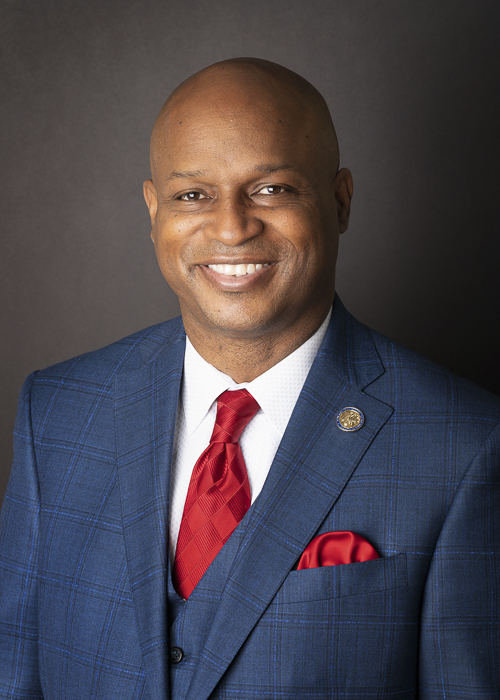
Rep. Chris Welch
Sponsored bills
Proposes to amend the Legislature Article of the Illinois Constitution concerning the decennial redistricting of Legislative and Representative Districts. Provides that Legislative and Representative Districts shall each be drawn, in order of priority, (1) to be substantially equal in population; (2) to ensure that no citizen is denied an equal opportunity to participate in the political process and to elect representatives of his or her choice; (3) to create, where practical, racial coalition or influence Districts; (4) to be contiguous; and (5) to the extent practicable, to be compact. Effective upon being declared adopted.
Creates the Algorithmic Pricing Transparency Act. Provides that any person or entity that sells or offers to sell goods or services through an online platform to consumers in this State shall provide a clear and conspicuous disclosure if the price displayed to a consumer is generated using surveillance pricing. Provides that a consumer may opt out of surveillance pricing and a covered entity shall provide the consumer with a non-personalized baseline price for the goods or services. Prohibits a covered entity from using specified personal information to generate algorithmic pricing. Provides that a violation of the Act is an unlawful practice under the Consumer Fraud and Deceptive Business Practices Act. Amends the Consumer Fraud and Deceptive Business Practices Act to make a conforming change. Effective one year after becoming law.
Maddy summaryHB 131 appropriates $2 from the General Revenue Fund to the Office of the Governor. This funding is designated for the office's ordinary and contingent expenses for Fiscal Year 2026, becoming effective on July 1, 2025.
Proposes to amend the Revenue Article of the Illinois Constitution. Provides that an additional income tax shall be imposed on individuals in an amount equal to 3% of the portion of the individual's net income that is greater than $1,000,000 for the taxable year. Provides that, of the revenue collected pursuant to those provisions, 50% shall be used to provide property tax relief and 50% shall be distributed to school districts solely on a per pupil basis. Effective upon being declared adopted.
Amends the Illinois Controlled Substances Act. Provides that the Prescription Monitoring Program does not apply to testosterone, mifepristone, misoprostol, GnRH analogues, or estrogen. Provides that the Department of Human Services shall purge from the records of the Prescription Monitoring Program all existing information concerning the prescribing or dispensing of testosterone, including any such information contained in the central repository or database, on or before January 1, 2027, and shall ensure that no further records concerning the prescribing and dispensing of testosterone are created or maintained by the Prescription Monitoring Program. Provides that the Department shall update and adopt rules consistent with the provision no later than January 1, 2027. Effective immediately.
Amends the College Campus Press Act. Defines "public media produced at a State-sponsored institution of higher learning". Provides that all public media produced at a State-sponsored institution of higher learning is a public forum for expression by the employees producing the media at the institution of higher learning. Provides that public media produced at a State-sponsored institution of higher learning is not subject to prior review by public officials of the State-sponsored institution of higher learning. Allows an employee or agent of an entity creating or distributing public media produced at a State-sponsored institution of higher learning to commence a civil action to obtain appropriate injunctive and declaratory relief as determined by a court for violation of the Act by such State-sponsored institution of higher learning. Provides that expression made by an employee or agent of an entity creating or distributing public media produced at a State-sponsored institution of higher learning is neither expression of campus policy nor speech attributable to a State-sponsored institution of higher learning. Provides that a State-sponsored institution of higher learning is immune from any lawsuit arising from expression actually made in public media produced at a State-sponsored institution of higher learning. Makes other changes.
Amends the Barber, Cosmetology, Esthetics, Hair Braiding, and Nail Technology Act of 1985. Provides that all apprentices shall be employed under an apprenticeship agreement between the sponsoring salon or shop and the apprentice that is approved by the Department of Labor. Provides requirements for the completion of an apprenticeship program, including training hours and supplemental instruction. Provides that an apprentice shall only provide licensed services under the supervision of a cosmetologist, barber, esthetician, or nail technician with an active license and for the scope of services for which the supervising licensed professional is licensed to practice. Requires apprentices to be trained in all branches of practical work and related supplemental instruction for the scope of practice for the license the apprentice seeks to obtain. Defines "apprentice". Provides that a person is qualified for a license as a barber if the person has graduated from a school of barbering or school of cosmetology approved by the Department of Financial and Professional Regulation or completed an apprenticeship under the Act (rather than only if the person has graduated from a school). Provides that the Department shall prescribe reasonable rules for the registration of apprentices.
Amends the Deposit of State Moneys Act and the Public Funds Investment Act. Provides that the State Treasurer or any public agency may consider the current and historical ratings that a financial institution has received under the Illinois Community Reinvestment Act when deciding whether to deposit State or public funds in that financial institution. Provides that, effective January 1, 2026, no State or public funds may be deposited in a financial institution subject to the Illinois Community Reinvestment Act unless either (i) the institution has a current rating of satisfactory or outstanding under the Illinois Community Reinvestment Act or (ii) the Department of Financial and Professional Regulation has not yet completed its initial examination of the institution pursuant to the Illinois Community Reinvestment Act. Makes conforming changes. Effective January 1, 2026.
Amends the Consumer Fraud and Deceptive Business Practices Act. Provides that a grocery store that offers a digital coupon to consumers shall make available a corresponding paper coupon of equal value. Provides that the paper coupons shall be easily accessible at the service desk and may also be placed in other locations around the store. Provides that a grocery store that violates the requirement commits an unlawful practice within the meaning of the Act.