Amends the Illinois Highway Code. Requires the Department of Transportation to make menstrual hygiene products available, at no cost, in the bathrooms of each Interstate highway rest area.
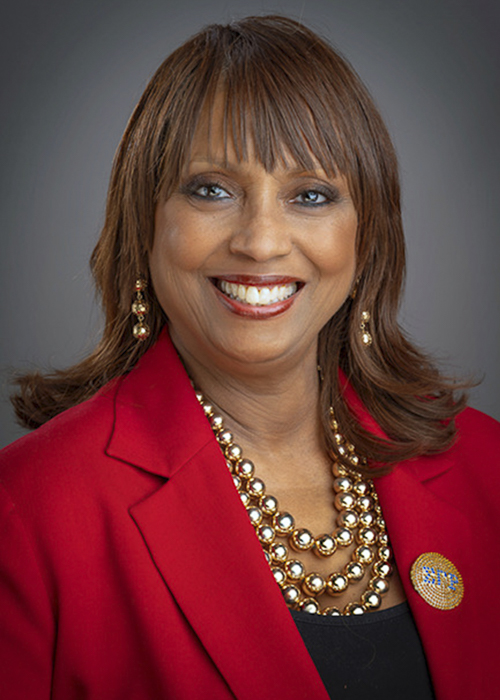
Rep. Debbie Meyers-Martin
Sponsored bills
Creates the Insulin for All Act. Provides that the Department of Public Health shall offer a discount program that allows participants to purchase insulin at a discounted, post-rebate price. Sets forth provisions concerning an insulin urgent-need program. Provides that by July 1, 2022, each manufacturer shall establish procedures to make insulin available to eligible individuals who are in urgent need of insulin or who are in need of access to an affordable insulin supply. Sets forth provisions concerning insulin urgent-need program exceptions, eligibility, forms, applications, claims and reimbursement, copayments, information sheets, navigators, and penalties. Sets forth provisions concerning an insulin patient assistance program and manufacturer responsibilities and process of the patient assistance program. Sets forth provisions concerning dispute resolution, reports, and penalties for insulin programs. Creates the Insulin Assistance Fund. Defines terms. Amends the Illinois Insurance Code. In provisions concerning cost sharing in prescription insulin drugs, provides that an insurer that provides coverage for prescription insulin drugs under the terms of a health coverage plan the insurer offers shall limit the total amount that an insured is required to pay for a 30-day supply of covered prescription insulin drugs at an amount not to exceed $35 (rather than $100). Makes a conforming change in the State Finance Act. Makes other changes. Effective immediately.
Amends the Probate Act of 1975. Removes language providing that a person who has been convicted of a felony is not qualified to act as an executor or an administrator.
Creates the End Youth Solitary Confinement Act. Provides that the use of room confinement of a person under 21 years of age at a juvenile or correctional facility for discipline, punishment, retaliation, or any reason other than as a temporary response to a juvenile's behavior that poses a serious and immediate risk of physical harm to any individual, including the juvenile, is prohibited. Provides that if a covered juvenile poses a serious and immediate risk of physical harm to any individual, including the juvenile, before a staff member of the facility places a covered juvenile in room confinement, the staff member shall attempt to use other less restrictive options, unless attempting those options poses a threat to the safety or security of any minor or staff. Establishes procedures for placing a covered juvenile in room confinement because the covered juvenile poses a serious and immediate risk of physical harm to himself or herself, or to others. Provides that each facility detaining covered juveniles shall report the use of each incident of room confinement to the Attorney General each month. Defines "covered juvenile". House Floor Amendment No. 1 Deletes a reference to the Department of Corrections. Provides that the reporting agency for certain provisions shall be an independent ombudsperson for the Department of Juvenile Justice, rather than the Attorney General. House Floor Amendment No. 2 Provides that "confinement" does not include medical isolation or quarantine. House Floor Amendment No. 3 Defines "administrative hold", "behavioral hold", "chief administrative officer", "confinement", and "investigative status". Provides that a covered juvenile may be placed on an administrative hold and confined when temporarily being housed in a particular covered juvenile center or for administrative or security purposes as personally determined by the chief administrative officer. Provides that placement on administrative hold shall be subject to the following time limitations: (1) when the covered juvenile is awaiting transfer to the Department of Corrections or a more secure setting, the administrative hold may not exceed 3 business days; and (2) the administrative hold may not exceed 7 calendar days when the covered juvenile is temporarily transferred to a different facility for the purposes of placement interviews, court appearances, or medical treatment. Provides that whenever a covered juvenile is on an administrative hold, the Department of Juvenile Justice, Department of Corrections, or county or municipality holding the covered juvenile shall provide the covered juvenile with access to the same programs and services received by covered juveniles in the general population. Provides that any restrictions on movement or access to programs and services shall be documented and justified by the chief administrative officer. House Floor Amendment No. 4 Defines "covered juvenile" as any person under 18 (rather than 21) years of age incarcerated in a correctional facility, jail, or detention facility of any kind operated by the Department of Corrections, the Department of Juvenile Justice, a county, or a municipality. House Floor Amendment No. 5 Replaces everything after the enacting clause. Reinserts the provisions of the introduced bill, as amended by House Amendments Nos. 1, 3, and 4. Specifies that "confinement" does not include medical isolation or quarantine.
Amends various Acts relating to the governance of public universities and community colleges in Illinois. Requires the governing board of each public university and community college district to contract for the provision of child care services on campus for its students. Provides that charges for service shall be at a reduced rate or service shall be free of charge, depending on the student's income. Effective immediately.
Amends the Tax Increment Allocation Redevelopment Act of the Illinois Municipal Code. Provides that "redevelopment project costs" include costs payable to businesses located within the redevelopment area that have experienced business interruption or other adverse conditions directly or indirectly attributable to the COVID-19 public health emergency. Provides that the costs may be reimbursed in the form of grants, subsidies, or loans and that the municipality may establish procedures for the payment of such costs, including application procedures, grant or loan agreements, certifications, payment methodologies, and other accountability measures that may be imposed upon participating businesses. Defines "costs of business interruption".
Amends the Criminal Code of 2012. Provides that a person commits sexual assault by deception if the person commits an act of sexual penetration and the person submits under the belief that the person committing the act is someone known to the victim other than the accused, and this belief is induced by pretense or concealment by the accused with the intent to induce that belief. Sexual assault by deception is a Class 3 felony.
Creates the Illinois Broadband Deployment, Equity, Access, and Affordability Act of 2022. Provides that access to affordable, reliable, high-speed broadband service is essential to full participation in modern life in the State and throughout the United States. Defines terms. Provides that the Department of Commerce and Economic Opportunity shall establish and implement a statewide broadband service grant program. Provides that the Department shall use money from the grant program only for the exclusive purpose of awarding grants to applicants for projects that are limited to the construction and deployment of broadband service into unserved areas in the State and for the Department's cost to administer the program. Provides that the Department shall not award grant money to a governmental entity or educational institution. Provides that the Department shall not, as a condition of an award of grant money, impose an open network architecture requirement, rate regulation, or other term or condition of service that differs from the applicant's terms or conditions of service in its other service areas. Includes provisions providing for the criteria for determining the award of funds, the information an applicant must provide for an application for a grant, the priority by which the Department shall follow in granting awards, and when the Department shall not award a grant to an applicant. Provides that when a grant is awarded, the Department shall provide notice on its website of each application receiving a grant. Provides that the Department shall require an applicant awarded a grant to submit a semi-annual report from the time the applicant receives the grant to 3 years after completion of the project. Makes a conforming change in the Freedom of Information Act. Effective immediately.
Amends the Criminal Code of 2012. Makes a technical change in a Section concerning the unlawful sale of public conveyance travel tickets to a minor. House Floor Amendment No. 3 Deletes reference to: 720 ILCS 5/10-8 Adds reference to: 5 ILCS 140/7.5 20 ILCS 3930/7.10 new 605 ILCS 140/5 Replaces everything after the enacting clause. Amends the Illinois Criminal Justice Information Act. Provides that the Illinois Criminal Justice Information Authority shall establish a pilot program to award $100 to any individual who supplies video or audio footage from the individual's residential security camera that materially contributes to a criminal conviction. Provides that the Authority shall distribute the award to the law enforcement agency investigating or the State's Attorney investigating the crime, who shall pay the individual directly. Provides that, to be eligible for an award under the pilot program, the State's Attorney that prosecuted the offender must certify to the Office of the Attorney General that (i) the individual supplied video or audio footage from the individual's residential security camera and (ii) the video or audio footage supplied by the individual contributed to the criminal conviction of an offender. Provides that the pilot program shall terminate after a total of $1,000,000 has been awarded under the pilot program. Amends the Expressway Camera Act. Adds the State highway system in the counties of Boone, Bureau, Champaign, DeKalb, DuPage, Grundy, Henry, Kane, Kendall, Lake, LaSalle, Macon, Madison, McHenry, Morgan, Peoria, Rock Island, Sangamon, St. Clair, Will, and Winnebago to the Act. Provides that images from the cameras may also be used in the investigation of any forcible felony, to detect highway conditions, and to facilitate highway safety and incident management. Provides that images from the cameras may be used by any law enforcement agency conducting an active law enforcement investigation. Provides that images from the cameras are exempt from disclosure under the Freedom of Information Act. Provides that all images and footage from the cameras must be deleted within 180 days, unless the images or footage is relevant to an ongoing investigation or pending criminal trial. Provides that cameras shall not be used to monitor individuals or groups in a discriminatory manner contrary to applicable State or federal law. Provides that each law enforcement agency shall report statistics to the Illinois Criminal Justice Information Authority and that no later than June 30, 2023, the Illinois Criminal Justice Information Authority shall issue a report concerning the instances in which camera-captured information lead to a successful conviction. Makes changes concerning funding for the program. Authorizes the Attorney General or local State's Attorney to prosecute certain offenses. Makes other changes. Effective immediately.

Urges the State of Illinois to launch a pilot project to establish a transitional shelter village that will support the crisis housing and health needs of people currently experiencing unsheltered homelessness.