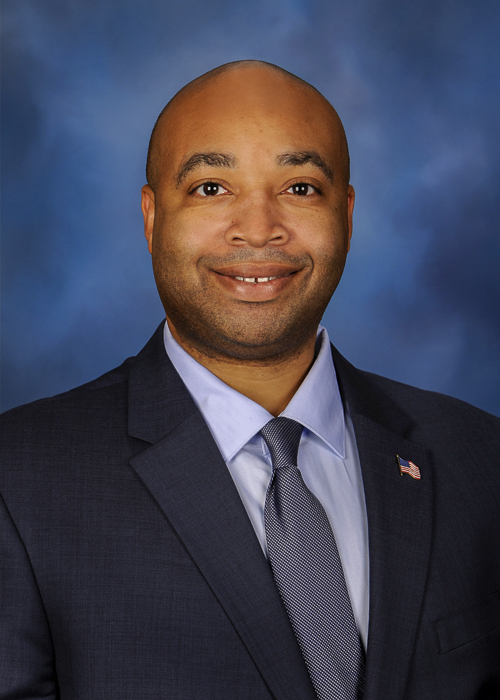
Photo of Justin Slaughter
D Illinois House · District 27 On the 2026 ballot

Rep. Justin Slaughter

Compare
Total votes
8,522
all sessions
Attendance
97%
243 missed
Higher than 86% of chamber peers
With party
99%
of cast votes
Higher than 89% of chamber peers
Bipartisan score
0%
crosses aisle rarely
Lower than 90% of chamber peers
Sponsored
1,158
bills & resolutions
Near the chamber average
Committees
4
assignments
1,158 bills and resolutions

Sponsored bills

Total
1,158
Primary
293
Co-sponsor
865
This page
1,158
matching current filters
Co-sponsor HB 3307
In committee · Illinois House · Co-sponsor
EDUCATION-TECH

Amends the Chicago School District Article of the School Code. Makes a technical change in a provision concerning the removal of a teacher or a principal.

In committee Mar 29, 2019 1 co-sponsor
Co-sponsor HB 2518
In committee · Illinois House · Co-sponsor
CRIM CD-THEFT-MINORS

Amends the Criminal Code of 2012. Provides that theft of property not from the person and not exceeding $500 in value is a petty offense if the offense was committed by a person under 18 years of age. Provides that theft of property not from the person and not exceeding $500 in value is a Class A misdemeanor if the theft was committed in a school or place of worship or if the theft was of governmental property committed by a person under 18 years of age.

In committee Mar 29, 2019 1 co-sponsor
Co-sponsor HB 2217
In committee · Illinois House · Co-sponsor
PROP TX-INCOME PRODUCING PROP

Amends the Property Tax Code. Provides that, in counties with 3,000,000 or more inhabitants, taxpayers of income producing property shall submit income and expense data related to the property annually to the chief county assessment officer. Provides that, in counties with fewer than 3,000,000 inhabitants, the county board may provide by resolution that taxpayers of income producing property shall submit income and expense data annually to the chief county assessment officer. Provides that, when determining the value of property for assessment purposes, the assessor may consider all relevant information pertaining to the fair cash value of the property, including, but not limited to, income and expense data, sales data, property characteristics data, construction cost data, appraisals, and other valuation information. Effective immediately.

In committee Mar 29, 2019 1 co-sponsor
Co-sponsor HB 2379
In committee · Illinois House · Co-sponsor
NEGLIGENT HIRING-LIMITATIONS

Creates the Limitations on Actions for Negligent Hiring Act. Provides that an action may not be brought against a party solely for hiring an employee or independent contractor who has been convicted of a nonviolent, non-sexual offense. Provides that in a negligent hiring action for the acts of an employee or independent contractor, the fact that the employee or independent contractor was convicted of a nonviolent, non-sexual offense before the beginning of the employee's or independent contractor's employment or contractual obligation may not be introduced into evidence. Provides that the new provisions do not preclude the filing of an action based upon any existing cause of action for failure of an employer or other person to provide adequate supervision of an employee or independent contractor, except that the fact that the employee or independent contractor has been convicted of a nonviolent, non-sexual criminal offense may be introduced into evidence in the suit only if: (1) the employer knew of the conviction or was grossly negligent in not knowing of the conviction; and (2) the conviction was directly related to the nature of the employee's or independent contractor's work and the conduct that gave rise to the alleged injury that is the basis of the suit. Provides exceptions in certain situations.

In committee Mar 29, 2019 1 co-sponsor
Co-sponsor HB 2814
In committee · Illinois House · Co-sponsor
MEDICAID-MANAGED CARE PAYMENTS

Amends the Medical Assistance Article of the Illinois Public Aid Code. Requires the Department of Healthcare and Family Services to require managed care organizations (MCOs) to ensure: (1) that any provider under contract with an MCO on the date of service shall be paid for any medically necessary service rendered to any of the MCO's enrollees, regardless of inclusion on the MCO's published and publicly available roster of available providers; (2) that all contracted providers are listed on an updated roster within 7 days of entering into a contract with the MCO; and (3) that the roster under item (2) is readily accessible by all medical assistance enrollees for purposes of selecting an approved healthcare provider. Requires the Department to require MCOs to expedite payments to providers based on specified criteria (rather than providing that the Department may establish a process for MCOs to expedite payments to providers based on criteria established by the Department). Contains provisions concerning discharge notifications and facility placements and other matters. Effective immediately.

In committee Mar 29, 2019 1 co-sponsor
Co-sponsor HB 1473
In committee · Illinois House · Co-sponsor
DHS-YOUTHBUILD PROGRAMS

Amends the Illinois Youthbuild Act. In language providing that the Secretary of Human Services shall make grants to applicants for the purpose of carrying out approved Youthbuild programs, deletes language providing that the grantmaking is subject to appropriation. Effective July 1, 2019.

In committee Mar 29, 2019 1 co-sponsor
Co-sponsor HB 2222
Passed · Illinois House · Co-sponsor
EMS SYSTEMS-OVERDOSE REPORTING

Amends the Emergency Medical Services (EMS) Systems Act. Provides that covered vehicle service provider personnel who treat and either release or transport to a health care facility an individual experiencing a suspected or an actual opioid overdose shall document in the patient's care report the date and time of the overdose, the location in latitude and longitude where the overdose victim was initially encountered, whether one or more doses of an opioid overdose reversal drug was administered, and whether the overdose was fatal or nonfatal when the overdose victim was initially encountered and during the transportation of the victim to a health care facility. Provides that a covered vehicle service provider shall also provide the information to a specified mapping application. Provides that the information documented by a covered vehicle service provider shall not be used in an opioid use-related criminal investigation or prosecution of the individual treated by the covered vehicle service provider personnel. Exempts from civil or criminal liability all covered vehicle service providers and covered vehicle service provider personnel who report the information in good faith. Amends the State Mandates Act to require implementation without reimbursement by the State. Effective immediately.

Passed Mar 20, 2019 1 co-sponsor
Co-sponsor HB 3796
In committee · Illinois House · Co-sponsor
JUV CT-COUNSEL & STATEMENTS

Amends the Juvenile Court Act of 1987. Provides that minors under 18 years of age (rather than 15 years of age) at the time of the commission of an act committed by an adult would be a violation of first degree murder, intentional homicide of an unborn child, second degree murder, voluntary manslaughter of an unborn child, involuntary manslaughter and reckless homicide, involuntary manslaughter and reckless homicide of an unborn child, drug-induced homicide, criminal sexual assault, aggravated criminal sexual assault, predatory criminal sexual assault of a child, criminal sexual abuse, or aggravated criminal sexual abuse, must be represented by counsel throughout the entire custodial interrogation of the minor. Provides that an oral, written, or sign language statement of a minor made without the presence of counsel during a custodial interrogation in violation of the Act on or after the effective date of the amendatory Act is inadmissible as evidence against the minor in a proceeding under the Act or under the Criminal Code of 2012. Makes a conforming change in the Code of Criminal Procedure of 1963.

In committee Feb 26, 2019 1 co-sponsor
Co-sponsor SB 1
Signed into law · Illinois Senate · Co-sponsor
MINIMUM WAGE/INCOME TAX CREDIT

Amends the Minimum Wage Law. Makes a technical change in a Section concerning the short title. Senate Floor Amendment No. 1 Deletes reference to: 820 ILCS 105/1 Adds reference to: 5 ILCS 100/5-45 from Ch. 127, par. 1005-45 35 ILCS 5/704A 820 ILCS 105/4 from Ch. 48, par. 1004 820 ILCS 105/7 from Ch. 48, par. 1007 820 ILCS 105/10 from Ch. 48, par. 1010 820 ILCS 105/11 from Ch. 48, par. 1011 820 ILCS 105/12 from Ch. 48, par. 1012 Replaces everything after the enacting clause. Amends the Illinois Income Tax Act and the Minimum Wage Law. Provides for an increase in the minimum wage and for a credit against withholding payments in relation to the increase. Increases the minimum wage to $9.25 per hour beginning January 1, 2020. Provides for annual increases in the minimum wage culminating in a minimum wage of $15 per hour beginning on January 1, 2025. Provides to employers with 50 or fewer full-time equivalent employees a credit against tax withheld beginning January 1, 2020. Reduces the credit beginning January 1, 2021. Provides employers may claim the credit amount in effect on January 1, 2025 until December 31, 2026 and that employers with no more than 5 employees may claim that credit until December 31, 2027. Authorizes the Department of Labor to perform random audits of employer to ascertain compliance with the Minimum Wage Law. Authorizes a penalty of $100 per employee for failure to maintain required records. Effective immediately. Pension Note (Government Forecasting & Accountability) There is no readily discernible fiscal impact associated with SB1, as engrossed. To the extent minimum wage workers participate in pension funds governed by the Pension Code, there could be an increase in accrued liability, but it would presumably be very small and likely actuarially insignificant. State Debt Impact Note (Government Forecasting & Accountability) This bill would not change the amount of authorization for any type of State-issued or State-supported bond, and, therefore, would not affect the level of State indebtedness. Fiscal Note (Dept of Revenue) Increasing the minimum wage to $15 per hour over 6 years increases state revenues. The positive effect on tax revenue, in the form of income and sales taxes, is only slightly offset by the negative effect on income tax revenues of the tax credit extended to eligible businesses. Overall, the net impact of this proposed legislation is an increase in state revenues of nearly $390 million by fiscal year 2027. The positive effect on tax revenue is produced by the additional income tax collection and sales tax collection given by higher wages and personal consumption expenditure in the state economy. We estimate Individual Income tax (IIT) revenue at the current individual income tax rate of 4.95 percent. The estimate for Sales Tax revenue values were decreased to account for the fact that the state does not tax services and receives no share of revenue on food for consumption off site, prescription drugs or certain medical devices. The negative effect on Income tax revenue is due to the tax credit against withholdings. The tax credit for eligible employers is a declining percentage of the wage increment defined as the differential between the employee's hourly wage from the final quarter of the previous calendar year and the State's minimum wage of the present year). The credit, applied on a calendar year basis, is set to scale down over the course of the ramp (to year 2025) at which point the calculation of the credit shifts to a flat, fixed dollar amount. The schedule of credits is as follows: 25% credit in 2020; 21% credit in 2021; 17% credit in 2022; 13% credit in 2023; 9% credit in 2024, and 5% credit in 2025. In calendar year 2026, the credit for businesses is fixed to match the credit taken in 2025; in calendar year 2027, the credit for those businesses with 5 or fewer employees is fixed to match the credit taken in 2025. In calculating the cost of the tax credit, we considered the number of minimum wage jobs increasing from $8.25 in 2019 to $10.00 in 2020, from $10.00 to $11.00 in 2021 and so on until 2027. We discounted those jobs in firms with more than 50 employees using Census bureau data on small firms in Illinois. We considered 1750 hours of work as full time in accordance with prior studies on the subject. All estimates above are static estimates, meaning that they do not account for changes in the labor supply and demand associated to the increase in labor cost. Home Rule Note (Dept. of Commerce & Economic Opportunity) This bill does not pre-empt home rule authority. State Mandates Fiscal Note (Dept. of Commerce & Economic Opportunity) This bill does create a State mandate. Balanced Budget Note (Office of Management and Budget) Please be advised that the Balanced Budget Note Act does not apply to SB 1, as it is not a supplemental appropriation that increases or decreases appropriations. Under the Act, a balanced budget note must be prepared only for bills that change a general funds appropriation for the fiscal year in which the new bill is enacted. Correctional Note (Dept of Corrections) There is no fiscal or population impact on the Department of Corrections. Judicial Note (Admin Office of the Illinois Courts) This bill would neither increase nor decrease the number of judges needed in the State of Illinois. Housing Affordability Impact Note (Housing Development Authority) This bill will have no effect on the cost of constructing, purchasing, owning, or selling a single-family residence.


Signed into law Feb 19, 2019 1 co-sponsor
Co-sponsor SB 337
Signed into law · Illinois Senate · Co-sponsor
GUN DEALER LICENSING-VARIOUS

Amends the Child Care Act of 1969. Makes a technical change in a Section concerning background investigations.

Signed into law Jan 18, 2019 1 co-sponsor
Showing 1,051 to 1,060 of 1,158 bills