Amends the Code of Criminal Procedure of 1963. Provides that there is a rebuttable presumption that the testimony of a victim who is a child under 13 years of age shall testify outside the courtroom and the child's testimony shall be shown in the courtroom by means of a 2-way closed circuit television (rather than closed circuit television). Provides that before the court permits the testimony of a victim outside the courtroom that is to be shown in the courtroom by means of a closed circuit television, the court must make a finding that the testimony by means of a 2-way closed circuit television (rather than closed circuit television) does not prejudice the defendant.
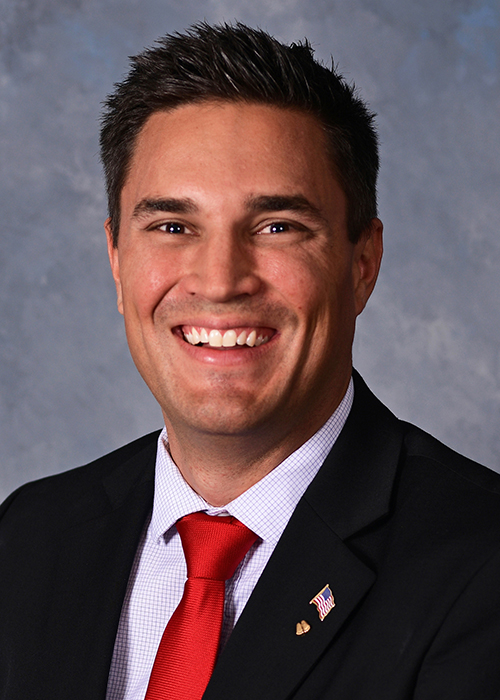
Rep. Adam Niemerg
Sponsored bills
Amends the Firearm Owners Identification Card Act. Lowers the age at which a person who is not an active duty member of the United States Armed Forces may apply for a Firearm Owner's Identification Card from 21 to 18 and provides that a person who is under 18 years of age may apply for a Firearm Owner's Identification Card without parental consent required if he or she is an active duty member of the United States Armed Forces. Provides that if the applicant is under 18 (rather than 21) years of age that he or she has never been convicted of a misdemeanor other than a traffic offense or adjudged delinquent and is an active duty member of the United States Armed Forces.
Creates the Coercive Abuse Against Mothers Prevention Act. Provides that it is illegal to coerce or force a pregnant woman to have an abortion. Provides that whoever coerces or forces a pregnant woman to have an abortion is guilty of a petty offense with a fine of $500 and a business offense with a fine of $1,500. Allows a pregnant woman injured by an abuser's violation of the Act to bring a civil suit to recover damages for such injury regardless of whether the abuser is criminally prosecuted and whether the pregnant woman has an abortion. Requires a reproductive health care facility to conspicuously post signs visible to all who enter its waiting, consultation, and procedure rooms specified notices and information. Requires a mandatory reporter to personally report every instance of alleged or suspected coerced abortion to the Department of Children and Family Services or the local law enforcement authority of the county the facility is in. Requires an attending health care professional to orally ask a pregnant woman, in a private room and without any individual accompanying her, if she is being coerced or forced to have an abortion. Provides that any mandatory reporter who has reason to believe a woman is or has been a victim of coercion and willfully and knowingly does not report such coercion, force, attempted coercion, threatened coercion, or threatened force is guilty of a business offense with a fine of $5,000. Provides that any health care professional who willfully violates the mandatory reporting requirements shall be referred to the Illinois State Medical Board for action on whether to suspend or revoke his or her license. Allows a pregnant woman injured by a facility's violation of the Act to bring a civil suit to recover damages for such injury. Makes other changes. Effective 90 days after becoming law.
Creates the Parental Notice of Abortion Act of 2025, with provisions similar to those of the Parental Notice of Abortion Act of 1995. Effective immediately.
Amends the Privileged Communications Part of the Evidence Article of the Code of Civil Procedure. Provides that a peer support advisor shall not be compelled to disclose in any court, or to any administrative board or agency, or to any public officer, a confession or admission made to him or her within his or her capacity as a peer support advisor, nor be compelled to divulge any information which has been obtained by him or her in his or her capacity as a peer support advisor. Includes legislative findings.
Creates the Universal Recognition of Occupational Licenses Act. Defines terms, including that "board" means a government agency, board, department, or other government entity that regulates a lawful occupation and issues an occupational license or government certification to an individual. Provides that, notwithstanding any other State law to the contrary, a board in the State shall issue an occupational license or government certification to a person who holds an occupational license or government certification in another state if the person satisfies specified conditions. Provides that, notwithstanding any other State law to the contrary, a board shall issue an occupational license or government certification to a person upon application based on work experience in another state if the person satisfies specified conditions. Sets forth provisions concerning State law examinations; decisions of a board; appeals; State laws and jurisdiction; exceptions to the Act; limitations of the Act; application fees; and emergency powers. Effective immediately.
Creates the COVID-19 Vaccination Employer Mandate Prohibition Act. Provides that it is unlawful for an employer in the State of Illinois to create, implement, or otherwise enforce a workplace vaccination program that requires any employee to demonstrate to the employer that he or she has received a vaccine or its related booster that was approved under emergency use authorization by the United States Food and Drug Administration. Effective immediately.
Creates the Education Savings Account Act. Requires the State Board of Education to create the Education Savings Account Program. Provides that a parent of an eligible student (defined as any elementary or secondary student who was eligible to attend a public school in this State in the preceding semester or is starting school in this State for the first time and who is a member of a household whose total annual income does not exceed an amount equal to 2.5 times the income standard used to qualify for a free or reduced-price lunch under the national free or reduced-price lunch program) shall qualify for the State Board to make a grant to his or her child's Education Savings Account by signing an agreement. Requires the State Board to deposit into an Education Savings Account some or all of the State aid under the State aid formula provisions of the School Code that would otherwise have been provided to the resident school district for the eligible student had the student enrolled in the resident school district. Provides that parents participating in the Program shall agree to use the funds deposited in their eligible students' accounts for certain qualifying expenses to educate the eligible student. Sets forth provisions concerning the calculation of grant amounts and other basic elements of the Program, administration of the Program, accountability standards for participating schools, and the responsibilities of the State Board and resident school districts.
Maddy summaryHB 2605 increases Illinois' standard income tax exemption for individual taxpayers from $2,050 to $150,000, effective immediately. This change directly affects individual Illinois residents by raising the income threshold before state income tax applies. The bill amends Section 204 of the Illinois Income Tax Act, specifically updating the "basic amount" provision in subsection (b)(8) for taxable years ending after December 31, 2025. This represents a significant policy shift from the prior $2,050 standard, reducing the tax burden for many middle- and lower-income earners.
Creates the COVID-19 Religious Exemption Act. Provides that it shall be unlawful for any person, public or private institution, or public official to discriminate against any person in any manner because of such person's refusal to obtain, receive, or accept a COVID-19 vaccination contrary to his or her belief. Requires all health care facilities to adopt written access to care and information protocols that are designed to ensure that belief-based objections do not cause impairment of patients' health and that explain how belief-based objections will be addressed in a timely manner to facilitate patient care. Provides that it is unlawful for any public or private employer, entity, agency, institution, official, or person to deny admission because of, to place any reference in its application form concerning, to orally question about, to impose any burdens in terms or conditions of employment on, or to otherwise discriminate against, any applicant, in terms of employment, admission to or participation in any programs for which the applicant is eligible, or to discriminate in relation thereto, in any other manner, on account of the applicant's refusal to obtain, receive, or accept a COVID-19 vaccination that is against the applicant's beliefs. Provides that it is unlawful for any public official, guardian, agency, institution, or entity to deny any form of aid, assistance, or benefits, or to condition the reception in any way of any form of aid, assistance, or benefits, or in any other manner to coerce, disqualify, or discriminate against any person, otherwise entitled to such aid, assistance, or benefits, because that person refuses to obtain, receive, or accept a COVID-19 vaccination contrary to the person's belief. Allows any person injured by any public or private person, association, agency, entity, or corporation by reason of any action prohibited by the Act to bring an action. Provides that a person who brings an action shall recover threefold the actual damages, the costs of the action, and reasonable attorney's fees, but in no case shall recovery for each violation be less than $2,500 plus costs of the action and reasonable attorney's fees. Makes other changes. Effective immediately.