

Maddy summaryHRES 132 is a non-binding House resolution expressing condolences for the over 36,000 earthquake victims in Türkiye and Syria and commending humanitarian response efforts. It specifically condemns the Assad regime for obstructing aid delivery and exploiting the disaster, urging the Biden administration to open all UN border crossings for aid and prevent U.S.-funded assistance from being diverted to Syria’s government. The resolution also calls for continued enforcement of the Caesar Syria Civilian Protection Act to protect Syrian civilians. As a symbolic resolution, it does not create new law but formally directs the administration’s diplomatic approach to the crisis.
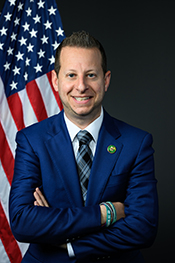
Rep. Jared Moskowitz
Sponsored bills
Maddy summaryHR 1218, the Expediting Israeli Aerial Refueling Act of 2023, requires the U.S. Air Force to train Israeli pilots and ground personnel to operate KC-46 aircraft within 60 days of enactment, including participation in the U.S. Military Personnel Exchange Program. The bill mandates the rotational deployment of U.S. KC-46 aircraft to Israel for up to five years or until Israel commissions its own KC-46s, with each deployment lasting at least 270 days annually. It directly affects the Israeli Air Force by enabling their use of U.S. refueling capabilities and the U.S. military through specific training and deployment obligations. The law expires ten years after enactment.
Maddy summaryThis bill makes it a federal crime to defraud veterans of their benefits, including benefits for dependents or survivors. It targets individuals who create schemes to steal or improperly obtain veterans' benefits, with penalties of up to five years in prison or fines. The law directly affects veterans, their families, and anyone seeking to exploit the benefits system. Key provisions define "veterans' benefits" broadly under federal law and establish criminal penalties for fraud attempts.
Maddy summaryThe Aviation Noise and Emissions Mitigation Act creates two grant programs to address noise and pollution from airports. The first program funds 3-year pilots for communities near airports to measure noise and emissions (including greenhouse gases and particulate matter) using technology that traces sources to specific aircraft and neighborhoods, with a focus on identifying disproportionately impacted areas. The second program provides grants to community groups, health departments, and local governments to implement mitigation strategies - such as noise-reducing building upgrades, health services, and environmental programs - prioritizing low-income and disadvantaged communities identified through the monitoring. Both programs require regular community engagement, public reporting, and alignment with environmental justice goals.
Maddy summaryHR 1008 adds harmful algal blooms to the list of qualifying events for federal disaster assistance under the Stafford Act, enabling affected communities to access emergency aid. It also requires the CDC to conduct a study on health effects from airborne toxins during blooms within one year of enactment, to be shared with relevant congressional committees. The bill establishes a framework for federal response but does not provide new funding or directly regulate pollution sources. It primarily affects coastal and lake communities where blooms threaten public health, tourism, and local economies through potential beach closures, fishing restrictions, and property value declines.
Humane and Existing Alternatives in Research and Testing Sciences Act of 2022 [ sic ] or the HEARTS Act of 2022 [ sic ] This bill establishes a center within the National Institutes of Health (NIH) and requires other activities to promote alternatives to using animals in research and testing. The duties of the center include developing nonanimal research models (e.g., advanced cell cultures and advanced imaging systems) and training scientists about the methods. Additionally, if a federal department or agency or federally funded research entity uses animals for research and testing, it must develop and update plans for reducing such uses and periodically report on the number and types of animals that they use to the center. The center must establish a standard process for entities to submit and update their plans and reports and for making the plans and reports publicly available. The NIH must also provide incentives for the use of nonanimal research and generally ensure that nonanimal alternatives are considered when reviewing and approving research applications and proposals. Further, NIH applications for research grants must include an assurance that nonanimal methods for carrying out the research are unavailable.
Maddy summaryHR 1088, the Shirley Chisholm Congressional Gold Medal Act, authorizes a posthumous Congressional Gold Medal to honor Congresswoman Shirley Chisholm, the first African-American woman elected to Congress (1968) and the first Black candidate for a major party's presidential nomination (1972). The bill directs the Treasury Secretary to design and strike a gold medal featuring Chisholm's image, which will be presented by Congress and then permanently displayed at the Smithsonian Institution. Duplicate bronze medals may be sold to the public to cover production costs, with proceeds deposited into the U.S. Mint fund. This bill commemorates Chisholm's legacy and achievements without creating new laws or affecting any current policies.
Maddy summaryThe Energy Resilient Communities Act creates a federal grant program to fund clean energy microgrids that keep critical community services running during climate disasters like wildfires or floods. Eligible entities - including local governments, nonprofits, and Tribal agencies - can apply for grants covering up to 90% of costs in environmental justice communities (defined as areas with high populations of people of color, low-income residents, or Tribal communities) to build microgrids supporting hospitals, schools, or medical baseline customers (e.g., those relying on life-saving medical devices). Priority is given to projects that reduce pollution, lower energy costs, create local jobs, and use U.S.-made materials, while requiring fair wages and community-focused hiring. The program mandates annual reports to Congress tracking grant use, environmental benefits, and job creation.
Maddy summaryThis bill expands health care coverage under TRICARE for military dependents. It eliminates a separate premium for young adults aged 21-26 enrolled in the TRICARE Young Adult Program, meaning they will no longer pay an extra fee for coverage. The bill also removes an eligibility restriction that previously limited coverage for some dependents in this age group. These changes directly affect military service members' adult children and spouses who rely on TRICARE Young Adult coverage. The policy update simplifies enrollment and reduces out-of-pocket costs for these beneficiaries.
Maddy summaryThis bill authorizes a single Congressional Gold Medal to honor all U.S. Army Dustoff crews who served during the Vietnam War (1962-1973). It recognizes their critical role in evacuating nearly 900,000 wounded personnel, including U.S., South Vietnamese, and allied forces, under extreme combat conditions. The medal, designed with input from the Secretary of Defense, will be presented to the U.S. Army Medical Department Museum for permanent display. Duplicate bronze medals may be sold to cover costs, but the primary action is the commemorative recognition of these crews' service.