

Essential Caregivers Act of 2025 This bill prohibits certain health care facilities from limiting the access of essential caregivers to residents of those facilities, including during designated emergency periods. Specifically, the bill generally prohibits Medicare skilled nursing facilities, Medicaid nursing facilities, Medicaid intermediate care facilities, and associated inpatient rehabilitation facilities from restricting the access of essential caregivers to residents of the facilities, including during emergency periods in which visitation rights are otherwise restricted. During emergency periods, facilities may restrict access for an initial period of up to seven days and for one additional maximum seven-day period (if the additional period is approved by the state health department). Facilities may restrict access for a total of 7 days (or 14 days with the approval of the state health department) during an emergency period. Essential caregivers must agree to comply with any safety protocols set by the facility, which may be no more stringent for caregivers compared to those for staff. Caregivers who fail to comply with these requirements may be denied access, subject to an appeals process.
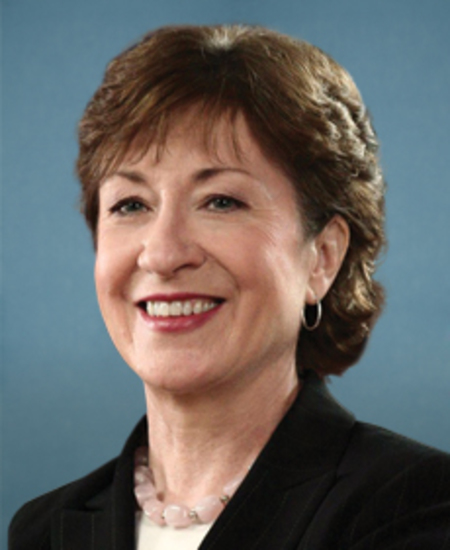
Sen. Susan M. Collins
Sponsored bills
Maddy summaryThis resolution designates December 13, 2025, as "National Wreaths Across America Day" to honor the Wreaths Across America project. It recognizes the annual tradition of placing veterans' remembrance wreaths on graves at national cemeteries and memorials across all 50 states and overseas locations, involving volunteers, the trucking industry, and patriotic escort groups like the Patriot Guard Riders. The resolution does not create new policy or affect specific groups through legislative action - it is a symbolic gesture celebrating the project’s mission to "Remember, Honor, and Teach" about veterans' sacrifices. The designation follows the project’s history of delivering over 23 million wreaths since 1992.
Maddy summaryThis bill removes waiting periods for disability and Medicare benefits for people diagnosed with metastatic breast cancer. Specifically, it amends the Social Security Act to add "metastatic breast cancer" to the list of conditions that immediately qualify individuals for disability insurance benefits (eliminating a standard 24-month waiting period) and for Medicare coverage (removing a 24-month waiting period for Medicare Part A). The changes apply only to new applications or benefit periods starting after the bill becomes law. It directly affects patients with metastatic breast cancer seeking timely access to income support and healthcare coverage.
Maddy summaryS 3427, the Domestic Organic Investment Act of 2025, creates a new USDA grant program to strengthen the domestic organic supply chain. It provides federal funding for eligible entities - including organic farmers, cooperatives, and Tribal governments - to expand storage, processing, and distribution capacity, modernize tracking systems, and improve compliance with organic standards. Grants for facility projects (e.g., cold storage) can reach up to $2 million, requiring a 50% non-federal match, while equipment-only projects receive up to $100,000 with a 25% match. The program prioritizes projects addressing import reliance and supply chain bottlenecks, aiming to boost domestic organic markets and reduce dependence on imported products.
Maddy summaryThe Saving Our Veterans Lives Act of 2025 establishes a Department of Veterans Affairs program to provide eligible veterans with secure firearm lockboxes and educational materials on safe storage, aiming to support suicide prevention. The program distributes lockboxes meeting specific safety standards (e.g., key or combination-locked, U.S.-made, non-resale) and partners with organizations to run public education campaigns, clarifying that participation does not affect lawful firearm ownership. The VA must report annually to Congress on program reach and challenges, and the bill authorizes $5 million yearly (2026-2036) to fund the initiative.
Maddy summaryS.Res. 538 designates November 2025 as "National Homeless Children and Youth Awareness Month" to highlight the issue of homelessness affecting children and youth. The resolution cites statistics showing over 1.4 million homeless children and youth in U.S. public schools during the 2022-2023 school year and emphasizes challenges like higher health risks, chronic absenteeism, and suicide rates among homeless youth. It encourages businesses, governments, and organizations to raise awareness and support efforts addressing homelessness during November 2025. As a symbolic resolution (not a law), it does not create new policies but aims to foster public attention and community action.
Maddy summaryS 3400, the Ally’s Act, requires most private health insurance plans and group health plans to cover hearing implants and related services for eligible individuals. It mandates coverage for cochlear implants, bone conduction devices, maintenance, repairs, upgrades every five years, hearing assessments, pre- and post-surgery care, and aural rehabilitation. Insurers cannot impose stricter cost-sharing or treatment limits for these services than for other medical care, and cannot deny coverage based on medical necessity determinations by a physician or audiologist. The law applies to plans covering individuals with hearing loss (including unilateral or bilateral) who meet medical criteria, effective for plan years starting January 1, 2026.
Maddy summaryThis bill requires the Department of Veterans Affairs (VA) to commission an independent study comparing the quality of mental health and addiction therapy care provided by VA health care providers versus non-VA providers. The study must assess key factors like health outcome improvements, use of evidence-based practices, coordination between providers, veteran satisfaction, and care for veterans with co-occurring conditions. It will cover various treatment settings - including telehealth, inpatient, and outpatient care - and must be completed within 18 months, with results published publicly. The study directly affects veterans receiving mental health or addiction therapy services through VA or non-VA providers. The bill does not change benefits or funding but aims to gather data to inform future care decisions.
Maddy summarySRES 531 is a non-binding Senate resolution celebrating the 50th anniversary of the Individuals with Disabilities Education Act (IDEA) on November 29, 2025. It recognizes IDEA's historical role in guaranteeing children with disabilities access to free appropriate public education in inclusive settings, transforming educational opportunities for millions. The resolution honors students, families, educators, and advocates who advanced IDEA's principles since its 1975 enactment. It does not create new policy but formally acknowledges the law's enduring impact on educational equity.
Maddy summaryS 3353, the Relief for Farmers Hit with PFAS Act, establishes a federal grant program to assist commercial farms and agricultural land affected by PFAS (chemicals found in some industrial products) contamination. Eligible states, tribes, or territories can receive funds to cover costs like monitoring health impacts, compensating for contaminated land or crops, upgrading equipment, conducting research on remediation, and providing financial aid to affected farmers. The program authorizes $500 million over five years (2026-2030), with funds prioritized for direct assistance to producers facing financial losses due to PFAS contamination. It requires annual reporting on fund usage and establishes a task force to advise on PFAS-related agricultural programs.