

Paycheck Fairness Act This bill addresses wage discrimination on the basis of sex. Specifically, it (1) limits an employer's defense that a pay differential is based on a factor other than sex to only bona fide job-related factors in wage discrimination claims, (2) enhances nonretaliation prohibitions, (3) makes it unlawful to require an employee to sign a contract or waiver prohibiting the employee from disclosing information about the employee's wages, and (4) increases civil penalties for violations of equal pay provisions. Additionally, the Equal Employment Opportunity Commission (EEOC) and the Office of Federal Contract Compliance Programs must train EEOC employees and other affected parties on wage discrimination. The bill directs the Department of Labor to (1) establish and carry out a grant program for negotiation skills training for girls and women, (2) conduct studies to eliminate pay disparities between men and women, and (3) make available information on wage discrimination to assist the public in understanding and addressing such discrimination. The bill also establishes the Secretary of Labor's National Award for Pay Equity in the Workplace for an employer who has made a substantial effort to eliminate pay disparities between men and women. Finally, the bill requires the EEOC to issue regulations for collecting from employers compensation and other employment data according to the sex, race, and national origin of employees for use in enforcing laws prohibiting pay discrimination.
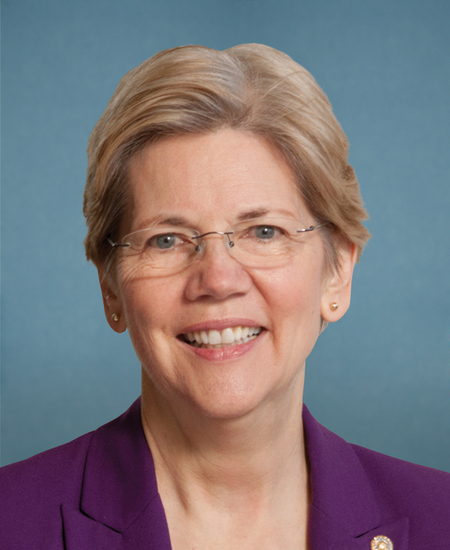
Sen. Elizabeth Warren
Sponsored bills
Spotlight Act This bill renders null and void final Internal Revenue Service (IRS) regulations published on May 28, 2020, relating to the reporting requirements of tax-exempt organizations. The bill requires tax-exempt organizations that fall under sections 501(c)(4), 501(c)(5), and 501(c)(6) of the Internal Revenue Code (e.g., social welfare organizations, labor organizations, business leagues) to disclose the names and addresses of all substantial contributors (persons who contribute more than $5,000 per year to such organizations) on their information returns. The bill also eliminates the authority of the IRS to provide exceptions to the disclosure requirements for tax-exempt organizations. This provision does not apply to determinations made by the IRS before July 16, 2018.
Climate Smart Ports Act of 2021 This bill requires the Environmental Protection Agency to establish a grant program for purchasing or installing equipment and technology to reduce pollution at ports. Specifically, the grants must be used for equipment or technology that produces zero exhaust emissions of certain pollutants and greenhouse gases or captures 100% of the exhaust emissions produced by an ocean-going vessel at berth.
Ethan's Law This bill establishes a framework to regulate the storage of firearms on residential premises at the federal, state, and tribal levels. At the federal level, the bill establishes statutory requirements for firearms on residential premises to be safely stored if a minor is likely to gain access without permission or if a resident is ineligible to possess a firearm. An individual who violates the requirements is subject to criminal penalties. A firearm stored in violation of the requirements is subject to seizure and forfeiture. At the state and tribal levels, the bill requires the Department of Justice to award grants to implement functionally identical requirements for the safe storage of firearms.
Coronavirus Containment Corps Act This bill requires the Centers for Disease Control and Prevention (CDC) to develop, within 21 days, a nationwide contact tracing strategy for COVID-19 (i.e., coronavirus disease 2019) that addresses issues including workforce needs. To implement that strategy, the bill establishes grant programs in the CDC and the Indian Health Service (IHS). It also expands programs in the Department of Labor. The CDC must award grants to state and local health departments to, among other purposes, hire and train individuals for contact tracing positions and related roles. The IHS must award similar grants to tribes and tribal organizations. Additionally, Labor must award grants for states and other jurisdictions to support recruitment and employment of dislocated workers and other individuals in public health roles. Grants and contracts that include contact tracing in their scope of work must comply with prevailing wage requirements that apply to federal service contracts. Employees who work under such grants or contracts must receive similar compensation to that prevailing in the locality where work is performed. The CDC and Labor must report certain information on specified timelines, and the Government Accountability Office must evaluate the activities of grantees.
Protecting Job Opportunities for Borrowers Act or the Protecting JOBs Act This bill prohibits a state from suspending, revoking, or denying a state-issued driver's license, teaching license, or professional license based solely on an individual's default or delinquency on a federal student loan or health education loan. Further, an aggrieved individual may bring a civil action against a state for violations.
This resolution honors the life and legacy of Henry Louis Aaron for his accomplishments on and off the baseball field and for defying racism and breaking down racial barriers in the fight for equality.
Medical Bankruptcy Fairness Act of 2021 This bill allows medically distressed debtors to exempt certain property from their estates in bankruptcy, which allows them to retain ownership of such property. Specifically, a medically distressed debtor may exempt up to $250,000 of the debtor's interest in (1) specified real or personal property that the debtor or debtor's dependent uses as a residence, or (2) a burial plot for the debtor or debtor's dependent. The bill also waives certain administrative and procedural requirements for a medically distressed debtor. Additionally, the bill allows a medically distressed debtor to discharge in bankruptcy debts for certain education loans. A debtor who seeks relief as a medically distressed debtor must attest in writing that the debtor's medical expenses are genuine and were not incurred to bring the debtor within the meaning of a medically distressed debtor under this bill.
CARES Windfall for the Wealthiest Repeal Act This bill restores and makes permanent the limitation on excess businesses losses of noncorporate taxpayers. It also allows taxpayers a carryback of their net operating losses arising in 2019 and 2020.
Inaugural Committee Transparency Act of 2021 This bill requires the presidential inaugural committee to disclose to the Federal Election Commission, by 90 days after the presidential inaugural ceremony, any disbursement made in an amount equal to or greater than $200 and the purpose of each disbursement. The committee must also disclose the name and address of the person to whom the disbursement was made, the date of the disbursement, and the total amount and purpose of the disbursement. The bill prohibits (1) an inaugural committee from soliciting or receiving a donation from a foreign national, in addition to the current ban on a committee accepting such a donation; (2) a person from making a donation to an inaugural committee in the name of another; (3) a foreign national from making a donation or making a promise to make a donation to such a committee; or (4) converting a donation to an inaugural committee to personal use. The committee must disburse any remaining donated funds not later than 90 days after the inaugural ceremony to tax-exempt charitable organizations, but may request an extension of such 90-day period.