

Commission to Study and Develop Reparation Proposals for African Americans Act This bill establishes the Commission to Study and Develop Reparation Proposals for African Americans. The commission shall examine slavery and discrimination in the colonies and the United States from 1619 to the present and recommend appropriate remedies. The commission shall identify (1) the role of the federal and state governments in supporting the institution of slavery, (2) forms of discrimination in the public and private sectors against freed slaves and their descendants, and (3) lingering negative effects of slavery on living African Americans and society.
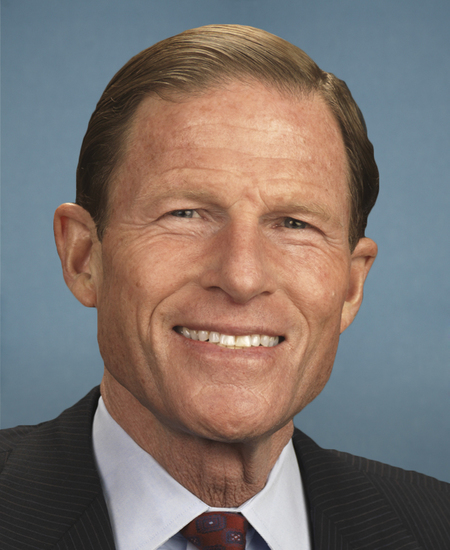
Sen. Richard Blumenthal
Sponsored bills
Kobe Bryant & Gianna Bryant Helicopter Safety Act This bill directs the Federal Aviation Administration (FAA) to issue regulations to implement National Transportation Safety Board recommendations for crash-resistant systems with respect to existing and new U.S.-registered turbine-powered rotorcraft (e.g., a helicopter) certificated for six or more passenger seats. Specifically, the FAA must require all U.S.-registered turbine-powered rotorcraft certificated for six or more passenger seats to be equipped with a flight data recorder, a cockpit voice recorder, and a terrain awareness and warning system. The FAA may exempt any civilian helicopter from one or more of the equipment requirements.
This concurrent resolution authorizes the use of the rotunda of the Capitol for the lying in state, upon death, of the last surviving Medal of Honor recipient for acts performed during World War II, if the individual or their next of kin so elects.
FEMA Empowering Essential Deliveries Act or the FEED Act This bill authorizes the Federal Emergency Management Agency (FEMA) to approve state, local, and Indian tribal government plans to partner with small and mid-size restaurants and nonprofit organizations to provide nutritious meals to individuals in need. Specifically, during the period following the President's emergency declaration of March 13, 2020, and under any subsequent major disaster declaration that supersedes it, FEMA may approve plans from state, local, and Indian tribal governments that (1) establish contracts with small and mid-sized restaurants and nonprofits, including faith-based organizations and soup kitchens, to prepare healthy meals for people in need; and (2) provide for partnerships with nonprofit organizations to purchase directly from food producers and farmers. FEMA shall waive federal matching requirements under the Robert T. Stafford Disaster Relief and Emergency Assistance Act during such period.
Health Force, Resilience Force, and Jobs to Fight COVID-19 Act of 2021 This bill establishes and expands programs to bring on individuals to perform public health functions, such as contact tracing and vaccine administration, to respond to the COVID-19 (i.e., coronavirus disease 2019) emergency and meet future public health needs. The bill provides funding for the Centers for Disease Control and Prevention (CDC) to establish a Health Force. The funds are designated as an emergency requirement, which exempts the funds from discretionary spending limits and other budget enforcement rules. To establish the force, the CDC must award grants within 30 days to state, tribal, territorial, and local governments and community health centers to recruit and train individuals for roles in public health and health care. The Federal Emergency Management Agency (FEMA) must hire and train additional individuals for its Cadre of On-Call Response/Recovery Employees. These employees may be detailed to certain federal agencies or to state, local, or tribal governments to support response efforts related to COVID-19 or other disasters or emergencies.
Direct Support for Communities Act This bill provides FY2021 supplemental appropriations to the Department of Housing and Urban Development (HUD) to award additional Community Development Block Grants to units of local government and counties to prevent, prepare for, and respond to coronavirus and the COVID-19 (i.e., coronavirus disease 2019) public health emergency. Specifically, within 30 days, HUD must distribute 50% of such funds to metropolitan cities and other units of local government and 50% to counties and parishes. These funds may be used to cover costs or replace lost, delayed, or decreased revenues stemming from the COVID-19 public health emergency. Additionally, the bill designates the funding as emergency spending, which is exempt from discretionary spending limits.
Fair Indexing for Health Care Affordability Act This bill revises the method for determining the annual per capita change in health insurance premiums for the purpose of determining the premium adjustment percentage that is used to establish the annual limits on cost sharing for health insurance plans.
This resolution honors the memory of U.S. Capitol Police Officer Brian D. Sicknick for sacrificing his life in the line of duty on January 6, 2021, and it calls for justice to be brought to those responsible for the attack on the Capitol and the death of Officer Sicknick.