

Summer Meals Act of 2021 This bill revises provisions related to the Summer Food Service Program (SFSP) of the Department of Agriculture (USDA), which provides meals to children and teens in low-income areas during the summer months when school is not in session. The bill redefines areas in which poor economic conditions exist , where the SFSP may operate, as areas in which at least 40% (currently, 50%) of the children have been determined to be eligible for free or reduced price school meals under the school lunch and breakfast programs. The bill reimburses service institutions (other than school food authorities) for up to one meal and one snack per child each day during after-school hours, weekends, and school holidays during the regular school calendar. Currently, such institutions are reimbursed for meals and snacks served to children over the summer months or to children who are on vacation under a continuous school calendar. USDA must award competitive grants to service institutions to increase participation in the summer food service program for children who lack the ability to access a congregate feeding site through (1) innovative approaches to limited transportation, (2) mobile meal trucks, and (3) any other method or approach that does not require children to access a congregate feeding site. Service institutions that are participating in the summer food service program for children may serve up to three meals, or two meals and one snack, during each day of operation. Currently, this option is reserved for camps and service institutions that serve meals primarily to migrant children.
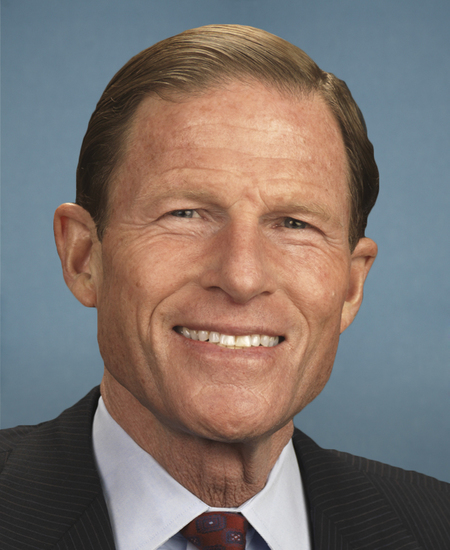
Sen. Richard Blumenthal
Sponsored bills
Gay and Trans Panic Defense Prohibition Act of 2021 This bill generally prohibits a federal criminal defendant from asserting, as a defense, that the nonviolent sexual advance of an individual or a perception or belief of the gender, gender identify or expression, or sexual orientation of an individual excuses or justifies conduct or mitigates the severity of an offense.
Help Empower Americans to Respond Act of 2021 or the HEAR Act This bill establishes a new criminal offense for the import, sale, manufacture, transfer, or possession of a firearm silencer or firearm muffler. The bill does not prohibit certain conduct with respect to a firearm silencer or firearm muffler, including the following: importation, sale, manufacture, transfer, or possession related to certain law enforcement efforts, or authorized tests or experiments; and importation, sale, transfer, or possession related to securing nuclear materials. In addition, the bill requires the Department of Justice to establish and implement a buy-back program to purchase firearm silencers and firearm mufflers. States and local governments may use Edward Byrne Memorial Justice Assistance Grant Program funds to compensate individuals who surrender firearm silencers and firearm mufflers under this buy-back program.
Family Medical Leave Modernization Act This bill expands who is permitted to take qualifying family and medical leave and provides additional leave for parents and family caregivers. The bill grants leave to private sector and federal employees to care for a domestic partner and any individual whose close association with such employees is like a family relationship, regardless of biological or legal relationship, if (1) such individual has a serious health condition, or (2) there is a qualifying exigency due to such employees' active duty in the Armed Forces. The bill entitles an employee who is a domestic partner, next of kin of a member of the Armed Forces, or any individual whose close association is like a family relationship, regardless of biological or legal relationship, to take leave to care for the service member. The bill entitles private sector and federal employees to take additional leave to participate in or attend their children's and grandchildren's school or community organization activities, meet routine family medical care needs, or care for their elderly relatives.
Choose Medicare Act This bill requires the Department of Health and Human Services (HHS) to establish public health insurance plans and addresses health insurance costs. Such public plans must be offered on health insurance exchanges and (1) meet the requirements of a qualified health plan; (2) cover benefits at the gold plan level; and (3) cover reproductive services, including abortions. Additionally, the bill makes a series of changes related to health insurance costs, including requiring employers to refer employees to health care navigators to assist with enrollment, establishing an annual limit on out-of-pocket costs for services under Medicare, providing HHS with the authority to negotiate prices under the Medicare prescription drug benefit program, expanding the premium-assistance credit by benchmarking the credit amount to the second-lowest cost gold plan and increasing the income threshold for eligibility, requiring qualified health plans to reduce cost sharing for low-income plan holders, providing funding for states to provide reinsurance to health insurance issuers and to assist individuals with out-of-pocket costs for plans offered through health insurance exchanges, applying the premium rate-setting requirements to large group health plans, and requiring HHS or states to take corrective actions to address unreasonable premium rates set by insurance issuers.
Investor Choice Act of 2021 This bill prohibits broker-dealers and investment advisers from including mandatory arbitration, forum selection restrictions, or bans on class action suits in a customer or client agreement. Issuers of securities are also prohibited from mandating arbitration in a shareholder agreement.
Guaranteed Refugee Admission Ceiling Enhancement Act or the GRACE Act This bill establishes that the maximum number of refugees admitted each fiscal year shall be no less than 125,000 and that the maximum number shall be treated as the numerical goal for refugee admissions for the applicable fiscal year. The President may set a higher number if it is justified by humanitarian concerns or is otherwise in the national interest. Currently, the number admitted each fiscal year may not exceed 50,000 unless the President determines that a higher number is justified by humanitarian concerns or is otherwise in the national interest. The bill directs the President to take into consideration information from the United Nations High Commissioner for Refugees when establishing the maximum admission number and making certain other related decisions. The President shall report to Congress quarterly on (1) the number of refugees admitted during the preceding quarter, (2) the number of aliens who were security-cleared during the preceding quarter, (3) a plan to reach the numerical goal for admitted refugees for that fiscal year, and (4) other related information.
Healthy Families Act This bill provides for paid and unpaid sick leave for employees to meet their own medical needs and those of their families. It requires employers with 15 or more employees to provide their employees with at least one hour of earned paid sick leave for every 30 hours worked, up to a maximum of 56 hours of paid sick leave in a year. An employer with fewer than 15 employees may also provide the same amount of paid sick leave, but may opt out of such requirement, in which case such employer must provide its employees at least 56 hours of unpaid leave in a year. An employee may use sick leave for absences (1) resulting from a physical or mental illness, injury or medical condition; (2) resulting from obtaining professional medical diagnosis or care, or preventive medical care; (3) to care for a child, parent, spouse, a domestic partner, or other blood or close relative; and (4) resulting from domestic violence, sexual assault, or stalking. The bill makes it unlawful for any employer to interfere with, restrain, or deny the exercise of an employee's right to accrue sick leave as provided by this bill. An employee may take legal action to enforce the right to sick leave granted by this bill and the Department of Labor must investigate complaints of violations of the requirements of this bill. Labor is authorized to conduct a public awareness campaign to educate and inform the public of the requirements for paid sick leave provided by this bill.
End Polluter Welfare Act of 2021 This bill limits or eliminates certain fossil fuel oil and gas subsidies for oil companies, including by (1) eliminating the limit on liability for offshore facilities and pipeline operators; (2) eliminating the authority of the Department of Energy to carry out the Fossil Energy Research and Development Program and prohibiting funds made available to the Advanced Research Project Agency from being used to carry out any project that supports fossil fuels; (3) terminating certain provisions relating to enhanced oil recovery, producing oil and natural gas from marginal wells, and limitations on percentage depletion for oil and natural gas wells; (4) terminating other deductions and accounting methods supporting oil, natural gas, and coal companies; (5) increasing the Oil Spill Liability Trust Fund financing rate; (6) denying a tax deduction for removal costs and damages relating to oil spills; (7) imposing an excise tax on the removal price of any taxable crude oil or natural gas; (8) increasing amortization periods for tertiary injectant expenses, development expenditures of a mine or other natural deposit, mining exploration expenditures, and intangible drilling and development costs for oil and gas wells and geothermal wells; (9) repealing the tax credits for the production of electricity from refined coal and for carbon oxide sequestration; and (10) requiring a study and elimination of certain other fossil fuel subsidies.
Affordable Housing Credit Improvement Act of 2021 This bill revises provisions of the low-income housing tax credit and renames it as the affordable housing credit . The bill increases the per capita dollar amount of the credit and its minimum ceiling amount beginning in 2021 and extends the inflation adjustment for such amounts. The bill modifies tenant income eligibility requirements and the average income formula for determining such income. It also revises rules for student occupancy of rental units and tenant voucher payments, and prohibits any refusal to rent to victims of domestic abuse. The bill further modifies the credit to increase state allocations of the credit; repeal the qualified census tract population cap; prohibit local approval and contribution requirements; increase the credit for certain projects designated to serve extremely low-income households; increase the credit for certain bond-financed projects designated by state agencies; eliminate the basis reduction for properties that receive certain energy-related tax benefits; and increase the population cap for difficult development areas (i.e., areas with high construction, land, and utility costs relative to area median gross income). The bill also includes Indian and rural areas as difficult development areas and modifies other requirements relating to casualty losses, acquisition credits, and foreclosures.