This resolution extends condolences to the family and friends of former Vice President Walter Mondale. The resolution acknowledges Mondale's lifetime service to the United States, including as a U.S. Senator and as the first presidential candidate from a major party to select a woman, Geraldine Ferraro, as his running mate.
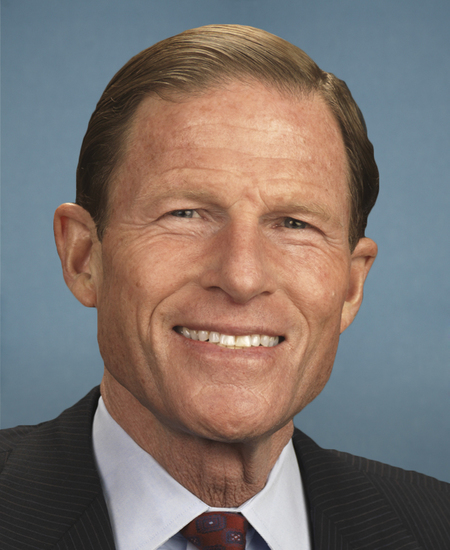
Sen. Richard Blumenthal
Sponsored bills
This resolution honors and recognizes the service provided to veterans by Veterans Service Organizations (VSOs) during the COVID-19 (i.e., coronavirus disease 2019) pandemic and commends their efforts to improvise and adapt to the challenges posed by COVID-19. The resolution also supports efforts by VSOs to enable veterans, their families, and their caregivers to receive the COVID-19 vaccine.
Protecting Americans from the Risks of Keyless Ignition Technology Act or the PARK IT Act This bill directs the Department of Transportation (DOT) to finalize regulations relating to automatic shutoff systems for motor vehicles and standards to prevent the movement of vehicles in specific situations. Specifically, DOT must require manufacturers to install technology in each motor vehicle (not including a battery electric vehicle) with a keyless ignition device and an internal combustion engine to automatically shut off the vehicle after the vehicle has idled for a period necessary to prevent carbon monoxide poisoning. Additionally, it must be installed in each motor vehicle with a keyless ignition device and automatic transmission to prevent movement (i.e., rollaway) of the vehicle if (1) the transmission of the vehicle is not in the park setting, (2) the vehicle does not exceed the speed determined by DOT, (3) the door for the operator of the vehicle is open, (4) the seat belt of the operator of the vehicle is unbuckled, and (5) the service brake of the vehicle is not engaged.
Debt-Free College Act of 2021 This bill establishes measures to cover the unmet financial need of students who are enrolled at certain institutions of higher education (IHEs). Unmet financial need refers to the difference between a student's cost of attendance and the student's expected family contribution, plus any federal, state, and local sources of grant aid. In addition, the bill makes certain Dreamer students (i.e., students who have been granted Deferred Action for Childhood Arrivals status) eligible for federal financial aid. First, the bill requires the Department of Education (ED) to award grants for state-federal partnerships with a goal of providing debt-free college for all eligible students at in-state public IHEs. Eligible student refers to an individual who (1) is enrolled or is eligible to enroll in an in-state public IHE, (2) completes a Free Application for Federal Student Aid or demonstrates eligibility for a Federal Pell Grant through institutional financial-aid eligibility forms, and (3) demonstrates satisfactory academic progress. Next, the bill requires ED to award grants to historically Black colleges and universities and minority-serving institutions to cover the unmet financial need of enrolled students. ED must establish an office to administer grants and provide oversight. In addition, the bill makes Dreamer students who entered the United States before the age of 16 and who meet certain educational criteria eligible for federal student aid.
Northern Rockies Ecosystem Protection Act This bill designates specified National Forest System lands, National Park System lands, and public lands in Idaho, Montana, Oregon, Washington, and Wyoming as wilderness and as components or additions to existing components of the National Wilderness Preservation System. The bill also designates specified federal lands as biological connecting corridors and as special corridor management areas. The Department of the Interior and the Department of Agriculture (USDA) shall accept the donation of valid existing permits or leases authorizing grazing on specified public lands or National Forest System lands. The bill designates segments of specified rivers and creeks in Idaho, Montana, and Wyoming as components of the National Wild and Scenic Rivers System. The bill designates specified areas as wildland recovery areas. USDA shall develop a wildland recovery plan for each recovery area. A panel of independent scientists shall study roadless lands greater than 1,000 acres that are within the National Forest System in the Wild Rockies bioregion in Idaho, Montana, Oregon, Washington, or Wyoming, but not designated as components of the National Wilderness Preservation System, for their role in maintaining biological diversity. The bill prohibits road construction, timber harvest, oil or gas leasing, mining, or other development that impairs the natural and roadless qualities of the land.

College for All Act of 2021 This bill establishes measures to expand access to higher education, including by eliminating tuition and required fees for eligible students, revising the Federal Pell Grant program, and reauthorizing certain programs to assist students from disadvantaged backgrounds. Specifically, the bill provides funding to eliminate tuition and required fees for (1) all students at community colleges and two-year tribal colleges and universities; (2) working- and middle-class students at four-year public institutions of higher education (IHEs) and tribal colleges and universities; and (3) eligible students at private, nonprofit historically Black colleges and universities (HBCUs) and minority-serving institutions. The bill permanently reauthorizes and otherwise revises the Federal Pell Grant program by providing funding to increase the maximum award for each eligible student, increasing the duration limit for the use of Pell Grants, and allowing students to use their awards to cover living and non-tuition expenses. Next, the bill makes Dreamer students (i.e., students who have been granted Deferred Action for Childhood Arrivals status) who entered the United States before the age of 16 and who meet certain educational criteria eligible for federal financial aid. Further, the bill requires the Department of Education to award grants to underfunded IHEs, HBCUs, and minority-serving institutions for investing in support programs to improve student outcomes (e.g., graduation rates). The bill also reauthorizes through FY2031 the Federal TRIO Programs and reauthorizes through FY2025 the Gaining Early Awareness and Readiness for Undergraduate Programs.
Fourth Amendment Is Not For Sale Act This bill generally prohibits law enforcement and intelligence agencies from obtaining U.S. customer or subscriber records or any illegitimately obtained information from a third party in exchange for anything of value (e.g., purchasing such information). Records or information obtained in violation of this bill are inadmissible as evidence in any trial, hearing, or other legal proceeding.
Medicare at 50 Act This bill establishes a Medicare buy-in option for certain qualifying individuals and also repeals restrictions relating to prescription drug prices under the Medicare prescription drug benefit. Specifically, the bill allows individuals aged 50 to 64 to enroll in Medicare if such individuals would otherwise qualify for Medicare at the age of 65. The Centers for Medicare & Medicaid Services (CMS) must determine enrollment periods and set premiums for the buy-in option established under the bill, in accordance with specified requirements. The CMS must also award grants to states and nonprofit organizations for outreach and enrollment activities relating to the buy-in option. The bill also repeals provisions that prohibit the CMS from negotiating the prices of prescription drugs or from establishing a formulary under the Medicare prescription drug benefit.
Access to Healthy Food for Young Children Act of 2021 This bill revises several provisions related to the Child and Adult Care Food Program. These revisions include increasing reimbursement rates; requiring reimbursements to be adjusted annually to reflect the Consumer Price Index for food away from home, rather than the Consumer Price Index for food at home used under current law; providing for an additional meal service to be served in child care settings with eight or more hours between the first meal service and the beginning of the fourth meal service; expanding geographical eligibility for tier I family or group day care homes; and requiring the Department of Agriculture to establish an advisory committee to examine the feasibility of reducing unnecessary or duplicative paperwork for those participating or seeking to participate in the program. The bill also provides funding to (1) provide nutrition training and technical assistance under the program, and (2) increase the participation of children from underserved communities.
Lethal Means Safety Training Act This bill requires the Department of Veterans Affairs (VA) to update its Lethal Means Safety and Suicide Prevention training course at least once a year to ensure it is culturally appropriate and uses best practices identified by subject matter experts (e.g., veterans service organizations). The bill requires certain VA employees and care providers to take the most recently updated version of the training course within 90 days after the person is hired, agrees to furnish care, or receives support and at least annually thereafter. Specifically, the bill requires the following categories of VA employees or care providers to take the training course: employees of the Veterans Health Administration or Veterans Benefits Administration who regularly interact with veterans, compensation and pension examiners, employees of Vet Centers or vocational rehabilitation facilities, employees of Veterans Community Care Providers who provide care to veterans, and caregivers receiving support under the Program of Comprehensive Assistance for Family Caregivers or the Program of General Caregiver Support Services. The VA must publish the training course on a publicly available VA website. Additionally, the VA must publish a report on its website that includes the percentage of individuals in each category who have completed such training.