

This bill repeals the limitation on the amount of distilled spirits excise tax covered over (paid) to the treasuries of the U.S. Virgin Islands and the Commonwealth of Puerto Rico. The bill requires certain amounts of the excise tax paid to the treasury of Puerto Rico to be transferred to the Puerto Rico Conservation Trust Fund.
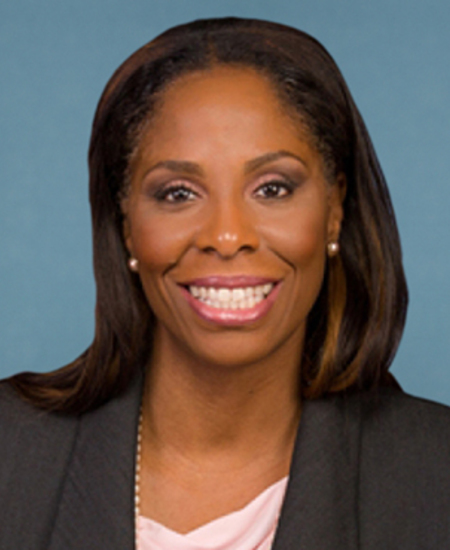
Rep. Stacey E. Plaskett
Sponsored bills
Supporting Medicaid in the U.S. Territories Act of 2021 This bill extends, increases, and otherwise modifies Medicaid funding for U.S. territories. Specifically, the bill extends (1) the temporarily increased Federal Medical Assistance Percentage (i.e., federal matching rate), and (2) a higher cap on Medicaid funding. Such provisions apply to Puerto Rico through FY2026 and to other territories through FY2029. The bill also requires Puerto Rico to implement an asset verification program and to report on its ability to comply with certain reporting requirements, procurement standards, and other Medicaid program integrity measures.
End Double Taxation of Successful Consumer Claims Act This bill allows a deduction from gross income (above-the-line deduction) for attorney fees and court costs in connection with a claim of a consumer protection violation.
Pathways to Health Careers Act This bill provides funding for, reauthorizes through FY2026, and makes a variety of changes to certain grants administered by the Department of Health and Human Services that provide education and training to low-income individuals for health care occupations, including by establishing a new competitive grant for projects designed to train low-income individuals in allied health professions.
This bill sets forth special tax rules for determining whether financial guaranty insurance companies are qualifying insurance corporations under the passive foreign investment company rules.
Food and Nutrition Education in Schools Act of 202 1 This bill directs the Department of Agriculture (USDA) to establish a Food and Nutrition Education in Schools Pilot Program to award grants to local educational agencies for (1) projects that hire qualified, full-time food and nutrition educators to carry out programs in schools that have the goal of improving student health and nutrition; and (2) projects that fund school gardens or other evidence-based interventions relating to student health and nutrition, aligned with the latest school nutrition standards, to create hands-on learning opportunities for students. In awarding grants under the program, USDA must prioritize projects that serve schools or districts (1) in which not less than 40% of students qualify for free or reduced-price meals, or (2) that include neighborhoods with high rates of childhood obesity or other diet-related diseases. Additionally, it must give priority to projects that provide programming in summer months and those that are joint partnership projects.
Vanessa Guillén Military Justice Improvement and Increasing Prevention Act This bill modifies the process and policy related to the disposition of charges and convening of courts-martial for certain sexual assault cases and other specified offenses under the Uniform Code of Military Justice (UCMJ). Among other elements, the bill provides that the determinations on the preferral, disposition, and referral of charges for specified offenses under the UCMJ must be made by a commissioned officer of the Armed Forces who is designated as a court-martial convening authority (in grade O-6 or higher) and who is available for detail as trial counsel, has significant trial experience, and is outside the chain of command of the member subject to the charges.
Chronic Kidney Disease Improvement in Research and Treatment Act of 2021 This bill modifies provisions relating to Medicare coverage of treatments for chronic kidney disease. Specifically, the bill expands the Medicare annual wellness visit to include chronic kidney disease screening and allows certain Medicare beneficiaries who have End Stage Renal Disease (ESRD) to enroll in Medicare supplemental policies. It also (1) provides for alternative payment methodologies for certain new drugs, biologics, and devices that are renal dialysis services; (2) revises quality measures; (3) establishes an incentive payment methodology; and (4) increases access to kidney disease education services. The bill also extends the coordination period (from 30 months to 42 months) during which private health insurers may serve as the primary payers for Medicare beneficiaries with ESRD.
Offshore Wind for Territories Act This bill addresses offshore wind development in certain submerged lands off the U.S. territories and coral reef conservation. Specifically, the bill requires the Department of the Interior to study the feasibility of conducting wind lease sales on the Outer Continental Shelf in the U.S. Exclusive Economic Zone adjacent to U.S. territories. If the study determines that such leases are feasible, then Interior must conduct wind lease sales in those areas as specified by this bill. In addition, the bill establishes the Coral Reef Conservation Fund for the Department of Commerce to carry out the Coral Reef Conservation Act of 2000, including to preserve, sustain, and restore the condition of coral reef ecosystems. The bill also specifies requirements for distributing revenues from the leases authorized by this bill to the Treasury, the Coral Reef Conservation Fund, and U.S. territories.
Shovel-Ready Restoration Grants for Coastlines and Fisheries Act of 2021 This bill requires the National Oceanic and Atmospheric Administration (NOAA) to establish a grant program for states, tribal and local governments, and other entities to implement projects that restore a marine, estuarine, coastal, or Great Lakes habitat, or that provide adaptation to climate change. NOAA must prioritize projects that (1) stimulate the economy; (2) begin within 90 days after an entity is awarded a grant; (3) employ fishermen who have been negatively impacted by the COVID-19 (i.e., coronavirus disease 2019) pandemic or pay fishermen for the use of a fishing vessel; (4) demonstrate any required studies or permits have been completed or can be completed shortly after an award is made; or (5) include communities that may not have adequate resources, including communities of color, and low-income, tribal, indigenous, and rural communities.