Natural Gas Export Expansion Act This bill revises requirements regarding natural gas imports or exports to expand the expedited application and approval process to any nation, even if not a party to a free trade agreement with the United States, that is not specifically excluded by this bill. The bill excludes any nation subject to sanctions or trade restrictions imposed by the United States or excluded by the President or Congress for national security reasons.
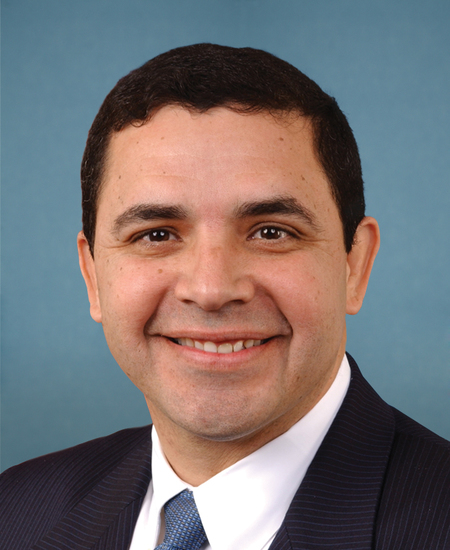
Rep. Henry Cuellar
Sponsored bills
Amputation Reduction and Compassion Act of 2021 or the ARC Act of 2021 This bill provides for coverage of peripheral artery disease screening tests without cost-sharing under Medicare, Medicaid, and private health insurance for certain at-risk individuals, and requires the development of certain educational programs and Medicare quality measures to reduce amputations relating to such disease.
Rural Opportunities to Use Transportation for Economic Success Act or the ROUTES Act This bill provides statutory authority for the Rural Opportunities to Use Transportation for Economic Success (ROUTES) Initiative at the Department of Transportation (DOT). The purpose of the initiative is to (1) improve analysis of rural projects applying for DOT discretionary grants, including ensuring that project costs, local resources, and the larger benefits to the American people and economy are appropriately considered; and (2) provide rural communities with technical assistance for meeting transportation infrastructure investment needs in a financially sustainable manner. To carry out the mission of the initiative, DOT must establish the ROUTES Council.
Fire Fighters and EMS Employer-Employee Cooperation Act This bill requires the Federal Labor Relations Authority to determine whether a state substantially provides fire and emergency medical services (EMS) personnel the right to form and join a labor organization; recognition by fire and EMS employers of the employees' labor organization, agreement to bargain with the organization, and reduction of any agreements to writing in a contract or memorandum of understanding; the right to bargain over hours, wages, and terms and conditions of employment; and arbitration or other mechanisms to resolve an impasse in collective bargaining negotiations. The bill makes the authority responsible for (1) determining the appropriateness of units for labor representation; (2) supervising elections; (3) conducting hearings and resolving complaints of unfair labor practices; and (4) protecting the right of employees to form, join, or assist any labor organization, or to refrain from doing so. An employer, fire and EMS personnel, or labor organization may not engage in a lockout, sickout, work slowdown, strike, or any other organized job action that will measurably disrupt the delivery of emergency services and is designed to compel an employer, fire and EMS personnel, or labor organization to agree to the terms of a proposed contract.

Tax Fairness for Workers Act This bill allows an above-the-line tax deduction for union dues and expenses. (An above-the-line deduction is subtracted from gross income and is available whether or not a taxpayer itemizes other deductions.) The bill also reinstates the miscellaneous itemized tax deduction for unreimbursed expenses attributable to the performance of services as an employee (Under current law, all miscellaneous itemized deductions are suspended through 2025).
Affordable Housing Credit Improvement Act of 2021 This bill revises provisions of the low-income housing tax credit and renames it as the affordable housing credit . The bill increases the per capita dollar amount of the credit and its minimum ceiling amount beginning in 2021 and extends the inflation adjustment for such amounts. The bill modifies tenant income eligibility requirements and the average income formula for determining such income. It also revises rules for student occupancy of rental units and tenant voucher payments, and prohibits any refusal to rent to victims of domestic abuse. The bill further modifies the credit to increase state allocations of the credit; repeal the qualified census tract population cap; prohibit local approval and contribution requirements; increase the credit for certain projects designated to serve extremely low-income households; increase the credit for certain bond-financed projects designated by state agencies; eliminate the basis reduction for properties that receive certain energy-related tax benefits; and increase the population cap for difficult development areas (i.e., areas with high construction, land, and utility costs relative to area median gross income). The bill also includes Indian and rural areas as difficult development areas and modifies other requirements relating to casualty losses, acquisition credits, and foreclosures.
Commission to Study and Develop Reparation Proposals for African Americans Act This bill establishes the Commission to Study and Develop Reparation Proposals for African Americans. The commission shall examine slavery and discrimination in the colonies and the United States from 1619 to the present and recommend appropriate remedies. The commission shall identify (1) the role of the federal and state governments in supporting the institution of slavery, (2) forms of discrimination in the public and private sectors against freed slaves and their descendants, and (3) lingering negative effects of slavery on living African Americans and society.
Preserving Family Farms Act of 2021 This bill increases to $11.7 million (currently, $750,000) the limitation on the special use valuation for farmland or other trades or businesses for estate tax purposes. The increased amount is adjusted for inflation for estates of decedents dying after 2021.
This resolution condemns Iranian state-sponsored terrorist attacks against U.S. citizens and officials and Iranian dissidents and expresses support for the people of Iran who are engaged in legitimate and peaceful protests against the Iranian regime.
Border Surge Response and Resilience Act This bill requires the Department of Homeland Security (DHS) to develop a plan for responding to irregular increases in migration at the border that present risks to border security. The plan shall include various elements including (1) a list of each agency, component, and office involved; (2) a process for quickly expanding capacity to temporarily process and hold individuals; and (3) a strategy for coordinating with local governments and other entities when DHS releases detained individuals. DHS must also identify metric thresholds for determining when to activate the plan and must activate the plan when such thresholds are satisfied. Furthermore, DHS must notify Congress no later than 14 days after activating the plan.