Accountable Care in Rural America Act This bill requires the Centers for Medicare & Medicaid Services (CMS) to exclude certain components from a methodology used under the Medicare Shared Savings Program. The program enables accountable care organizations (ACOs) to receive payments for savings stemming from care coordination and management. Specifically, the bill requires the CMS to exclude an ACO's assigned Medicare fee-for-service beneficiaries from certain regional adjustments to the ACO's benchmark for savings determinations, and to otherwise ensure that an ACO is not in a less favorable financial position due to its share of assigned beneficiaries in the region.
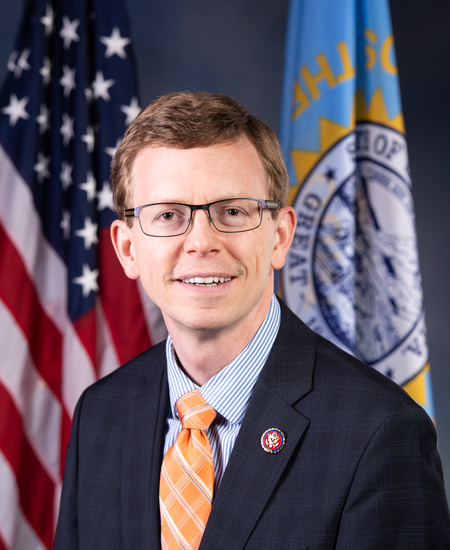
Rep. Dusty Johnson
Sponsored bills
Adopt the Greenhouse gases, Regulated Emissions, and Energy use in Transportation model Act or the Adopt GREET Act This bill requires the Environmental Protection Agency (EPA) to update the methodology used in life-cycle analyses of greenhouse gas emissions that result from the production and use of corn-based ethanol and biodiesel fuel. The EPA must update its methodology within 90 days and every five years thereafter. In the first update, the EPA must adopt the most recent Greenhouse gases, Regulated Emissions, and Energy use in Transportation model (commonly referred to as the GREET model) developed by Argonne National Laboratory.
This resolution condemns the rocket attacks by Hamas against Israel beginning the week of May 9, 2021. It also states that the United States must continue to invest in and support Israel's security and sovereignty.
Guarding Readiness Resources Act of 2021 This bill modifies the treatment of funds received by the National Guard Bureau as a reimbursement from a state or other U.S. territory (e.g., Guam) for the use of military property. Specifically, the funds must be credited to (1) the appropriation, fund, or account used in incurring the obligation; or (2) an appropriation, fund, or account currently available for the purposes of which the expenditures were made. Such funds must be treated as a reprogramming request and may only be obligated or disbursed after the National Guard Bureau submits a written request and receives authorization from Congress. The National Guard Bureau must annually submit an account of the use of funds disaggregated by appropriation and subactivity group.
United States Army Rangers Veterans of World War II Congressional Gold Medal Act This bill provides for the award of a single Congressional Gold Medal to the U.S. Army Rangers Veterans of World War II in recognition of their dedicated service during World War II.
Advancing Emergency Preparedness Through One Health Act of 2021 This bill requires interagency coordination to respond to zoonotic diseases through a One Health Program. A One Health Program recognizes the interconnection between people, animals, plants, and their shared environment. Specifically, the Department of the Interior, the Department of Health and Human Services, and the Department of Agriculture must develop a framework to coordinate federal activities to reduce hazards to human and animal health under the One Health Program. These departments must work with other federal entities on the framework, including the Department of Commerce. This framework must establish goals, identify activities necessary to achieve those goals, and recommend legislation or other actions to advance One Health efforts. Additionally, the Government Accountability Office must evaluate this framework and its implementation.
Biodiesel Tax Credit Extension Act of 2021 This bill extends the income and excise tax credits for biodiesel and renewable diesel used as fuel through 2025.
Recognizing Military Service in PSLF Act This bill requires the Department of Education to count each month for which a borrower's federal student loan payment was in deferment or forbearance during a period of active duty, including certain National Guard duty, as a qualifying payment for the purpose of the Public Service Loan Forgiveness (PSLF) program. Under current law, a borrower who is a service member is eligible to receive student loan forgiveness under the PSLF program; however, if the borrower places their loan into deferment or forbearance while they are on active duty, that period of time does not count as a qualifying payment for the PSLF program.
Agricultural Security Risk Review Act This bill expands the membership of the Committee on Foreign Investment in the United States to include the Secretary of Agriculture. (The committee reviews the national security implications of certain foreign investments in U.S. businesses or real estate, including critical infrastructure or technologies.)
Surface Transportation Advanced through Reform, Technology, and Efficient Review Act 2.0 or the STARTER Act 2.0 This bill addresses provisions related to federal-aid highway, transit, highway safety, motor carrier, innovation, and resiliency programs of the Department of Transportation (DOT). It also sets forth requirements for the operation of railroad freight cars in the United States. For example, the bill extends FY2020 enacted levels through FY2026 for federal-aid highway, transit, and safety programs. DOT must provide competitive grants for projects to provide parking for commercial motor vehicles on the federal-aid highway system; establish a discretionary program to award competitive grants for eligible projects that encourage economic viability of the nation, a metropolitan area, or a region; create a public awareness campaign to reduce instances of driving while under the influence of prescription and over-the-counter medications; and promulgate regulations to implement an apprenticeship program for licensed commercial motor vehicle drivers under the age of 21. The bill also establishes new competitive grant programs to spur innovation of connected vehicle applications into operational deployments and to test the safe integration of automated driving system technologies into the on-road transportation system. Additionally, the bill addresses projects to improve the resiliency of federal-aid highways and bridges on and off the National Highway System. Further, the bill prohibits the operation of railroad freight cars in the United States that have been manufactured or assembled by certain foreign countries or that contain sensitive technology from such countries.