

Maddy summaryThis bill requires the Secretary of Energy to conduct a study on how data centers impact communities of color and low-income communities, working with agencies like the EPA and the Council on Environmental Quality. The study will examine specific issues including water and energy consumption, air and soil quality, effects on property values and local tax revenue, and public health risks related to pollution and heat. The Secretary must consult with local governments and Indian Tribes during the study and submit a report to Congress within 18 months that includes a map of data center locations relative to affected communities, along with recommendations for mitigating potential harms.
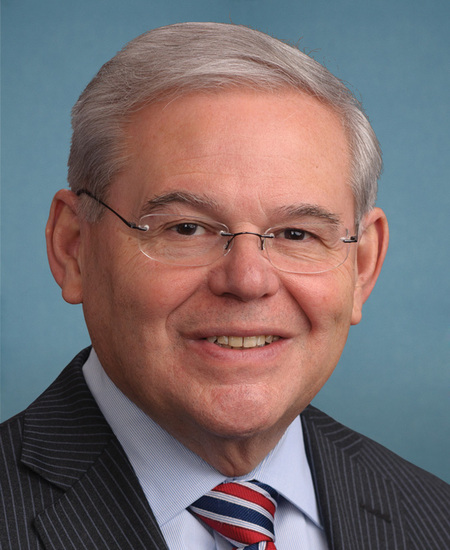
Rep. Robert Menendez
Sponsored bills
Maddy summaryThis bill, titled the Toll Evasion Prevention and Plate Visibility Act of 2026, prohibits the sale of products designed to obscure license plates and bans the sale of counterfeit or altered plates. It gives the Federal Trade Commission authority to enforce these rules and allows the Federal Highway Administration to issue guidance on plate design and frames that affect readability. The legislation also establishes a grant program to help states and local agencies develop technology systems to identify vehicles that evade tolls and provides $10 million in funding from 2027 to 2030 for these efforts.
Maddy summaryHRES 1106 is a non-binding House resolution honoring the life and legacy of Rev. Jesse Louis Jackson, Sr., a prominent civil rights leader and activist. The resolution recognizes his lifelong work in advancing equality through organizations like Operation PUSH, his leadership in the anti-apartheid movement, and his historic presidential campaigns in 1984 and 1988. It expresses condolences to his family and calls on all Americans to continue his legacy of promoting civil rights and unity. As a commemorative resolution, it does not create new laws or affect any policies.
Maddy summaryThis bill, known as the Direct File Act of 2026, would establish a government-run online system allowing taxpayers to prepare and file their individual income tax returns for free. The legislation prohibits the Treasury Department from entering into agreements that restrict its ability to provide tax preparation or filing services, and it voids any existing contracts with such restrictions. The program would use IRS data to simplify filing, include customer support, be available in multiple languages, and allow users to file even if they are not required to. It also enables taxpayers in participating states to file state and local returns alongside their federal returns, with funding provided to states that meet certain standards.
Maddy summaryThe DISCLOSE Act of 2026 aims to increase transparency in election spending and prevent foreign influence. It expands the ban on foreign money to cover federal, state, and local elections, including ballot initiatives and judicial nominations, and criminalizes using corporations to conceal these funds. The bill mandates that organizations spending over $10,000 on campaign-related activities, such as independent expenditures or judicial nomination advocacy, disclose their beneficial owners and top donors. Additionally, it establishes new "Stand By Every Ad" disclaimers for political communications, requiring the highest-ranking official to approve the message and, for certain ads, list their top funders. These provisions directly affect non-candidate organizations, individuals involved in political and judicial nomination spending, and foreign nationals.
Maddy summaryThis bill, titled the Parks to People Active Transportation Act, directs the U.S. Department of Transportation to create a competitive grant program for building and improving greenway paths that connect communities. Eligible organizations such as state and local governments, regional planning councils, and Indian Tribes can apply for funding to construct hard-surfaced walkways, bikeways, or shared-use paths that cross jurisdictional lines and link to public transit. The program prioritizes projects that reduce vehicle congestion, improve safety for pedestrians and cyclists, and address disparities in access to jobs, schools, and recreational opportunities for low-income and minority communities. Grants may cover up to 80 percent of project costs, with higher funding levels available for rural areas and communities with high poverty rates, and the legislation authorizes $300 million annually from 2027 through 2031 to support these initiatives.
Maddy summaryHR 7599 creates a federal framework for extreme risk protection orders (ERPOs), allowing family members or law enforcement to petition courts to temporarily prohibit individuals from possessing firearms when they pose a risk of harm to themselves or others. The bill establishes a process for issuing ex parte orders (up to 14 days) followed by a hearing within 72 hours to determine if a longer-term order (up to 180 days) should be issued, requiring respondents to surrender firearms to U.S. Marshals or designated law enforcement. Courts must consider specific factors like recent threats, violence, substance abuse, or cruelty to animals before issuing orders, with no fees for petitioners. The law requires law enforcement training to address bias, includes annual reporting requirements, and ensures firearms are returned once the order expires and the individual is eligible to own firearms under federal law.
Maddy summaryThis bill requires most employers to provide workers with earned paid sick leave. Employees would earn 1 hour of paid sick time for every 30 hours worked, up to 56 hours per year, which can be used for their own illness, medical care, caring for family members (including children, parents, spouses, domestic partners, or other family-like relationships), or addressing domestic violence, sexual assault, or stalking situations. The bill prohibits employers from retaliating against workers who use this leave and requires employers to inform employees about their rights. It ensures that workers who leave and return to the same employer within a year can reinstate their unused sick leave. This law would not override more generous state or local paid leave policies.
Maddy summaryHRES 1058 is a non-binding House resolution recognizing the federal government’s duty to develop a Transgender Bill of Rights. It calls for specific policy changes, including amending civil rights laws to explicitly prohibit discrimination based on gender identity in employment, housing, and public accommodations; protecting access to gender-affirming medical care; and streamlining legal recognition of gender identity on federal documents like passports and voter registration. The resolution also proposes expanding protections for transgender and nonbinary individuals in healthcare, education, immigration, and correctional facilities, while emphasizing community-led policy development. As a resolution, it does not create new law but sets a framework for future legislative action.
Department of Homeland Security Appropriations Act, 2026 This bill provides FY2026 appropriations for various agencies and offices within the Department of Homeland Security (DHS), except for U.S. Immigration and Customs Enforcement (ICE), U.S. Customs and Border Protection (CBP), and management and oversight activities of the Office of the Secretary. Specifically, the bill provides appropriations to DHS for the Federal Protective Service, the Office of Inspector General, the Transportation Security Administration, the U.S. Coast Guard, the U.S. Secret Service, the Cybersecurity and Infrastructure Security Agency, the Federal Emergency Management Agency (FEMA), U.S. Citizenship and Immigration Services, the Federal Law Enforcement Training Centers, and the Science and Technology Directorate. The bill does not provide appropriations for some agencies and activities that have been funded in prior DHS appropriations acts, including ICE, CBP, and management and oversight activities of the Office of the Secretary.