Community Bank Relief Act of 2021 This bill requires banking agencies to set the community bank leverage ratio between 8% and 8.5% for calendar years 2022, 2023, and 2024 for community banks seeking to satisfy simplified capital adequacy requirements. Currently, banking agencies are statutorily required to set the rate between 8% and 10% through rulemaking. Under current regulations, the rate will increase from 8.5% to 9% on January 1, 2022.
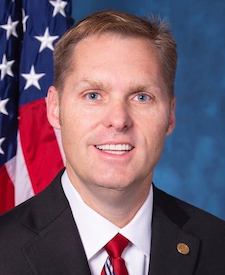
Rep. Michael Guest
Sponsored bills
9/11 Memorial and Museum Act This bill directs the Department of Homeland Security (DHS) to award to the official organization that operates the National September 11 Memorial & Museum a one-time grant to be used solely for the purposes of the operation, security, and maintenance of the memorial and museum. As a condition on receipt of the grant, the organization must provide for free admission to all facilities and museums associated with the memorial and museum for active and retired members of the Armed Forces, individuals who were registered first responders to the terrorist attacks of September 11, 2001, and family members of victims of such attacks; provide for dedicated free admission hours for the general public at least once a week; and allow for annual federal audits of its financial statements.
Eliminating Global Market Distortions to Protect American Jobs Act of 2021 This bill addresses unfair trade practices by making various changes to U.S. antidumping and countervailing duty law. Antidumping provides relief to U.S industries and workers that are materially injured or threatened with injury due to imports of like products sold in the U.S. market at less than fair value, while countervailing duty provides such relief from imports of products subsidized by a foreign government or public entity. Specifically, the bill establishes a process for successive antidumping and countervailing duty investigations. Successive investigations may be concurrent (an ongoing investigation of the same product from different countries) or recently completed (not more than two years before the date of the initiation of the successive investigation). Further, the bill establishes a time line for the Department of Commerce to issue determinations in successive investigations. Among other provisions, the bill authorizes Commerce to apply countervailing duty law to subsidies provided by a foreign government or public entity to a company operating in a different country, use another method for calculating the cost of production in specific circumstances, and require importers to provide a certification that the imported merchandise is not subject to an antidumping or countervailing duty order. Additionally, the bill establishes procedures for Commerce to conduct circumvention inquiries, including by specifying the deadlines for preliminary and final determinations. The bill repeals the Softwood Lumber Act of 2008, which addresses the importation of softwood lumber and softwood lumber products.
Conscience Protection Act of 2021 This bill provides statutory authority for certain protections for health care providers that refuse to participate in abortions based on religious beliefs or other convictions. Health care providers include individual professionals, medical facilities, health insurance organizations, and social services providers that refer clients to health care services. The federal government and entities that receive federal funding for health-related activities, including state and local governments, may not discriminate against a health care provider that refuses to be involved in, or provide coverage for, abortions. Currently, similar requirements apply to various related activities, including certain employment or personnel decisions (the Church Amendments), abortion services training (the Coats-Snowe Amendment), qualified health plans offered through health insurance exchanges, and annual appropriations bills for the Department of Health and Human Services (HHS) and other federal agencies (the Weldon Amendment). The HHS Office for Civil Rights must investigate complaints of this kind of discrimination. Furthermore, HHS may terminate or reduce HHS funding for health-related activities if a person or entity fails to comply with nondiscrimination requirements. Additionally, the Department of Justice or any entity adversely affected by such discrimination may bring a civil action to obtain appropriate relief. A plaintiff does not need to seek or exhaust administrative remedies before bringing the action. A plaintiff may also bring an action, including one for money damages, against a governmental entity. In many cases, principles of sovereign immunity shield states and some localities from these kinds of actions.

Parents Bill of Rights Act This bill outlines various rights of parents and guardians regarding the elementary or secondary school education of their children. Among other requirements, the bill (1) directs local educational agencies to publicly post the curriculum for each elementary and secondary school grade level; and (2) requires schools to notify parents and guardians of their rights, including the right to review the school's curriculum and budget.
Parental Rights Protection Act This bill restricts government entities from requiring that individuals age 18 or younger receive certain COVID-19 vaccines that were authorized through emergency use and related procedures. Specifically, a federal, state, tribal, territorial, or local government entity (including a local educational agency) that receives funding from either the Department of Education or the Department of Health and Human Services may not require such COVID-19 vaccinations for individuals age 18 or younger. In particular, a local educational agency that mandates COVID-19 vaccinations for students loses its eligibility for federal education funding. The bill also requires the prior, informed, written consent of a parent or guardian before administration of such COVID-19 vaccines to an individual age 18 or younger.
Vote Overtime Tarnishes Everyone Resolution or the VOTE Resolution This resolution amends the House rules to cap the time permitted for a record vote or quorum call at twice the time directed by the Speaker of the House for that record vote or quorum call.
This bill prohibits the Small Business Administration from directly making a loan under the 7(a) Program, which authorizes loans and loan guaranties to small businesses that meet certain requirements.
Fairness for Federal Contractors Act of 2021 This bill prohibits executive agencies from requiring contractors to receive a COVID-19 vaccination. The bill also requires the Government Accountability Office to study the degree to which Executive Order 14042 (Ensuring Adequate COVID Safety Protocols for Federal Contractors) caused disruptions to federal contracts, supply chains, and transportation systems.
Pregnancy Loss Mental Health Research Act of 2021 This bill expands research and related activities that address mental health complications following a pregnancy loss (i.e., miscarriage, stillbirth, or abortion). Specifically, the National Institutes of Health and the National Institute of Mental Health (NIMH) must expand and intensify research on mental health complications following pregnancy loss. In particular, NIMH must conduct a longitudinal study to determine the prevalence and other information about such mental health complications. Additionally, the Department of Health and Human Services must award grants to health providers, state or local governments, or other appropriate nonprofits to deliver services to individuals with mental health conditions following a pregnancy loss. Funding made available under this bill may not be provided to an entity (or an entity's affiliate, subsidiary, successor, or clinic) that performs abortions other than in the case of a pregnancy (1) that is the result of rape or incest; or (2) when the life of the woman is in danger due to a physical disorder, injury, or illness.