

Maddy summaryHR 7727, the Sustaining Rural Healthcare Act, creates a new "Critical Access in Character" designation to help rural hospitals facing closure risk maintain Medicare reimbursement rates. It allows the Secretary of Health and Human Services to designate qualifying hospitals (located in rural areas, serving underserved communities, with high Medicare use, and at risk of reduced services) as eligible for payment rates equivalent to Critical Access Hospitals (CAHs). Hospitals receive this designation for up to three years to stabilize financially and operationally, with renewal possible only for good cause. The bill directly affects rural hospitals at risk of closing, ensuring continued access to essential health services for patients in those communities. This policy change modifies Medicare reimbursement rules without altering existing CAH status.
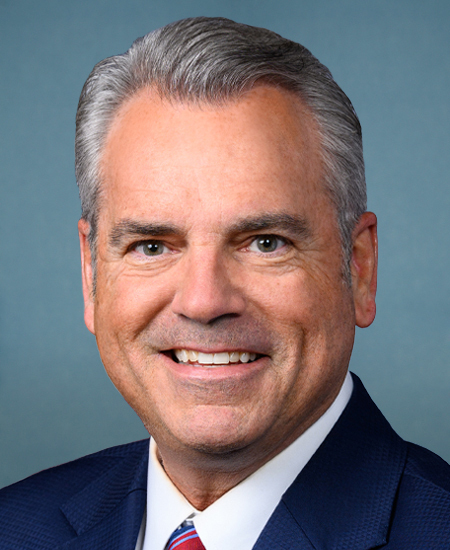
Rep. Mark Alford
Sponsored bills
Maddy summaryHR 7680, the Protect Our Ballots Act of 2026, requires certain tax-exempt nonprofits to use the E-Verify employment verification system. Specifically, it applies to 501(c)(3) organizations that pay individuals for personal services related to political campaigns, management, or activities. These nonprofits must elect to participate in E-Verify and comply with its terms when hiring for such political work. The bill does not affect nonprofits that do not engage in political activities or hire for non-political purposes.
Respect State Housing Laws Act This bill eliminates a provision that requires a 30-day notice period before a landlord may begin eviction proceedings against a tenant in federally assisted or federally backed housing.
Maddy summaryHRES 1073 is a non-binding resolution designating February 21-28, 2026, as "National FFA Week" to recognize the National Future Farmers of America (FFA) Organization’s role in developing agricultural education leaders and to celebrate the 50th anniversary of Alaska’s State FFA Association. It does not create new laws or affect any specific groups or policies; instead, it formally expresses the House’s support for this commemorative week. The resolution highlights FFA’s mission to prepare students for leadership and careers in agriculture, food, and natural resources. As a symbolic gesture, it has no direct legislative or financial impact on constituents.
Protection of Women in Olympic and Amateur Sports Act This bill requires certified national governing bodies (NGBs) of amateur sports (e.g., USA Gymnastics) to prohibit a person whose sex is male from participating in an amateur athletic competition that is designated for females, women, or girls. Under the bill, male means an individual who has, had, will have—or would have, but for a developmental or genetic anomaly or historical accident—the reproductive system that at some point produces, transports, and utilizes sperm for fertilization.
Maddy summaryThis bill amends the tax code to allow first-time homebuyers to use funds from 529 college savings plans for home purchases without tax penalties, under specific conditions. It permits tax-free withdrawals of the original contributions (plus earnings) if the account was maintained for 15 years, the funds are used within 60 days for a first home purchase, and the total lifetime withdrawals do not exceed $35,000. If the home is sold within 5 years, a recapture tax may apply based on the time held. It directly affects first-time homebuyers who have maintained 529 plans for 15 years and use the funds for qualifying home purchases.
Maddy summaryThis bill prevents state or local governments from banning or restricting energy connections (like installation, modification, or access) based on the type or source of energy, such as electricity, natural gas, or renewable fuels. It directly affects consumers choosing energy providers and energy companies seeking to offer services. The key provision prohibits local laws, regulations, or policies that limit energy services sold in interstate commerce, covering all energy types listed in the bill’s definitions. It does not create new programs but limits regulatory authority at the state or local level. The law aims to ensure open access to diverse energy sources without source-based restrictions.
Maddy summaryThe Make Elections Great Again Act (HR 7300) would require voters to present photo identification to cast ballots in person or by mail for federal elections, with limited exceptions for religious objections or military voters. It would establish new requirements for proving U.S. citizenship during voter registration, including documentary proof of citizenship and proof of state residency. The bill would change mail-in ballot procedures by requiring voters to request mail-in ballots (rather than universal mail-in voting), implementing barcode tracking for mail-in ballots, and setting strict deadlines for ballot receipt. These provisions would apply to all states for federal elections held in 2027 or later, affecting how voters register, vote in person, and submit mail-in ballots for federal office elections.
Safeguard American Voter Eligibility Act or the SAVE America Act This bill requires individuals to provide documentary proof of U.S. citizenship when registering to vote, and requires photo identification to vote, in federal elections. Specifically, the bill prohibits states from accepting and processing an application to register to vote in a federal election unless the applicant presents documentary proof of U.S. citizenship. The bill specifies what documents are considered acceptable proof of U.S. citizenship, such as identification that complies with the REAL ID Act of 2005 that indicates U.S. citizenship. Further, the bill (1) prohibits states from registering an individual to vote in a federal election unless, at the time the individual applies to register to vote, the individual provides documentary proof of U.S. citizenship; and (2) requires states to establish an alternative process to demonstrate U.S. citizenship. Each state must take affirmative steps on an ongoing basis to ensure that only U.S. citizens are registered to vote, which shall include establishing a program to identify individuals who are not U.S. citizens using information supplied by certain sources. Additionally, states must remove noncitizens from their official lists of eligible voters. The bill (1) provides for a private right of action for certain violations, and (2) establishes criminal penalties for certain offenses. Individuals voting in federal elections must present an eligible photo identification document. An individual who votes by absentee ballot must submit a copy of their identification document with both the request for, and the submission of, the absentee ballot.
Maddy summaryThis is a ceremonial resolution (HRES 1020), not a legislative bill. It contains factual inaccuracies: Greenland is an autonomous territory within Denmark, not a U.S. territory, and no such agreement securing U.S. sovereignty over Greenland military installations has ever been negotiated or implemented under any administration. The resolution falsely claims President Trump "secured a historic strategic agreement" for permanent U.S. control, which contradicts actual U.S.-Denmark relations and international law. As a purely commemorative resolution with no policy or legal effect, it does not establish new rights, obligations, or mechanisms. A factual summary cannot be provided due to the resolution's misleading claims about the agreement.