This resolution supports the designation of Public Schools Week.
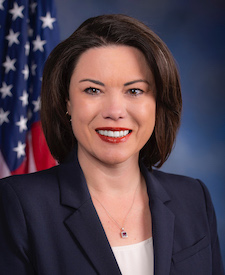
Rep. Angie Craig
Sponsored bills
Renewable Fuel Standard Integrity Act of 2021 This bill revises requirements for exemptions from the renewable fuel standard (RFS) given to small refineries of crude oil. The existing RFS requires transportation fuel to contain a minimum volume of renewable fuel. The bill establishes an annual deadline for petitions by small refineries for exemptions from the RFS. In addition, the bill subjects information in the petition to public disclosure requirements.
Iran Hostages Congressional Gold Medal Act This bill requires the Speaker of the House of Representatives and the President pro tempore of the Senate to arrange for the award of a Congressional Gold Medal commemorating the bravery and endurance of the 53 hostages of the Iran Hostage Crisis. Following its award, the medal shall be given to the National Museum of American History of the Smithsonian Institution for display and research. The Department of the Treasury must strike duplicate medals in silver for presentation to a hostage (or the personal representative of a deceased hostage), and Treasury may also strike and sell duplicate medals in bronze.
Broadband - Measuring Availability and Aligning Policies Task Force Act or the Broadband MAPS Act This bill requires the Federal Communications Commission (FCC) to establish a task force that oversees implementation and use of broadband availability maps. Specifically, the task force must (1) oversee specified data collection and analysis, including creating and updating broadband availability maps; (2) identify relevant FCC actions and ensure they are informed by the maps; (3) provide cost estimates for maintaining the maps; and (4) provide necessary recommendations to ensure the FCC can produce sufficiently granular and accurate maps to determine areas that lack broadband internet access service.
This resolution impeaches President Donald John Trump for high crimes and misdemeanors. Specifically, the resolution sets forth an article of impeachment stating that President Trump incited an insurrection against the government of the United States. The article states that prior to the joint session of Congress held on January 6, 2021, to count the votes of the electoral college, President Trump repeatedly issued false statements asserting that the presidential election results were fraudulent and should not be accepted by the American people or certified by state or federal officials; shortly before the joint session commenced, President Trump reiterated false claims to a crowd near the White House and willfully made statements to the crowd that encouraged and foreseeably resulted in lawless action at the Capitol; members of the crowd, incited by President Trump, unlawfully breached and vandalized the Capitol and engaged in other violent, destructive, and seditious acts, including the killing of a law enforcement officer; President Trump's conduct on January 6, 2021, followed his prior efforts to subvert and obstruct the certification of the presidential election, which included a threatening phone call to the Secretary of State of Georgia on January 2, 2021; President Trump gravely endangered the security of the United States and its institutions of government, threatened the integrity of the democratic system, interfered with the peaceful transition of power, and imperiled a coequal branch of government; and by such conduct, President Trump warrants impeachment and trial, removal from office, and disqualification to hold U.S. office.

Vaccine Fairness Act This bill requires the Department of Health and Human Services (HHS) to provide weekly reports to Congress concerning the distribution of COVID-19 (i.e., coronavirus disease 2019) vaccines to the public. HHS must also make publicly available certain data on the number of vaccine doses administered.
COVID-19 Supply Chain Resiliency Act of 2021 This bill establishes the Office of COVID-19 Supply Chain Resiliency to identify and address supply chain issues related to the COVID-19 (i.e., coronavirus disease 2019) pandemic. Specifically, the office must establish a national strategy to address identified supply chain issues related to the pandemic, serve as a central point of contact for and provide technical assistance to entities dealing with these issues, and develop legislative recommendations to strengthen critical supply chains for pandemics. The office shall cease to exist 18 months after the COVID-19 public health emergency (and any renewal thereof) is terminated.
This resolution expresses the sense of the House of Representatives that the U.S. Postal Service should restore mail delivery service standards to those of July 1, 2012.
Law Enforcement Officers Equity Act This bill expands the definition of law enforcement officer under provisions of the Federal Employees Retirement System (FERS) and the Civil Service Retirement System (CSRS). Specifically, the bill expands the definition to include (1) federal employees whose duties encompass the investigation or apprehension of suspected or convicted criminals and who are authorized to carry a firearm; (2) Internal Revenue Service employees whose duties are primarily the collection of delinquent taxes and the securing of delinquent returns; (3) U.S. Postal Inspection Service employees; (4) Department of Veterans Affairs police officers; and (5) certain U.S. Customs and Border Protection employees who are seized-property specialists with duties relating to custody, management, and disposition of seized and forfeited property. The bill deems service performed by an incumbent law enforcement officer on or after the enactment date of this bill to be service performed as a law enforcement officer for retirement purposes. The past service of such incumbents shall be treated as service performed by a law enforcement officer for retirement purposes only if a written election is submitted to the Office of Personnel Management within five years after the enactment of this bill or before separation from government service, whichever is earlier. An incumbent who makes an election before the enactment of this bill may pay a deposit into the Civil Service Retirement and Disability Fund to cover prior service. A law enforcement officer shall not be subject to mandatory separation during the three-year period beginning on the enactment of this bill.
Small Business Succession Planning Act This bill requires the Small Business Administration (SBA) to establish a program to assist small businesses with developing and implementing business succession plans. The bill also provides a tax credit for a business that establishes a succession plan or that successfully carries out such a plan. A business succession plan identifies who will assume the ownership responsibilities of a small business upon the owner's death or retirement, and it includes an operational description of the small business to ensure the continuation of operations. To carry out the program, the SBA must develop and make publicly available a toolkit to assist small business with succession planning. Further, it must train resource partners on the toolkit, educate small businesses about the program, and ensure that each SBA district office and each resource partner employs someone to counsel small businesses on using the toolkit.