Keystone XL Pipeline Construction and Jobs Preservation Act This bill authorizes the TransCanada Keystone Pipeline to construct, connect, operate, and maintain the pipeline facilities in Phillips County, Montana, for the import of oil from Canada to the United States.
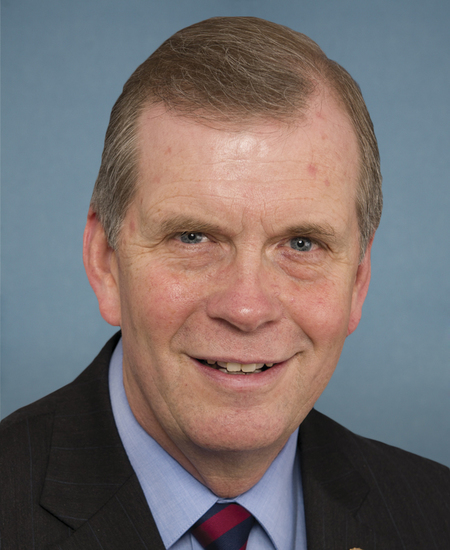
Rep. Tim Walberg
Sponsored bills
National Right-to-Work Act This bill repeals those provisions of the National Labor Relations Act and the Railway Labor Act that permit employers to make an agreement with a labor union to require employees to join such union as a condition of employment. Currently, at least 27 states have enacted laws prohibiting employers from compelling employees to become members of a union as a condition of employment.
Fair and Open Competition Act or the FOCA Act This bill prohibits federal construction contracts or controlling documents for federally supported construction projects from requiring or prohibiting project labor agreements. Such documents also may not discriminate against or give preference to a bidder or contractor who signs or refuses to sign a project labor agreement. An agency may exempt a project from this prohibition to avert an imminent threat to public health or safety or to serve the national security.
Social Security and Medicare Lock-Box Act This bill establishes (1) in the Federal Old-Age and Survivors Insurance Trust Fund, a Social Security Surplus Protection Account; and (2) in the Federal Hospital Insurance Trust Fund, a Medicare Surplus Protection Account. The Managing Trustee of each trust fund (in both cases, the Secretary of the Treasury) (1) must transfer the annual surplus of the trust fund to its respective account; and (2) may not invest the balance in the account until a law takes effect that authorizes, for amounts in the trust fund, an investment vehicle other than U.S. obligations. The bill establishes in the executive branch a commission to study the most effective vehicles for investment of the trust funds, other than investments in the form of U.S. obligations.
Iran Hostages Congressional Gold Medal Act This bill requires the Speaker of the House of Representatives and the President pro tempore of the Senate to arrange for the award of a Congressional Gold Medal commemorating the bravery and endurance of the 53 hostages of the Iran Hostage Crisis. Following its award, the medal shall be given to the National Museum of American History of the Smithsonian Institution for display and research. The Department of the Treasury must strike duplicate medals in silver for presentation to a hostage (or the personal representative of a deceased hostage), and Treasury may also strike and sell duplicate medals in bronze.
Brownfields Broadband Deployment Act This bill excludes certain communications facility deployment or modification projects from specified review requirements. Specifically, the bill excludes from specified environmental and historic preservation review a project for the deployment or modification of a communications facility that is to be carried out entirely within a brownfield site (real property, the expansion, redevelopment, or reuse of which may be complicated by the presence or potential presence of a hazardous substance, pollutant, or contaminant).
Telecommunications Skilled Workforce Act This bill establishes measures to address the workforce needs of the telecommunications industry. Specifically, the bill requires the Federal Communications Commission (FCC) to establish an interagency working group to develop recommendations for addressing these workforce needs. The FCC must also establish and issue guidance on how states can meet the workforce needs of the telecommunications industry, including guidance on how a state workforce development board can (1) utilize federal resources available to meet telecommunications industry workforce needs; and (2) promote and improve recruitment in qualified industry-led workforce development programs, including the Telecommunications Industry Registered Apprenticeship Program. The Government Accountability Office must submit to Congress a report that estimates the number of skilled telecommunications workers that will be required to build and maintain (1) broadband infrastructure in rural areas, and (2) the 5G wireless infrastructure needed to support 5G wireless technology.

"Six Triple Eight" Congressional Gold Medal Act of 2021 This bill directs the Speaker of the House of Representatives and the President pro tempore of the Senate to arrange for the award of a Congressional Gold Medal in honor of the women of the 6888th Central Postal Directory Battalion (commonly known as the Six Triple Eight) in recognition of their pioneering military service, devotion to duty, and contributions to increase the morale of personnel stationed in the European theater of operations during World War II. The medal shall be given to the Smithsonian Institution and made available for display and research.
Pre-existing Conditions Protection Act of 2021 This bill reestablishes requirements for private health insurance plans with respect to preexisting conditions, guaranteed enrollment, and discrimination based on health-related factors if they are repealed by another law. In such event, the bill prohibits private health insurance plans from (1) limiting or excluding benefits covering preexisting conditions; (2) denying enrollment to employers or individual applicants, subject to specified limits; (3) establishing rules for eligibility based on an individual's health status; or (4) requiring an individual to a pay higher premium than similarly situated individuals enrolled in the plan based the individual's health status. The bill also prohibits plans from collecting genetic information in connection with issuing health insurance and provides requirements for workplace wellness programs connected to health insurance.
United States-Israel PTSD Collaborative Research Act This bill establishes a grant program for collaborative efforts between the United States and Israel to advance research on post-traumatic stress disorders. The Department of Defense, in coordination with the Department of Veterans Affairs and the Department of State, shall award grants to eligible academic institutions or nonprofit entities in the United States. Work shall be conducted by the eligible entity and an entity in Israel under a joint research agreement.