

American Broadband Act This bill addresses broadband and other communications services. The bill limits applicable state and local regulatory authority. Limitations include setting (and providing statutory authority for) deadlines for reviews and decisions related to personal wireless and other telecommunication service facilities, as well as cable franchises and services. Further, a state or locality may not provide broadband services in areas with more than one other commercial provider. The bill exempts certain telecommunications infrastructure projects from environmental and historic preservation reviews, including projects carried out after a declared disaster or emergency (e.g., a wildfire). The bill also establishes a rebuttable presumption that a request for a review of the effects of deploying wireless service on historically, culturally, or religiously significant tribal or Native Hawaiian land is complete if the tribe or Native Hawaiian organization receives certain forms. The bill enhances criminal penalties for willful or malicious destruction of a communication facility. Furthermore, the General Services Administration must establish a common fee schedule for deploying wireless facilities that affect federal property. Additionally, the National Telecommunications and Information Administration must award grants for expanding high-speed broadband access, facilitate through an interagency strike force timely reviews of telecommunications-related requests that affect federal property (e.g., a request for an easement or right-of-way), and report on certain requests concerning communications facilities on federal real property. The bill also requires collaboration among federal agencies that support broadband deployment.
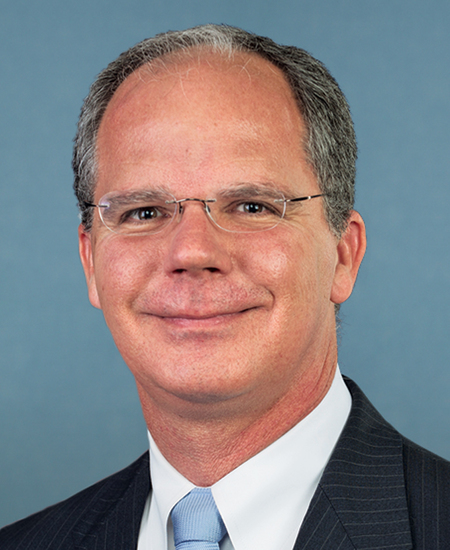
Rep. Brett Guthrie
Sponsored bills
Consumer Safety Technology Act This bill requires various agencies to explore the use of emerging technologies in the context of consumer products and safety. First, the Consumer Product Safety Commission must consult with relevant stakeholders, such as data scientists and product manufacturers, and use artificial intelligence in a pilot program for a least one of the following processes: (1) tracking trends in injuries involving consumer products, (2) identifying consumer product hazards, (3) monitoring the sale of recalled consumer products, or (4) identifying consumer products that do not meet specified importation requirements related to product safety. Additionally, the Department of Commerce must consult with the Federal Trade Commission (FTC) and other relevant agencies to study potential applications of blockchain technology (i.e., the technology that supports digital currencies such as Bitcoin), including the use of such technology to address fraud and other unfair or deceptive practices. Finally, the FTC must report on its efforts to address unfair or deceptive trade practices related to digital tokens (i.e., transferable units of a digital currency).
Reopening to address Every COmplete Record request for Devoted Servicemembers Act of 2021 or the RECORDS Act of 2021 This bill directs the Office of the Archivist of the United States to take specified steps to address record request backlogs. Specifically, the office must take actions to ensure that (1) the number of individuals employed by the National Personnel Records Center is equal to or exceeds the number of such individuals employed on March 2, 2020, and (2) the percentage of such individuals regularly reporting to work in person is equal to or exceeds the percentage of such individuals regularly reporting to work in person on that date. The office shall submit to specified congressional committees a report that provides a comprehensive plan to address the record request backlog of the National Personnel Records Center and improve the efficiency and responsiveness of operations at the center, identifies measurable goals with respect to the comprehensive plan and metrics for tracking progress toward such goals, and describes strategies to prevent future record request backlogs.
This resolution reaffirms the commitment of the United States to the NATO alliance and states that the alliance allows the United States to better protect its shared economic and security interests throughout the world. The resolution also (1) commends the U.S. forces and allies that participated in the Defender-Europe 2021 exercise; and (2) urges allies in the strongest possible terms to recommit to NATO's founding principles by strengthening democratic institutions, respecting individual liberty, and reinforcing the rule of law.
Trillion Trees Act This bills establishes a variety of requirements and incentives to plant trees and conduct other land management practices for the purposes of capturing and storing carbon in domestic and international trees and forests. Additionally, the bill provides incentives to research or develop other carbon sequestration tools. Specifically, the bill directs the Department of Agriculture (USDA) to set targets to increase forest carbon stock through January 1, 2100, for the purposes of sequestering and storing carbon in U.S. forests. It also establishes and provides funding for the Trillion Trees Challenge Fund to provide grants to nonfederal entities for activities related to reforestation efforts on public or private lands. In addition, it raises the cap on the Reforestation Trust Fund to enhance forest health in the National Forest System and requires the USDA to establish a Tree City USA Grant Program. The bill also allows the U.S. Agency for International Development to enter into an agreement with a nonprofit organization to establish an International Forest Foundation to promote reforestation and prevent deforestation. Additionally, it establishes requirements and incentives to address seedling shortages and support nurseries. Finally, the bill provides market incentives to research or develop other carbon sequestration tools relating to biochar, sustainable building practices, biochemical and bioplastic products, and biomass energy.
Flexible Financing for Rural America Act This bill allows rural utility service providers to submit to the Department of Agriculture (USDA) a request to adjust the interest rate or modify the terms of certain loans. The request shall include a report summarizing how the adjustment or modification will assist the borrower in providing critical utility services to a rural community. Specifically, on receipt of a request, USDA or the Department of the Treasury (in the case of a loan owned by the Federal Financing Bank) must adjust the interest rate on the loan to match certain interest rates for obligations of comparable maturity to the term remaining on the loan (or a higher rate requested by the borrower), and make modifications to the loan terms as necessary to address changes in the financial position of the borrower due to the COVID-19 public health emergency and to promote the financial sustainability of the borrower. In carrying out the adjustments or modifications, USDA or Treasury shall not impose or collect any fee from, or impose any penalty on, a borrower. The bill also provides funding to implement the adjustments and modifications and for the liquidation of residual intragovernmental amounts owed by the Federal Financing Bank in connection with certain loans.
Safely Ensuring Lives Future Deployment and Research In Vehicle Evolution Act or the SELF DRIVE Act This bill establishes the federal role in ensuring the safety of highly automated vehicles by encouraging the testing and deployment of such vehicles. A highly automated vehicle is a motor vehicle, other than a commercial motor vehicle, that is equipped with an automated driving system capable of performing the entire dynamic driving task on a sustained basis. The bill preempts states from enacting laws regarding the design, construction, or performance of highly automated vehicles or automated driving systems unless such laws enact standards identical to federal standards. The Department of Transportation (DOT) must require safety assessment certifications for the development of a highly automated vehicle or an automated driving system. Manufacturers of highly automated vehicles must develop written cybersecurity and privacy plans for such vehicles prior to offering them for sale. The bill applies certain safety exemptions and testing standards to highly automated vehicles. DOT must (1) inform prospective buyers of highly automated vehicles of the capabilities and limitations of such vehicles; (2) establish the Highly Automated Vehicle Advisory Council to, among other things, develop guidance regarding mobility access for the disabled, elderly, and underserved populations; (3) require all new passenger motor vehicles less than 10,000 pounds to be equipped with a rear seat occupant alert system; and (4) research updated safety standards for motor vehicle headlamps.
Hamas International Financing Prevention Act This bill imposes sanctions targeting Hamas, the Palestinian Islamic Jihad, and any affiliate or successor groups. The President shall periodically report to Congress a list of each foreign person or instrumentality that knowingly assists, provides significant support or services to, or is involved in a significant transaction with a senior member or supporter of any of the targeted groups. The President shall impose two or more sanctions on the named persons. Specifically, the person may be (1) denied credit and services from the Export-Import Bank, (2) barred from purchasing certain controlled defense articles, (3) denied exports of items on the U.S. Munitions List, (4) prevented from receiving exports of certain goods or technology controlled for national security reasons, (5) prohibited from receiving financing of more than $10 million from any U.S. financial institution, or (6) subject to property-blocking restrictions. The President shall periodically report to Congress a list of foreign governments that have repeatedly provided material support for the targeted groups' terrorist activities. The President shall bar these governments from receiving for one year (1) U.S. assistance, or (2) exports of controlled munitions. The Department of Treasury shall instruct U.S. leadership of international financial institutions to oppose the provision of assistance to an identified government for one year. The bill provides for certain exceptions and waivers, such as for transactions that would serve U.S. national interests. The President shall report to Congress and periodically provide briefings on other specified topics related to the targeted groups, such as where these groups secure financing and surveillance equipment.
Blockchain Promotion Act of 2021 This bill directs the Department of Commerce to establish the Blockchain Working Group to submit a report to Congress that contains a recommended definition of the distributed ledger technology commonly referred to as blockchain technology and other specified recommendations regarding this technology.
Blockchain Innovation Act This bill requires the Department of Commerce to consult with the Federal Trade Commission and other relevant agencies to study potential applications of blockchain technology (i.e., the technology that supports digital currencies such as Bitcoin), including the use of such technology to address fraud and other unfair or deceptive practices.