

This bill directs the Speaker of the House and the President pro tempore of the Senate to arrange for the award of three Congressional Gold Medals to the U.S. Capitol Police (USCP) and other law enforcement agencies that protected the U.S. Capitol on January 6, 2021. Following the award of these medals, one medal shall be given to the USCP, one medal shall be given to the Metropolitan Police Department of the District of Columbia, and one medal shall be given to the Smithsonian Institution and displayed with a plaque listing all law enforcement agencies that participated in protecting the Capitol on January 6, 2021.
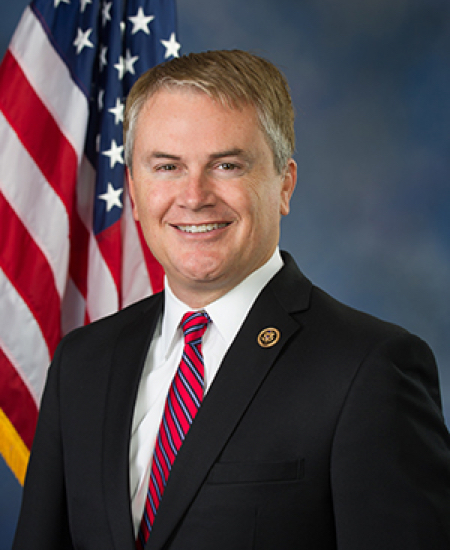
Rep. James Comer
Sponsored bills
Stronger Child Abuse Prevention and Treatment Act This bill reauthorizes through FY2027 and revises the Child Abuse Prevention and Treatment Act and the Child Abuse Prevention and Treatment and Adoption Reform Act of 1978 to expand services for preventing and treating child abuse. Specifically, the bill establishes requirements concerning collecting and exchanging data about child abuse and neglect. For instance, the bill requires the Department of Health and Human Services (HHS) to (1) establish uniform national standards for tracking and reporting child fatalities and near fatalities resulting from maltreatment, and (2) develop an electronic interstate data exchange system that allows states to share information from their child abuse and neglect registries with other states. The bill also addresses child abuse and neglect related to families impacted by substance use disorders, racial bias in the child protective services system, and child sexual abuse. Further, the bill revises the community-based grants program to emphasize access to effective services for diverse populations and to promote the development of statewide strategies to scale up family strengthening services. Finally, the bill requires HHS to examine unregulated custody transfers and make recommendations for preventing, identifying, and responding to such transfers.
Developing Responsible Individuals for a Vibrant Economy Act or the DRIVE-SAFE Act This bill directs the Department of Transportation to promulgate regulations to implement an apprenticeship program for licensed commercial motor vehicle drivers under the age of 21. Under the program, an apprentice must complete two probationary periods that total 400 hours of on-duty time, of which at least 240 hours must be driving time in a commercial motor vehicle. Additionally, the apprentice must be accompanied in the cab of the commercial motor vehicle by an experienced driver. Further, the bill requires all commercial motor vehicles used in the program for training to be equipped with safety technology such as active braking collision mitigation systems and video event capturing systems. An employer shall not knowingly allow, require, permit, or authorize a driver under the age of 21 to operate a commercial motor vehicle unless the driver is participating in, or has completed, an apprenticeship program that meets the requirements set forth in this bill.
Fair Access to Banking Act This bill restricts certain banks, credit unions, and payment card networks from refusing to do business with a person who is in compliance with the law. Restrictions include prohibiting the use of certain lending programs, initiating the process of terminating an institution's depository insurance, and instituting specified civil penalties.
This resolution supports the designation of a National FFA Week. It also (1) recognizes the important role of the National FFA Organization (Future Farmers of America) in developing the next generation of leaders who will change the world, and (2) celebrates 50 years of National FFA alumni and supporters.
Death Tax Repeal Act This bill repeals the estate and generation-skipping transfer taxes. It also makes conforming amendments related to the gift tax.
This bill requires the Federal Communications Commission (FCC) to analyze and report on the demands associated with edge provider data transmitted over rural broadband networks during a specified six-year period. An edge provider is an entity that provides content, applications, or services over the internet (e.g., search engine providers, streaming video or music services, social media platforms, and retailers). Some edge providers generate revenue by selling products or subscriptions to their content, while others offer their content for free and generate revenue by selling advertising to users based on user-provided information. In its analysis, the FCC must retrospectively and prospectively estimate the quantity of edge provider data transmitted over rural broadband networks. It must also calculate costs to rural broadband providers that are not otherwise recovered for transmitting such data. These costs include (1) initial deployment of rural broadband networks, (2) operation and maintenance of those networks, and (3) the delivery of services to users over those networks.
Guidance Out Of Darkness Act or the GOOD Act This bill establishes requirements concerning the posting of agency guidance documents. Specifically, an agency must publish guidance documents online on the dates they are issued, publish all of its guidance documents that are in effect in a single location on a designated website, display a hyperlink on its website that provides access to the guidance documents on such website, and indicate on such website if a guidance document has been rescinded. The documents must be categorized as guidance documents and further divided into subcategories.
This joint resolution proposes a constitutional amendment limiting Representatives to three terms and Senators to two terms. Terms beginning before the ratification of this amendment do not count towards these term limits.
This joint resolution proposes a constitutional amendment prohibiting total outlays for a fiscal year from exceeding total receipts for that fiscal year unless Congress authorizes the excess by a three-fifths roll call vote of each chamber. The prohibition excludes outlays for repayment of debt principal and receipts derived from borrowing. The amendment requires roll call votes of (1) three-fifths of each chamber of Congress to increase the public debt limit, and (2) a majority of each chamber for legislation increasing revenue. It also requires the President to submit a balanced budget to Congress annually. Congress is authorized to waive these requirements when a declaration of war is in effect or if the United States is engaged in a military conflict which causes an imminent and serious military threat to national security.