Make Russia Pay Act This bill requires the Department of the Treasury to liquidate all Russian assets seized by the United States and deposit the resulting funds into a Ukrainian Humanitarian Aid Fund established by the bill. Treasury may use the funds to provide assistance to Ukraine, including by providing funding to Ukraine's government for humanitarian and security assistance.
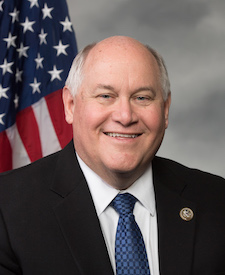
Rep. Ron Estes
Sponsored bills
This bill designates the facility of the United States Postal Service located at 17 East Main Street in Herington, Kansas, as the Captain Emil J. Kapaun Post Office Building.
Suspending Normal Trade Relations with Russia and Belarus Act This bill suspends normal trade relations with Russia and Belarus. It also prohibits the importation of energy products from Russia. Specifically, the bill authorizes the President to proclaim increases in the rates of duty applicable to products of Russia or Belarus. This authority terminates on January 1, 2024. The President may restore normal trade relations with Russia and Belarus, subject to congressional disapproval. Additionally, the bill prohibits the importation of Russian products that are classified under chapter 27 of the Harmonized Tariff Schedule (which includes mineral fuels, mineral oils and products of their distillation, bituminous substances, and mineral waxes). The bill directs the U.S. Trade Representative to take certain actions, including to consider steps to suspend Russia's participation in the World Trade Organization and seek to halt the accession process of Belarus.
This resolution condemns the terrorist attack on Congregation Beth Israel in Colleyville, Texas, on January 15, 2022. It also expresses support for the affected community, commends the actions of law enforcement and emergency responders, and reaffirms a commitment to combat hate, bigotry, anti-Semitism, and violence against Jewish Americans.
Powering America through Domestic Energy Act or the PADE Act This bill requires the President to prohibit the importation of crude oil and petroleum products from Russia. In addition, the bill requires the President to obtain congressional approval before (1) declaring a moratorium on the use of hydraulic fracturing, or (2) withdrawing federal land from oil and gas leasing under mineral leasing laws.
Israel Anti-Boycott Act This bill prohibits participation by certain entities and individuals in boycotts or requests for boycotts imposed by international governmental organizations (i.e., the United Nations and the European Union). Specifically, the bill applies to covered persons the prohibition of specified actions in compliance with or in support of a boycott against a country that is friendly to the United States and that is not itself the object of a U.S. boycott. The bill defines a covered person as a domestic concern, the U.S. government or a state government, or a representative or official of such domestic concern or government. The bill also adds to the list of specified prohibited actions the act of furnishing information to any foreign country or international governmental organization that furthers an imposed boycott. Under current law, a person who violates the prohibitions against such boycotts may be subject to a monetary fine or imprisonment; however, the bill removes imprisonment as a potential penalty for certain violations.

Maddy summaryThis non-binding resolution, introduced in March 2022, calls for the House wing of the U.S. Capitol and House Office Buildings to reopen to the public, citing the unprecedented closure since March 2020 as the longest in history. It urges removing visitor restrictions like logs and prioritizing public access, noting that other state capitols and public venues operated safely during the same period. As a "sense" resolution, it does not mandate action but expresses the House’s position on restoring public access to a democratic symbol. The resolution specifically targets the House wing (not the full Capitol) and aims to encourage the Capitol Police and House leadership to act.
This joint resolution nullifies the rule titled Medicare and Medicaid Programs; Omnibus COVID-19 Health Care Staff Vaccination , which was issued by the Centers for Medicare & Medicaid Services on November 5, 2021. The rule requires health care providers, as a condition of Medicare and Medicaid participation, to ensure that staff are fully vaccinated against COVID-19.
This resolution supports the designation of a National FFA Week. It also (1) recognizes the important role of the National FFA Organization (Future Farmers of America) in developing the next generation of leaders who will change the world, and (2) celebrates 70 years of the National FFA Organization's membership magazine.
Health Care for Burn Pit Veterans Act This bill updates policies and procedures related to Department of Veterans Affairs (VA) health care and benefits for veterans who have been exposed to toxic substances. Specifically, the bill extends the eligibility period for VA hospital care, medical services, and nursing home care for combat veterans who served after September 11, 2001, and were exposed to toxic substances, radiation, or other conditions, including those who did not enroll to receive VA care during the eligibility period. The VA must incorporate into its existing health care screening a screening to help determine potential exposures to toxic substances during military service. Among other requirements, the VA must also provide annual training to health care and benefits personnel with respect to veterans who were exposed to toxic substances; analyze total and respiratory disease mortality in veterans who served in specified locations on specified dates; conduct an epidemiological study on the health trends of veterans who served in the Armed Forces after September 11, 2001; conduct a study to determine trends in the rates of the incidence of cancer in veterans; publish a list of VA resources for veterans who were exposed to toxic substances, families and caregivers of such veterans, and survivors of such veterans who are receiving death benefits; and report on the data quality of the Individual Longitudinal Exposure Record and its usefulness in supporting veterans in receiving VA health care and benefits.