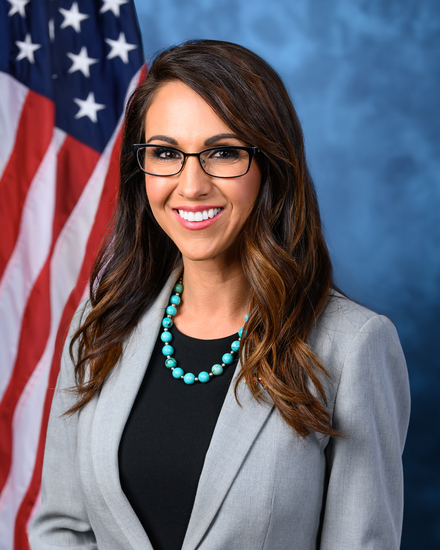
Photo of Lauren Boebert
R United States House · District 4 · Colorado On the 2026 ballot

Rep. Lauren Boebert

Compare
Total votes
2,818
all sessions
Attendance
96%
118 missed
Near the chamber average
With party
82%
of cast votes
Lower than 95% of chamber peers
Bipartisan score
9%
crosses aisle rarely
Higher than 94% of chamber peers
Sponsored
1,019
bills & resolutions
Near the chamber average
Committees
7
assignments
1,019 bills and resolutions

Sponsored bills

Total
1,019
Primary
88
Co-sponsor
931
This page
1,019
matching current filters
Co-sponsor HR 34
In committee · Florida House · Co-sponsor
LASSO Act

Maddy summaryThe LASSO Act requires 10% of annual revenue generated from public lands managed by the Interior Department and Agriculture Department (including national forests and Outer Continental Shelf areas) to be deposited into the Social Security Trust Fund. This directly affects the Social Security Trust Fund by increasing its funding, while ensuring no fee hikes for public land activities or reductions in funds for states, tribes, or local governments. The bill mandates this transfer annually without altering existing revenue-sharing agreements or pricing structures. It aims to bolster Social Security finances through a specific, measurable mechanism tied to federal land management.

In committee Feb 10, 2026 1 co-sponsor
Co-sponsor HR 7421
In committee · Florida House · Co-sponsor
SAFE Olympic Sports Act

Maddy summaryHR 7421, the SAFE Olympic Sports Act, requires national governing bodies for Olympic sports to maintain eligibility rules based on an athlete's biological sex as defined in the bill. It mandates that competitions must restrict participation to athletes whose sex at conception aligns with the event's category (e.g., female-only events for those biologically female). The bill defines "sex" as an immutable biological classification determined at conception, with specific biological criteria for male and female. This applies to Olympic, Paralympic, Pan-American, and other sanctioned amateur competitions, requiring governing bodies to continue sanctioning single-sex events they previously approved.

In committee Feb 9, 2026 1 co-sponsor
Co-sponsor HR 7452
In committee · Florida House · Co-sponsor
Air Quality Act

Maddy summaryHR 7452, titled the "Air Quality Act" (though it addresses weather modification, not air quality), prohibits all weather modification activities in the U.S., including cloud seeding, geoengineering, and stratospheric aerosol injection, for individuals, companies, and federal agencies. It imposes criminal penalties of up to $100,000 or 5 years in prison per violation, plus civil fines of $10,000 per violation, and requires new reporting systems for aircraft involved in such activities and public complaints to the EPA. The bill repeals all existing federal laws, regulations, or executive orders authorizing weather modification and bans all federal research or experimentation on weather modification. It defines "weather modification" broadly to include any atmospheric alteration affecting weather, climate, or sunlight.

In committee Feb 9, 2026 1 co-sponsor
Co-sponsor HR 7400
In committee · Florida House · Co-sponsor
Making Homeownership Affordable Again Act

Maddy summaryHR 7400, the "Making Homeownership Affordable Again Act," removes the current $250,000 ($500,000 for married couples) limit on tax-free profit when selling a primary residence and extends this exclusion to sales involving first-time homebuyers. It directly affects homeowners selling their current home and first-time homebuyers purchasing a home. The key provision eliminates the dollar cap on capital gains exclusion under tax code Section 121 and defines "first-time homebuyer" as someone without home ownership in the past three years. This policy change applies to home sales occurring after the bill's enactment.

In committee Feb 5, 2026 1 co-sponsor
Co-sponsor HR 5438
In committee · Florida House · Co-sponsor
Incentivize Savings Act

Maddy summaryThis bill modifies federal budget rules for unspent agency funds. It requires federal agencies to allocate 49% of unused funds to the next fiscal year, 49% toward paying the national debt, and 2% for retention bonuses (capped at 10% of an employee's base pay). Agencies must also limit future budget requests to the previous year's amount adjusted for inflation. The bill directly affects all executive branch agencies (excluding the Red Cross), altering how they manage leftover budget authority. It does not create new savings programs for individuals but changes government fiscal management procedures.

In committee Feb 4, 2026 1 co-sponsor
Co-sponsor HR 3699
In committee · Florida House · Co-sponsor
Energy Choice Act

Maddy summaryThis bill prevents state or local governments from banning or restricting energy connections (like installation, modification, or access) based on the type or source of energy, such as electricity, natural gas, or renewable fuels. It directly affects consumers choosing energy providers and energy companies seeking to offer services. The key provision prohibits local laws, regulations, or policies that limit energy services sold in interstate commerce, covering all energy types listed in the bill’s definitions. It does not create new programs but limits regulatory authority at the state or local level. The law aims to ensure open access to diverse energy sources without source-based restrictions.

In committee Feb 4, 2026 1 co-sponsor
Co-sponsor HR 7300
In committee · Florida House · Co-sponsor
Make Elections Great Again Act

Maddy summaryThe Make Elections Great Again Act (HR 7300) would require voters to present photo identification to cast ballots in person or by mail for federal elections, with limited exceptions for religious objections or military voters. It would establish new requirements for proving U.S. citizenship during voter registration, including documentary proof of citizenship and proof of state residency. The bill would change mail-in ballot procedures by requiring voters to request mail-in ballots (rather than universal mail-in voting), implementing barcode tracking for mail-in ballots, and setting strict deadlines for ballot receipt. These provisions would apply to all states for federal elections held in 2027 or later, affecting how voters register, vote in person, and submit mail-in ballots for federal office elections.

In committee Feb 2, 2026 1 co-sponsor
Co-sponsor HR 4242
In committee · Florida House · Co-sponsor
Innovate Less Lethal to De-Escalate Tax Modernization Act

Maddy summaryThis bill exempts certain less-than-lethal projectile devices from federal sales taxes and National Firearms Act restrictions. It directly affects manufacturers, importers, and producers of these devices, which are defined as non-lethal tools (like rubber bullets or beanbag rounds) designed not to cause serious injury and unable to be easily converted to use standard firearm ammunition. Key mechanisms include a 90-day classification process for manufacturers seeking exemption, an annual public list of approved devices, and annual congressional reports on devices excluded from the exemption. The policy change applies to devices meeting specific safety criteria, such as projectile velocity limits and design features preventing misuse as conventional weapons.

In committee Feb 2, 2026 1 co-sponsor
Co-sponsor HR 7296
In committee · Florida House · Co-sponsor
SAVE America Act

Safeguard American Voter Eligibility Act or the SAVE America Act This bill requires individuals to provide documentary proof of U.S. citizenship when registering to vote, and requires photo identification to vote, in federal elections. Specifically, the bill prohibits states from accepting and processing an application to register to vote in a federal election unless the applicant presents documentary proof of U.S. citizenship. The bill specifies what documents are considered acceptable proof of U.S. citizenship, such as identification that complies with the REAL ID Act of 2005 that indicates U.S. citizenship. Further, the bill (1) prohibits states from registering an individual to vote in a federal election unless, at the time the individual applies to register to vote, the individual provides documentary proof of U.S. citizenship; and (2) requires states to establish an alternative process to demonstrate U.S. citizenship. Each state must take affirmative steps on an ongoing basis to ensure that only U.S. citizens are registered to vote, which shall include establishing a program to identify individuals who are not U.S. citizens using information supplied by certain sources. Additionally, states must remove noncitizens from their official lists of eligible voters. The bill (1) provides for a private right of action for certain violations, and (2) establishes criminal penalties for certain offenses. Individuals voting in federal elections must present an eligible photo identification document. An individual who votes by absentee ballot must submit a copy of their identification document with both the request for, and the submission of, the absentee ballot.


In committee Jan 30, 2026 1 co-sponsor
Co-sponsor HR 7282
In committee · Florida House · Co-sponsor
FRAMER Act

Maddy summaryHR 7282, the FRAMER Act, requires states to reimburse builders for the cost difference between their own energy efficiency standards and the Department of Housing and Urban Development’s (HUD) minimum standard for new homes built in Opportunity Zones. It directly affects residential builders in Opportunity Zones (designated tax-advantaged areas) by providing payments for exceeding HUD’s baseline energy requirements. The bill mandates that builders disclose to homebuyers the cost difference covered by the reimbursement and any price reduction tied to the payment. The program expires after 7 years, and the government must report annually on reimbursement amounts and cost differences across states and localities.

In committee Jan 30, 2026 1 co-sponsor
Showing 81 to 90 of 1,019 bills
Previous 1 8 9 10 102 Next