

Family and Medical Insurance Leave Act or the FAMILY Act This bill entitles every employee to a family and medical leave insurance (FMLI) monthly benefit payment of two-thirds of the employee's regular pay, limited to a maximum of $4,000, for not more than 60 days of qualified caregiving. The bill establishes the Office of Paid Family and Medical Leave within the Social Security Administration to administer the FMLI program. An FMLI benefit payment must be coordinated with any periodic benefits received under a state or local temporary disability insurance or family leave program. The bill imposes a tax on employers, employees, and self-employed individuals to fund FMLI benefits. It also establishes the Federal Family and Medical Leave Insurance Trust Fund to hold tax revenues.
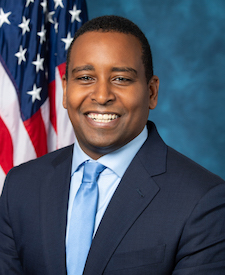
Rep. Joe Neguse
Sponsored bills
Scientific Integrity Act This bill revises provisions regarding the release of scientific research results by federal agencies. Each agency that funds, conducts, or oversees scientific research must (1) adopt and enforce a scientific integrity policy that includes requirements such as that scientific conclusions are not based on political considerations, and (2) submit such policy to the Office of Science and Technology Policy (OSTP) for approval. Each agency must make such policy available to the public and submit such policy to Congress. Agencies and the OSTP must periodically review the policies. The Government Accountability Office shall review implementation of the policies. Each agency shall (1) appoint a Scientific Integrity Officer, (2) establish a process for dispute resolution consistent with the scientific integrity policy, and (3) establish a specified training program for current and new employees.
Restoring Communities Left Behind Act This bill directs the Department of Housing and Urban Development to establish a grant program for local partnerships to carry out neighborhood revitalization support activities in economically distressed areas. Eligible activities include weatherization and energy efficiency improvements; housing accessibility improvements for seniors and persons with disabilities; purchasing delinquent mortgages; purchasing and developing vacant or distressed properties to create affordable rental housing and for other purposes; and improving parks, sidewalks, and street lighting.
Air Traffic Noise and Pollution Expert Consensus Act of 20 21 This bill requires the Federal Aviation Administration to enter into an arrangement with the National Academies of Sciences, Engineering, and Medicine to examine and report on the various health impacts of air traffic noise and pollution.
Health Force, Resilience Force, and Jobs to Fight COVID-19 Act of 2021 This bill establishes and expands programs to bring on individuals to perform public health functions, such as contact tracing and vaccine administration, to respond to the COVID-19 (i.e., coronavirus disease 2019) emergency and meet future public health needs. The bill provides funding for the Centers for Disease Control and Prevention (CDC) to establish a Health Force. The funds are designated as an emergency requirement, which exempts the funds from discretionary spending limits and other budget enforcement rules. To establish the force, the CDC must award grants within 30 days to state, tribal, territorial, and local governments and community health centers to recruit and train individuals for roles in public health and health care. The Federal Emergency Management Agency (FEMA) must hire and train additional individuals for its Cadre of On-Call Response/Recovery Employees. These employees may be detailed to certain federal agencies or to state, local, or tribal governments to support response efforts related to COVID-19 or other disasters or emergencies.
Safe and Quiet Skies Act of 2021 This bill sets forth requirements for commercial air tour flights. Among other requirements, the bill prohibits tour flights within a half mile of military installations, national cemeteries, national wilderness areas, national parks, and national wildlife refuges; prohibits tour flights from operating at an altitude of less than 1,500 feet; requires tour flights over occupied areas (e.g., residential, commercial, and recreational areas) to be no louder than 55dbA; and allows states and localities to impose additional requirements that are stricter than the minimum federal requirements.
Veteran Overmedication and Suicide Prevention Act of 2021 This bill requires the Department of Veterans Affairs (VA) to contract with the National Academies of Sciences, Engineering, and Medicine to report on the deaths of covered veterans who died by suicide during the last five years, regardless of whether information relating to such deaths has been reported by the Centers for Disease Control and Prevention. A covered veteran is any veteran who received VA hospital care or medical services during the five-year period preceding the veteran's death. Among other elements, the report shall include the total number of covered veterans who died by suicide, violent death, or accidental death, as well as certain demographic information.
Department of Veterans Affairs Electronic Health Record Advisory Committee Act This bill requires the Department of Veterans Affairs to establish the Electronic Health Record Advisory Committee to provide guidance regarding the implementation of and transition to an electronic health record system.
Child and Animal Abuse Detection and Reporting Act This bill requires the Children’s Bureau of the Administration for Children and Families to disseminate information through the National Clearinghouse on Child Abuse and Neglect Information about the incidence of cases of child abuse that involve abuse to animals.
Medical Debt Relief Act of 2021 This bill modifies requirements related to the reporting of medical debt. Specifically, a consumer reporting agency is prohibited from adding medical debt information to a consumer credit report if the debt was fully paid or settled, or is less than a year old. Additionally, a debt collector must notify the consumer prior to reporting medical debt to a consumer reporting agency.