Dr. Neil Compton Conservation Act This bill redesignates the Tyler Bend Visitor Center located on Tyler Bend Road in St. Joe, Arkansas, as the Dr. Neil Compton Visitor Center. The Department of the Interior may display information at the Dr. Neil Compton Visitor Center to educate the public about the contributions of Dr. Neil Compton to the history of the Buffalo National River.
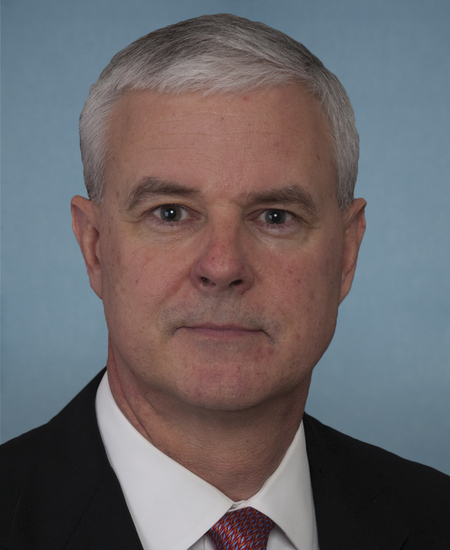
Rep. Steve Womack
Sponsored bills
Purple Heart Freedom to Work Act This bill increases the monthly income limit that is used to determine whether certain Purple Heart recipients are eligible for Social Security Disability Insurance (SSDI) benefits. Specifically, when making such determinations with respect to Purple Heart recipients who are entitled to SSDI benefits based on combat-related injuries, the Social Security Administration must use the limit that applies to individuals who are blind rather than the lower limit that applies to other SSDI recipients. In addition, the bill phases out SSDI benefits for these Purple Heart recipients, with benefits reduced by $1 for every $4 of earnings in excess of the limit.
Contact Lens Prescription Verification Modernization Act This bill revises the requirements for the verification of prescriptions related to the purchase of contact lenses. Specifically, online sellers of prescription contact lenses must provide consumers with a method to transmit a digital copy of their prescriptions to such sellers. Online sellers also must encrypt protected health information they send by email. Additionally, the bill prohibits any seller of prescription contact lenses from using telephone calls with an artificial or prerecorded voice (i.e., robocalls) to verify a consumer's prescription.
Ghost Army Congressional Gold Medal Act This bill directs the Speaker of the House of Representatives and the President pro tempore of the Senate to award a Congressional Gold Medal to the 23rd Headquarters Special Troops and the 3133d Signal Service Company, known as the Ghost Army , collectively, in recognition of its service during World War II.
This resolution expresses support for the designation of DIPG Awareness Day. DIPG is diffuse intrinsic pontine glioma, a terminal childhood brain cancer.
Violence Against Women Extension Act of 2021 This bill reauthorizes for FY2022 various programs and activities authorized by the Violence Against Women Act of 1994 and subsequent legislation and administered by the Office on Violence Against Women within the Department of Justice.
Iran Sanctions Relief Review Act of 2021 This bill restricts the President's authority to unilaterally undertake certain actions with respect to Iran and increases congressional oversight of those actions. Specifically, the President must report to Congress before terminating or waiving sanctions related to Iran or taking a licensing action that significantly alters U.S. foreign policy with respect to Iran. Each report must (1) describe the proposed action and its rationale, and (2) indicate whether or not the action is intended to significantly alter foreign policy concerning Iran. If the intention is to alter that policy, the report must provide additional information about the policy objectives and anticipated effects of the action. After the President submits a report, the bill provides Congress with a 30-day period to review it; this period is extended to 60 days for reports submitted between July 10 and September 7. During this period, Congress may enact a joint resolution approving or disapproving the action. During the review period, the President may not take the action unless Congress passes a joint resolution of approval; if Congress enacts a joint resolution of disapproval, the bill prohibits the President from taking the action. The bill also outlines procedures for the introduction and consideration of these types of joint resolutions.

STOP Straw Purchases Act This bill establishes new criminal offenses and penalties to deter straw purchases of firearms (i.e., firearm purchases from a licensed gun dealer by one person on behalf of another person). Current law prohibits and imposes penalties—a fine, a prison term of up to 10 years, or both—for making false statements in connection with the acquisition of a firearm from a federally licensed dealer. This bill increases the statutory maximum prison sentence—from 10 years to 25 years—for a violation by a person who is acting as a straw purchaser. Under this bill, a straw purchaser is a person who makes false statements involving deception about the identity of the actual buyer and knows or has reasonable cause to believe the actual buyer intends the firearm to be (1) used in a crime of violence or drug trafficking crime, or (2) transferred to a prohibited person. Additionally, the bill establishes new related criminal offenses. Specifically, it prohibits and imposes penalties for inducing another person, as a leader of a straw purchasing ring, to act as a straw purchaser in a continuing series of transactions from which the person obtains income or resources; or obtaining a firearm by inducing another person to act as a straw purchaser. Finally, the bill directs the Bureau of Alcohol, Tobacco, Firearms and Explosives to include in the Firearms Transaction Record form a statement outlining penalties for acting as a straw purchaser.
This bill waives certain eligibility requirements for hospitals participating in the 340B drug discount program (i.e., a program that allows entities to receive covered outpatient drugs at reduced prices from manufacturers) during the COVID-19 (i.e., coronavirus disease 2019) public health emergency. Specifically, the bill waives the required minimum proportion of low-income patients served for hospitals that began participating in the program during or prior to the COVID-19 emergency.
Save Local Business Act This bill provides that a person may be considered a joint employer in relation to an employee under federal labor law only if such person directly, actually, and immediately (and not in a limited and routine manner) exercises significant control over the essential terms and conditions of employment. Such control may by demonstrated by hiring and discharging employees, determining individual employee rates of pay and benefits, day-to-day supervision of employees, assigning individual work schedules, positions, and tasks, and administering employee discipline.