

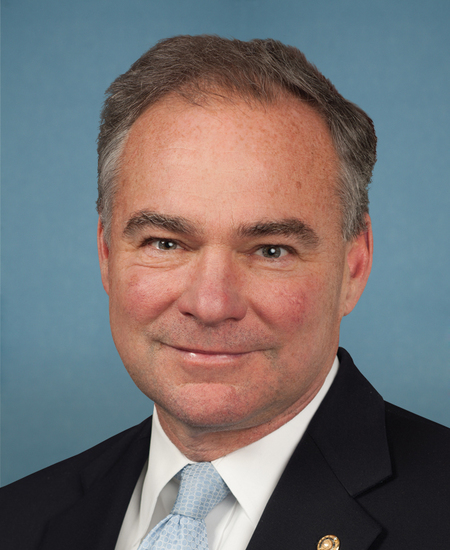
This resolution reaffirms the Senate's commitment to the historic partnership between the United States and Ecuador, and it supports actions to strengthen this bilateral relationship. Further, it recognizes President Moreno and his administration for committing to democratic values and commends President Moreno for taking steps to protect freedom of expression and freedom of the press in Ecuador.
Sponsored bills
Virginia Plan to Reduce Gun Violence Act of 2021 This bill makes various changes to federal firearms laws, including to expand background checks, limit handgun purchases, and extend firearms-related restrictions to new categories of persons. The bill also establishes a grant program to support the implementation of extreme risk protection order laws. Among its provisions, the bill establishes new background check requirements for firearm transfers between private parties (i.e., unlicensed individuals); generally prohibits an unlicensed person from purchasing more than one handgun in a 30-day period; establishes a grant program to help states and Indian tribes implement extreme risk protection order laws (i.e., red flag laws); generally requires gun owners to report lost or stolen firearms to law enforcement within 48 hours of discovery; makes it unlawful to recklessly leave a loaded and unsecured firearm in a manner that endangers a minor who is under 14 years of age; and extends firearms-related restrictions on the receipt, possession, shipment, or transportation of firearms and ammunition to persons convicted of a misdemeanor crime of stalking and persons who are subject to an extreme risk protection order.
Gay and Trans Panic Defense Prohibition Act of 2021 This bill generally prohibits a federal criminal defendant from asserting, as a defense, that the nonviolent sexual advance of an individual or a perception or belief of the gender, gender identify or expression, or sexual orientation of an individual excuses or justifies conduct or mitigates the severity of an offense.
Help Empower Americans to Respond Act of 2021 or the HEAR Act This bill establishes a new criminal offense for the import, sale, manufacture, transfer, or possession of a firearm silencer or firearm muffler. The bill does not prohibit certain conduct with respect to a firearm silencer or firearm muffler, including the following: importation, sale, manufacture, transfer, or possession related to certain law enforcement efforts, or authorized tests or experiments; and importation, sale, transfer, or possession related to securing nuclear materials. In addition, the bill requires the Department of Justice to establish and implement a buy-back program to purchase firearm silencers and firearm mufflers. States and local governments may use Edward Byrne Memorial Justice Assistance Grant Program funds to compensate individuals who surrender firearm silencers and firearm mufflers under this buy-back program.
Guaranteed Refugee Admission Ceiling Enhancement Act or the GRACE Act This bill establishes that the maximum number of refugees admitted each fiscal year shall be no less than 125,000 and that the maximum number shall be treated as the numerical goal for refugee admissions for the applicable fiscal year. The President may set a higher number if it is justified by humanitarian concerns or is otherwise in the national interest. Currently, the number admitted each fiscal year may not exceed 50,000 unless the President determines that a higher number is justified by humanitarian concerns or is otherwise in the national interest. The bill directs the President to take into consideration information from the United Nations High Commissioner for Refugees when establishing the maximum admission number and making certain other related decisions. The President shall report to Congress quarterly on (1) the number of refugees admitted during the preceding quarter, (2) the number of aliens who were security-cleared during the preceding quarter, (3) a plan to reach the numerical goal for admitted refugees for that fiscal year, and (4) other related information.
Healthy Families Act This bill provides for paid and unpaid sick leave for employees to meet their own medical needs and those of their families. It requires employers with 15 or more employees to provide their employees with at least one hour of earned paid sick leave for every 30 hours worked, up to a maximum of 56 hours of paid sick leave in a year. An employer with fewer than 15 employees may also provide the same amount of paid sick leave, but may opt out of such requirement, in which case such employer must provide its employees at least 56 hours of unpaid leave in a year. An employee may use sick leave for absences (1) resulting from a physical or mental illness, injury or medical condition; (2) resulting from obtaining professional medical diagnosis or care, or preventive medical care; (3) to care for a child, parent, spouse, a domestic partner, or other blood or close relative; and (4) resulting from domestic violence, sexual assault, or stalking. The bill makes it unlawful for any employer to interfere with, restrain, or deny the exercise of an employee's right to accrue sick leave as provided by this bill. An employee may take legal action to enforce the right to sick leave granted by this bill and the Department of Labor must investigate complaints of violations of the requirements of this bill. Labor is authorized to conduct a public awareness campaign to educate and inform the public of the requirements for paid sick leave provided by this bill.
Affordable Housing Credit Improvement Act of 2021 This bill revises provisions of the low-income housing tax credit and renames it as the affordable housing credit . The bill increases the per capita dollar amount of the credit and its minimum ceiling amount beginning in 2021 and extends the inflation adjustment for such amounts. The bill modifies tenant income eligibility requirements and the average income formula for determining such income. It also revises rules for student occupancy of rental units and tenant voucher payments, and prohibits any refusal to rent to victims of domestic abuse. The bill further modifies the credit to increase state allocations of the credit; repeal the qualified census tract population cap; prohibit local approval and contribution requirements; increase the credit for certain projects designated to serve extremely low-income households; increase the credit for certain bond-financed projects designated by state agencies; eliminate the basis reduction for properties that receive certain energy-related tax benefits; and increase the population cap for difficult development areas (i.e., areas with high construction, land, and utility costs relative to area median gross income). The bill also includes Indian and rural areas as difficult development areas and modifies other requirements relating to casualty losses, acquisition credits, and foreclosures.
Veterans Medical Marijuana Safe Harbor Act This bill provides guidance related to veterans and medical marijuana that shall be effective for five years. Specifically, the bill authorizes (1) a veteran to use, possess, or transport medical marijuana in accordance with applicable state or Native American tribal law; (2) a Department of Veterans Affairs (VA) physician to discuss with a veteran the use of medical marijuana as a treatment if the physician is in a state or on tribal land that authorizes such treatment; or (3) a VA physician to recommend, complete forms for, or register veterans for participation in a medical marijuana treatment program in accordance with applicable state or tribal law. The bill requires the VA to report on (1) the effects of medical marijuana on veterans in pain; and (2) the relationship between state-approved medical marijuana treatment programs, program access, and opioid use and abuse reduction.
This resolution designates April 18, 2021, as Military Retiree Appreciation Day.
Keep Americans Safe Act This bill establishes a new criminal offense for the import, sale, manufacture, transfer, or possession of a large capacity ammunition feeding device (LCAFD). The bill does not prohibit certain conduct with respect to an LCAFD, including the following: importation, sale, manufacture, transfer, or possession related to certain law enforcement efforts, or authorized tests or experiments; importation, sale, transfer, or possession related to securing nuclear materials; and possession by a retired law enforcement officer. The bill permits continued possession of, but prohibits sale or transfer of, a grandfathered LCAFD. Newly manufactured LCAFDs must display serial number identification and the date of manufacture. Additionally, the bill allows a state or local government to use Edward Byrne Memorial Justice Assistance Grant Program funds to compensate individuals who surrender an LCAFD under a buy-back program.