

Asylum Abuse Reduction Act This bill places restrictions on aliens seeking asylum and contains provisions related to immigration enforcement. Under this bill, an asylum seeker who arrives at a U.S. land port of entry without entry documents may not be admitted unless an asylum officer at a U.S. embassy or consulate has interviewed the alien and has concluded that the alien (1) has been persecuted in the alien's country of nationality due to their race, religion, or other characteristics; (2) has a credible fear of persecution if they returned to that country; or (3) would be tortured by the government upon return to that country. (Currently, an alien arriving at a port of entry may apply for asylum and an immigration officer there typically will give the alien a credible fear interview.) Furthermore, an alien who traveled through a third country to enter the United States through the southern border shall be ineligible for asylum unless (1) the alien has applied for and been denied asylum or protection in that third country, (2) the alien was a victim of severe human trafficking, or (3) the third country is not party to certain international agreements relating to refugees. Each federal judicial district shall appoint at least one judge to issue arrest warrants for individuals violating orders to depart, upon a showing of probable cause. Under this bill, the Flores agreement (a lawsuit settlement which imposes various requirements relating to the treatment of alien minors detained for immigration-related purposes) shall not apply.
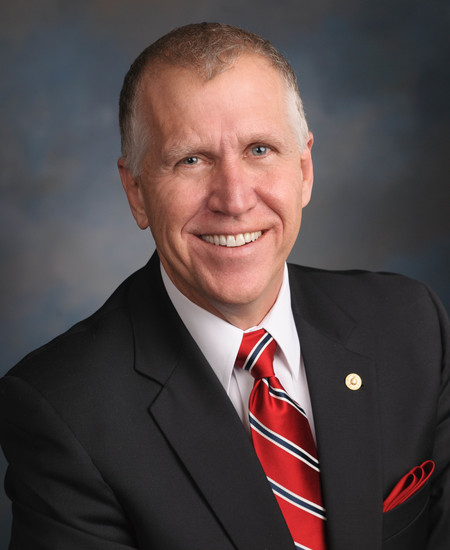
Sen. Thom Tillis
Sponsored bills
Transparency for Confucius Institutes Act This bill requires an institution of higher education (IHE) that participates in federal student-aid programs to enter into a program participation agreement if a Confucius Institute operates on the IHE's campus. (Confucius Institutes are Chinese government-funded centers for language education and cultural programming at IHEs.) The agreement must be entered into with the Office of Chinese Language Council International (i.e., Confucius Institute Headquarters, Hanban) and be made publicly available online. Among other requirements, the Confucius Institute must be physically located apart from the IHE's own Chinese language, history, and cultural programs.
Fair Access to Banking Act This bill restricts certain banks, credit unions, and payment card networks from refusing to do business with a person who is in compliance with the law. Restrictions include prohibiting the use of certain lending programs, initiating the process of terminating an institution's depository insurance, and instituting specified civil penalties.
Ensuring Lasting Smiles Act This bill requires private health insurance plans to cover diagnosis and treatment of congenital anomalies and birth defects, such as reconstructive services and items. Coverage must include services and items that functionally improve, repair, or restore any body part that is medically necessary for normal bodily functions or appearance, as determined by the treating physician. Coverage limits and cost-sharing requirements for such services and items may not be more restrictive than those applicable to all medical and surgical benefits under the plan.
Educational Notification and Disclosure of Actions risking Loss of Life by Hazing Act or the END ALL Hazing Act This bill requires institutions of higher education (IHEs) that participate in federal student-aid programs to collect information and publicly report on hazing-related misconduct. Specifically, IHEs must prepare biannual reports and post the reports on their websites. The reports must include information on hazing-related misconduct committed by a student organization, including the name of the student organization that committed the violation, a description of the violation, and sanctions placed on the organization. Further, IHEs must report to campus police and law enforcement authorities within 72 hours of becoming aware of any allegation of hazing that involved serious bodily injury or a significant risk of serious bodily injury. The bill does not apply to foreign IHEs.
Protect and Serve Act of 2021 This bill establishes a new criminal offense for knowingly assaulting a law enforcement officer and causing serious bodily injury (or attempting to do so) in circumstances that affect interstate commerce. It imposes criminal penalties—a prison term, a fine, or both—on a violator.
American Innovation and Jobs Act This bill revises and expands the deductibility of research and experimental expenditures to allow immediate expensing of such expenditures. It also allows the amortization over a period of at least 60 months of certain other types of research and experimental expenditures not treated as expenses. The bill increases the maximum amount eligible for the tax credit for new and small businesses and increases to 20% the rate of the credit for business startups.
Let States Cut Taxes Act This bill removes a prohibition on states and territories using COVID-19 (i.e., coronavirus disease 2019) relief funding under the American Rescue Plan Act of 2021 to offset a reduction in revenue resulting from a reduction in taxes or a delay in the imposition of a tax or tax increase.
Highway Formula Fairness Act This bill modifies the formula that the Department of Transportation uses to apportion federal highway funds among the states for the national highway performance program, the surface transportation block grant program, the highway safety improvement program, the congestion mitigation and air quality improvement program, the national highway freight program, and metropolitan transportation planning.
Sister City Transparency Act This bill requires the Government Accountability Office to study the activities of sister city partnerships involving foreign communities in countries that received a score of 45 or less on Transparency International's 2019 Corruption Perceptions Index. A sister city partnership is a formal agreement between a U.S. community and a foreign community that is recognized by Sister Cities International and that is operating within the United States. Among other elements, the required study must (1) identify oversight practices that U.S communities implement to mitigate the risks of foreign espionage and economic coercion within sister city partnerships, (2) assess the extent to which U.S. communities ensure transparency regarding sister city partnership contracts and activities, and (3) review the range of activities conducted within sister city partnerships.