

Maternal Health Quality Improvement Act This bill requires the Department of Health and Human Services (HHS) to establish specified grant programs to support positive maternal health care outcomes for pregnant and postpartum women and their infants. Specifically, HHS must award grants to (1) develop best practices to reduce preventable maternal mortality, and (2) train health care professionals to reduce and prevent discrimination when providing maternal health services. In addition, HHS may award grants to establish evidence-informed, integrated health care services to pregnant and postpartum women and their infants. The bill also provides statutory authority for a grant program that supports perinatal quality collaboratives. These are networks of perinatal care providers and public health professionals that work to improve pregnancy outcomes through continuous quality improvement. HHS also must (1) contract with an independent research organization to study and make recommendations on trainings for health professional schools and education programs on reducing and preventing discrimination in the provision of maternal health services, and (2) address pregnant and postpartum women and their infants in public awareness initiatives related to vaccinations.
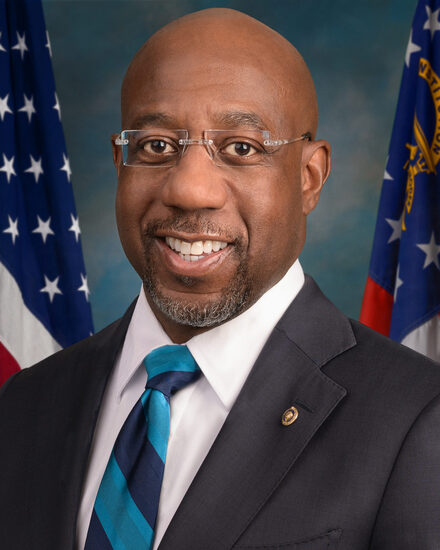
Sen. Raphael G. Warnock
Sponsored bills
This resolution offers the condolences of the Senate regarding the death of Senator John William Warner and expresses deep appreciation for his outstanding and important service to his country.
National Origin-Based Antidiscrimination for Nonimmigrants Act or the NO BAN Act This bill imposes limitations on the President's authority to suspend or restrict aliens from entering the United States. It also prohibits religious discrimination in various immigration-related decisions, such as whether to issue an immigrant or nonimmigrant visa, unless there is a statutory basis for such discrimination. The President may temporarily restrict the entry of any aliens or class of aliens after the Department of State determines that the restriction would address specific and credible facts that threaten U.S. interests such as security or public safety. The bill also imposes limitations on such restrictions, such as requiring the President, State Department, and the Department of Homeland Security (DHS) to (1) only issue a restriction when required to address a compelling government interest, and (2) narrowly tailor the suspension to use the least restrictive means to achieve such an interest. Before imposing a restriction, the State Department and DHS shall consult with Congress. The State Department and DHS shall report to Congress about the restriction within 48 hours of the restriction's imposition. If such a report is not made, the restriction shall immediately terminate. Individuals or entities present in the United States and unlawfully harmed by such a restriction may sue in federal court. DHS may suspend the entry of aliens traveling to the United States on a commercial airline that failed to comply with regulations related to detecting fraudulent travel documents.
Institutional Grants for New Infrastructure, Technology, and Education for HBCU Excellence Act or the IGNITE HBCU Excellence Act This bill establishes a grant program to support long-term improvements of historically Black colleges and universities (HBCUs) and graduate programs at HBCUs. Specifically, the bill requires the Department of Education (ED) to award grants to HBCUs to improve campus facilities. A recipient must use grant funds for certain activities, such as constructing or renovating facilities, carrying out major repairs, and strengthening the safety and security of a campus. Any new construction, modernization, or renovation projects must meet building code and energy and water conservation requirements. Further, HBCUs must seek to procure contracts from certain small businesses, including those owned and controlled by veterans and service-disabled veterans. The bill prohibits the use of grant funds for specified activities, including for the payment of routine and predictable maintenance costs, minor repairs, and utility bills. The Government Accountability Office must study the implementation of the grant program. The bill also requires ED to repay the outstanding balance of principal, interest, fees, and costs and any related reimbursements for certain capital financing loans.
Railway Upgrades for Rural American Lines Act or the RURAL Act This bill modifies requirements for the Railway-Highway Crossings Program. Specifically, the bill (1) requires the Department of Transportation to set aside highway safety improvement funds for states for the replacement of functionally obsolete warning and protective devices at railway-highway crossings, and (2) revises the amount of incentive payments a state may provide a local government for permanent closure by such government of public at-grade railway-highway crossings.
Visit America Act This bill implements measures to support the U.S. travel and tourism industry and to address the declining percentage of international visitors to the United States. Specifically, the bill requires the Department of Commerce to develop a 10-year travel and tourism strategy with annual goals for the number of international visitors to the United States and for travel exports. The bill also establishes the role of Assistant Secretary of Commerce for Travel and Tourism, whose responsibilities shall include (1) setting an annual goal for the number of international visitors to the United States, (2) providing support for improved visitor visa processing, and (3) promoting travel exports abroad. Further, the assistant secretary must develop and implement a COVID-19 pandemic recovery strategy to assist the recovery of the U.S. travel and tourism industry from travel restrictions necessitated by the pandemic. The bill also provides statutory authority for the United States Travel and Tourism Advisory Board, which shall aid the assistant secretary in developing and implementing the COVID-19 pandemic recovery strategy.
This resolution offers the condolences of the Senate regarding the death of Senator David Henry Gambrell and honors his life and legacy.
This resolution designates May 2021 as Older Americans Month.
Rights for the Transportation Security Administration Workforce Act of 2021 or the Rights for the TSA Workforce Act of 2021 This bill modifies the workplace rights, protections, and benefits applicable to Transportation Security Administration (TSA) personnel. Specifically, the bill within 180 days, eliminates personnel authorities of the Department of Homeland Security (DHS) and the Department of Transportation governing the conditions of employment for TSA employees, thus making TSA employees subject to the personnel management system applicable to other federal employees; sets forth transition rules that protect the pay rates, leave rights, and other rights of TSA and Federal Air Marshal Service employees; and requires DHS to consult with the labor organization certified by the Federal Labor Relations Authority to carry out the conversion of such positions. The bill also directs the TSA to implement in-person or remote mental health programs at each field office of the Federal Air Marshal Service and consult with labor associations to address concerns regarding federal air marshals, including mental health and suicide rates; requires DHS to prioritize the hiring of veterans, including disabled veterans; and directs the TSA to ensure its employees are provided proper guidance regarding prevention and protections against the coronavirus.
This bill designates the community-based outpatient clinic of the Department of Veterans Affairs in Columbus, Georgia, as the Robert S. Poydasheff Department of Veterans Affairs Clinic or the Robert S. Poydasheff VA Clinic.