

Baby Food Safety Act of 2021 This bill imposes certain safety requirements on infant and toddler food. The bill establishes maximum levels of certain toxic elements (cadmium, and lead, mercury, and inorganic arsenic) allowable in infant and toddler food, defined as food intended to be sold for children up to 36 months old. The Food and Drug Administration (FDA) shall periodically review and, if necessary, further lower these levels. The FDA may also establish limits on other toxic elements upon review of relevant health and dietary data. Furthermore, facilities that manufacture, process, pack, or hold infant and toddler food must have certain controls and plans to ensure that their food complies with the limits on toxic elements established by this bill. Such facilities shall also make publicly available certain information, including results from tests for toxic elements in their infant and toddler foods. The bill also expands the FDA's authority to require a recall of adulterated or misbranded food to include infant and toddler food that exceeds limits on toxic elements. The Centers for Disease Control shall carry out a public awareness campaign about the risks of toxic elements in infant and toddler food. The FDA shall commission research on agricultural methods that minimize levels of toxic heavy metals in crops.
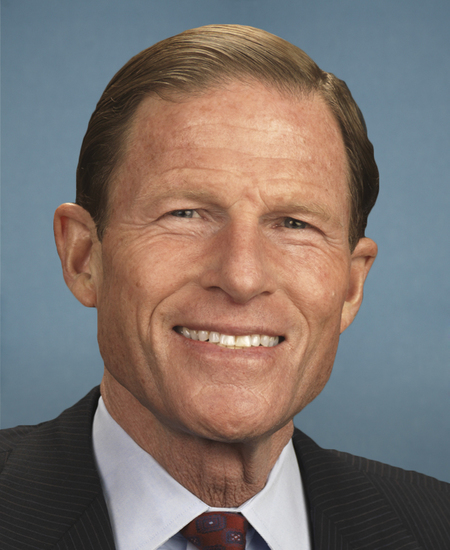
Sen. Richard Blumenthal
Sponsored bills
This bill makes changes to facilitate data sharing between the Supplemental Nutrition Assistance Program (SNAP) and programs that subsidize communication services to verify eligibility for applicable programs. Specifically, the Federal Communications Commission (FCC) must award grants to states and tribes for establishing or modifying connections between databases with information regarding benefit programs (e.g., SNAP) and the National Lifeline Eligibility Verifier to verify eligibility for the Lifeline program (which subsidizes telephone and internet services for low-income individuals) and the Emergency Broadband Benefit Program (which subsidizes broadband services for those who suffered income loss during the COVID-19 pandemic and other eligible households). The bill also reauthorizes through FY2026 the fund that supports the Emergency Broadband Benefit Program. In addition, the FCC must establish an automated connection to share data between the National Lifeline Eligibility Verifier and the National Accuracy Clearinghouse for SNAP. The FCC must coordinate with the Department of Agriculture to establish the connection.
Tax Assistance for Crumbling Foundations Act This bill repeals the tax rule in effect through 2025 that limits the deduction for personal casualty losses to losses attributable to a federally declared disaster.
Aid to Homeowners with Crumbling Foundations Act of 2021 This bill requires the Department of Housing and Urban Development to provide grants for states to assist residential building owners in repairing or replacing concrete foundations that have deteriorated due to pyrrhotite (an iron sulfide mineral).
Gun Records Restoration and Preservation Act This bill amends several appropriations laws to remove limitations on the authority of the Bureau of Alcohol, Tobacco, Firearms and Explosives to conduct activities related to the administration of federal firearms laws. Specifically, the bill removes provisions that limit the use of firearms tracing data, limit the disclosure of data under the Freedom of Information Act, prohibit imposing a requirement that gun dealers conduct a physical inventory, prohibit consolidating or centralizing records maintained by federal firearm licensees (e.g., gun dealers), and require national instant criminal background check records to be destroyed within 24 hours.
Regional Greenhouse Gas Reduction Act of 2021 This bill establishes an Office of Regional Greenhouse Gas Reduction Programs within the Environmental Protection Agency (EPA), a grant program to support regional greenhouse gas reduction programs, and an interagency task force. The office must support existing regional greenhouse gas reduction programs and facilitate the establishment of new regional greenhouse gas reduction programs. Such programs use market-based tools to reduce greenhouse gases across states at the regional level. In addition, the office must establish a program that awards grants to a state, local government, or regional consortium of such governments to take preliminary steps towards developing or participating in a regional greenhouse gas reduction program. Finally, the EPA must establish an interagency task force to support new and existing regional programs.
This resolution condemns and denounces all forms of anti-Asian sentiment, including those related to COVID-19 (i.e., coronavirus disease 2019), and calls on federal law enforcement officials, working with state and local agencies, to take specified steps. The resolution calls on federal officials to expeditiously investigate and document all credible reports of hate crimes, harassment, bullying, and threats against the Asian American and Pacific Islander communities; the Attorney General to work with state and local agencies and Asian American and Pacific Islander community-based organizations to prevent discrimination and to expand culturally competent and linguistically appropriate education campaigns on public reporting of hate crimes; and the Department of Health and Human Services to issue guidance describing best practices to mitigate racially discriminatory language in describing the pandemic. The resolution recommits the United States to serving as a model for the world in building a more inclusive, diverse, and tolerant society by (1) prioritizing language access and inclusivity in communication practices, and (2) combating misinformation and discrimination that puts Asian Americans and Pacific Islanders at risk.
This resolution celebrates the successes and contributions of Latinas in the United States and recognizes the changes still to be made to ensure that Latinas can realize their full potential as equal members of society.
American Cures Act This bill permanently funds several federal agencies and programs that perform biomedical research. The bill provides specified funding for the National Institutes of Health, the Centers for Disease Control and Prevention, the Department of Defense health program, and the Department of Veterans Affairs medical and prosthetics research program. The bill exempts the funding from sequestration, which is a process of automatic, usually across-the-board spending reductions under which budgetary resources are permanently cancelled to enforce specific budget policy goals. It also exempts the budgetary effects of the funding from the Statutory Pay-As-You-Go Act of 2010 (PAYGO) and the Senate PAYGO rule.
No Junk Plans Act This bill nullifies a rule by the Department of Treasury, the Department of Labor, and the Department of Health and Human Services regarding short-term, limited-duration health insurance plans. Short-term, limited-duration health insurance plans are plans that may only offer coverage for a limited amount of time under law and that are exempt from the market requirements of the Patient Protection and Affordable Care Act (e.g., coverage of individuals with preexisting conditions). The rule increases the maximum authorized duration of such plans from less than 3 months (including renewals) to an initial maximum duration of less than 12 months (with a total duration of up to 36 months, including renewals). The rule took effect October 2, 2018.